LimX Dynamics hits $2.2B valuation in humanoid robotics
▼ Summary
– LimX Dynamics raised $200 million at a $2.21 billion valuation in a pre-IPO funding round led by IDG Capital, Lens Technology, and Abu Dhabi’s Stone Venture.
– Founder Will Zhang stated that listing is essential for survival, comparing the humanoid robot race to China’s EV startups that listed in the US between 2018 and 2020.
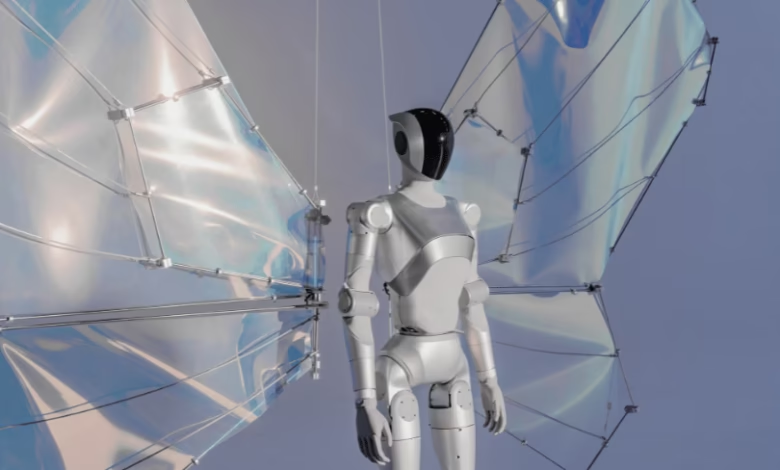
– LimX, founded in 2022, produces full-size humanoids and multi-form robots and has moved beyond the invention stage to focus on creating a marketable product.
– China has over 100 humanoid companies, with sector investment hitting 47 billion yuan ($6.95 billion) in Q2, and several rivals like Unitree and EngineAI are pursuing IPOs.
– Over half of LimX’s thousands of orders come from overseas, including plans to ship humanoids to the Middle East, though US export restrictions pose a risk.
China’s humanoid robotics sector has produced another billion-dollar player. LimX Dynamics, a startup based in Shenzhen, has raised $200 million at a staggering $2.21 billion valuation. The company’s founder is blunt about the stakes: going public is no longer optional , it is survival.
The funding round, announced on Tuesday, values LimX at 15 billion yuan (around $2.21 billion), according to The Information. This pre-IPO round attracted an unusually international group of backers. IDG Capital, Apple supplier Lens Technology, and Abu Dhabi’s Stone Venture led the investment. Italy’s GGG, Germany’s Redstone VC, Nio Capital, and WestSummit Capital also participated.
The capital arrives with a clear sense of urgency. LimX is already preparing for an IPO, likely in Hong Kong, and has entered a confidential review phase. Founder Will Zhang did not mince words about the reasoning.
“Listing is a must,” Zhang told reporters, as reported by CNBC. He drew a parallel to China’s EV startups , Nio, Xpeng, and Li Auto , all of which listed in the U. S. between 2018 and 2020. Once a technology matures, he argued, a company that fails to go public risks disappearing, much like the defunct EV maker WM Motor.
Zhang founded LimX in 2022, during the pandemic, after leaving a tenured professorship at Ohio State University. The company now produces full-size humanoids and multi-form robots. It claims to have passed the “0 to 1” invention stage. The harder challenge, Zhang noted, is creating a product people actually want.
LimX is far from alone in this race. China now hosts more than 100 humanoid companies, all fueled by a national push for “embodied AI.” Investment in the sector reached 47 billion yuan ($6.95 billion) in the second quarter alone. That is more than double the first quarter and roughly six times the figure from a year earlier, according to data provider Xiniu.
The result is a stampede to go public. Unitree has been fast-tracked for a Shanghai listing, EngineAI has filed in Hong Kong, and rivals DeepRobot and Leju are also preparing. Morgan Stanley expects China to ship 50,000 humanoids this year.
What distinguishes LimX is where its demand comes from. More than half of its thousands of orders are from overseas, according to The Information. The company plans a multi-year push to ship thousands of humanoids to the Middle East. It is already delivering its entertainment robot, Luna, to customers in South Korea.
Europe’s humanoid sector is also well funded. NEURA Robotics raised up to $1.4 billion, and Western firms like 1X are solving the hardest technical challenges, such as dexterous hands. But China’s density of manufacturers, capital, and orders remains difficult to match.
There is a catch to this export success. Washington keeps adding Chinese robotics companies to its military-companies list. A firm shipping thousands of humanoids into allied markets is exactly the kind of story that draws scrutiny. For now, though, LimX has both the money and the order book.
The open question is the one Zhang identified: can these robots do work people will actually pay for?
(Source: The Next Web)