Helium Baked Off Rocky Exoplanet’s Atmosphere
▼ Summary
– Most planets initially have hydrogen/helium atmospheres, but these can be lost or transformed over billions of years, as seen with Venus, Earth, and Mars having “second atmospheres.”
– Atmospheric loss is influenced by factors including element weight, molecular bonding (e.g., hydrogen in methane), planetary gravity, magnetic fields, and proximity to a star’s radiation and heat.
– A study in *Nature* reports observations of helium escaping from an exoplanet’s atmosphere orbiting star LHS 1140, about 50 light-years away.
– The rate of helium loss provides clues about the composition of the remaining atmosphere on that exoplanet.
– The exoplanet LHS 1140b orbits a dim red dwarf star, takes nearly 25 days per orbit, and receives less than half the light Earth gets from the Sun.
Most of the universe’s gas is a blend of hydrogen and helium, and scientists believe most planets originally started with atmospheres built from these same elements. Over billions of years, however, planetary evolution can dramatically alter that composition. Hydrogen often reacts with other chemicals, while both hydrogen and helium can gradually escape into space. Venus, Earth, and Mars, for instance, are thought to have developed secondary atmospheres after their original hydrogen-helium envelopes were lost or transformed.
The mechanisms behind atmospheric loss are complex. Lighter elements tend to escape more easily, but hydrogen can sometimes be shielded when it bonds into molecules like methane and ammonia. A planet’s gravity helps retain certain gases, and a magnetic field can limit the ability of stellar radiation to strip material away. Proximity to a star also plays a critical role, both because of the radiation emitted and because stellar heating can expand the atmosphere, pushing it beyond the reach of gravity’s hold.
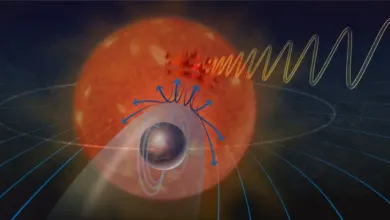
Given these many variables, predicting what exoplanet atmospheres will look like is challenging. But a study published in Wednesday’s issue of Nature presents observations of helium escaping from the atmosphere of an exoplanet orbiting the red dwarf star LHS 1140, roughly 50 light-years away. By measuring the rate at which helium is being lost, researchers can draw conclusions about what remains of the planet’s atmosphere.
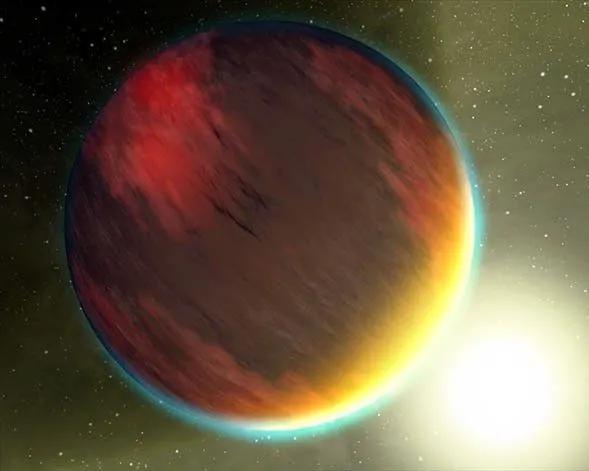
The star LHS 1140a hosts two known planets. One, LHS 1140c, orbits extremely close to the star, completing a full orbit in under four days and receiving about five times more radiation than Earth gets from the Sun. The other, LHS 1140b, is much farther out, taking nearly 25 days to orbit. Even so, it still sits significantly closer to its star than Mercury does to the Sun. Because LHS 1140a is such a faint star, this distant planet receives less than half the starlight Earth does.
(Source: Ars Technica)