Amazon’s Proteus robot takes voice orders, heading to Europe by 2027
▼ Summary
– Amazon unveiled a next-generation Proteus robot that takes instructions in plain language, with European deployment planned for the first half of 2027.
– The new Proteus is designed to operate anywhere across a fulfilment site, unlike the current version limited to dock areas.
– Amazon plans to invest over €10bn in its European fulfilment network and add 25,000 jobs in the region.
– Two other robot systems, STARK and Vulcan, are being expanded across Europe alongside the Proteus.
– Amazon will open more than 25 sub-same-day delivery sites in Europe this year and expand its ultra-fast essentials service.
At Amazon’s “Delivering the Future” event in Dartford, east of London, on 4 June, the company introduced a next-generation Proteus robot that responds to plain-language voice commands. No technical expertise or programming interface is required. Alongside this unveiling, Amazon also announced a plan to invest more than €10 billion (approximately $11.6 billion) in its European fulfilment network over the next several years.
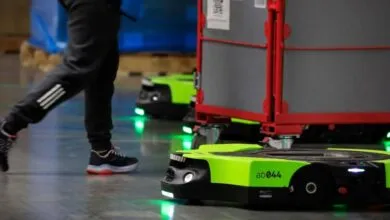
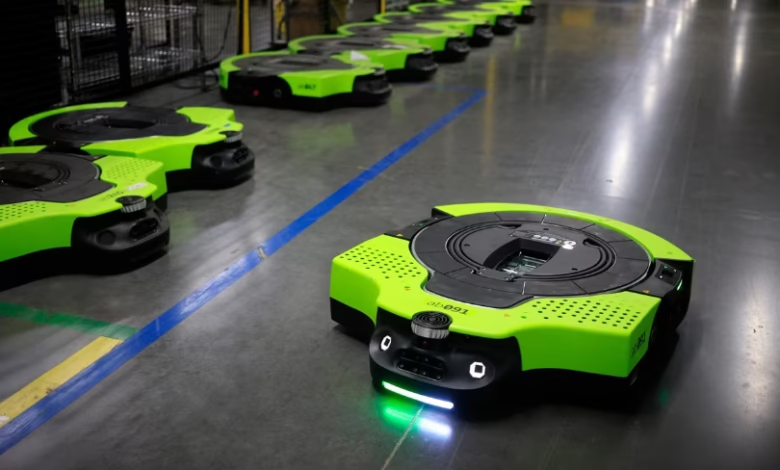
The most striking upgrade is the interface itself. “You tell it what needs to be done. It figures out the priority, the route, the timing,” explained Scott Dresser, vice president of Amazon Robotics, describing the robot as an assistant for material movement. The current Proteus, already deployed at 25 US sites, is confined to dock areas where it moves carts weighing nearly 400 kilograms. The new version, however, is designed to operate across an entire fulfilment or delivery site, handling containers as they arrive and shuttling them between workstations.
The robot is not yet shipping. The next-generation Proteus is currently being piloted in Amazon’s labs, with European deployment scheduled for the first half of 2027. That timeline aligns with two other systems Amazon is scaling across the region: STARK, a collaborative tote-handling robot first tested in Barcelona and slated to reach 15 European sites by 2027, and Vulcan, Amazon’s first robot with tactile sensing, which has moved from Spokane, Washington to its Hamburg facility in Germany.
The financial commitment is substantial. Amazon positioned robotics as one element of a broader plan to invest more than €10 billion in modernising European fulfilment, and it stated that it would add 25,000 jobs to its European fulfilment-centre workforce in the coming years. That headcount figure serves as the company’s direct response to the inevitable question about automation and employment, paired with its assertion that robotics has generated new roles in reliability, maintenance, and engineering.
The robots were introduced alongside a push for faster delivery. Amazon said it will open more than 25 sub-same-day delivery sites across Europe this year, including in Britain and Germany, and expand Amazon Now, its ultra-fast essentials service, to Manchester and Birmingham. Same-day fresh-grocery delivery now reaches more than 2,300 US cities and parts of Tokyo, with further expansion planned. Its next-generation assistant, Alexa+, is set to launch in 10 additional countries in 2027.
This spending is part of a much larger investment. In February, Amazon forecast a more than 50% increase in capital expenditure to $200 billion this year, joining its peers in an infrastructure build-out driven by AI. Against that backdrop, €10 billion for European fulfilment is a regional line item rather than the headline. But it is the part with a tangible face: a robot that, by 2027, an Amazon worker in Dartford or Hamburg should be able to instruct simply by telling it what to do. Whether it performs as reliably on a live warehouse floor as it does in a lab is the question the 2027 rollout will ultimately answer.
(Source: The Next Web)