Google’s Dreambeans turns your life into a cartoon
▼ Summary
– Google Labs launched Dreambeans, an AI app that uses data from Gmail, Calendar, Photos, YouTube, and Search History to generate a daily list of lifestyle suggestions, such as places to visit or things to try.
– The app limits users to 10–14 stories per day, designed as a “doomscrolling antidote” to provide inspiration without encouraging phone addiction.
– Privacy features allow users to control which Google services connect to the app, delete their data at any time, and ensure only the user can access their generated stories.
– The name “Dreambeans” comes from the app processing user data overnight (“dream”) and delivering a concentrated set of ideas in the morning, like a fresh cup of coffee (“beans”).
– Dreambeans is currently available only to U.S.-based Google AI Ultra subscribers on Android and iOS, with a waitlist for users with a personal Google account.
Google’s experimental division, Google Labs, has officially unveiled Dreambeans, a new AI-driven mobile app for both iOS and Android that transforms your everyday digital footprint into a playful, illustrated narrative.
But what exactly is Dreambeans, and why the whimsical name? Let’s break it down.
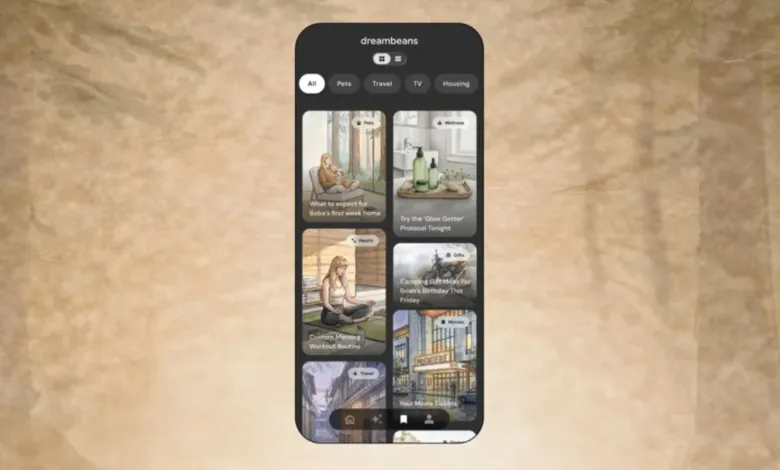
At its core, the app pulls data from your connected Google services , think Gmail, Calendar, Photos, YouTube, and Search History , and distills that information into a daily set of AI-generated “stories.” These aren’t just random animations; they are curated lifestyle prompts. Product lead Gozde Oznur describes them as “places to visit, topics to explore, things to try, upcoming trips, events that you should be aware of.” In other words, Dreambeans acts as a personalized inspiration engine, turning your calendar entries, search queries, and photo memories into actionable suggestions.
For example, if your Calendar shows you’re picking up a new puppy, Dreambeans might serve up a story about caring for a young dog. If you frequently search for local coffee shops, it could recommend a nearby café you haven’t tried. Some stories even pull in news articles tailored to your past interests. The company emphasizes that these ideas are generated “with your permission,” using what they call Personal Intelligence to connect the dots across your Google ecosystem.
The app is also designed as a doomscrolling antidote. Instead of overwhelming users with an endless feed, Dreambeans caps daily output at roughly 10 to 14 stories. Oznur explains that the goal is to offer a few sparks of inspiration, then encourage users to put the phone down and actually go experience those ideas. This approach aligns with a growing trend among startups , including Bond, which TechCrunch recently reviewed , that aim to curb phone addiction by offering smart, limited suggestions.
Privacy is a central concern. According to Oznur, the stories generated by Dreambeans are visible only to the user. People can delete their data at any time and choose precisely which Google services they want to link to the app. This granular control is meant to reassure users who might be wary of sharing so much personal information.
As for the name “Dreambeans,” it’s surprisingly literal. Oznur says the “dream” part reflects how the app processes your data overnight while you sleep, sifting through the massive volume of information. The “beans” part draws a parallel to a morning coffee ritual: “It has processed everything overnight and hands you a concentrated drop of inspiration in the morning.”
Currently, Dreambeans is available only to eligible Google AI Ultra subscribers based in the U. S., on both Android and iOS platforms. For everyone else, there is a waitlist open to users with a personal Google account.
(Source: TechCrunch)