Google I/O 2026: The Dawn of the Agentic Web and the Future of Search
▼ Summary
– Google I/O 2026 announced the shift from conversational AI to “actionable AI,” with the Agentic Web now being actively deployed.
– Gemini 3.5 Flash powers Google Antigravity, an agent-first platform for developers to build dynamic web applications.
– AI Mode, driven by Gemini 3.5 Flash, is now the global default for Google Search, featuring persistent Information Agents and generative UI.
– Gemini Omni enables omnimodal creation, integrating physics and cultural understanding into video generation via Google Flow.
– Universal Cart unifies e-commerce across Search, YouTube, and Gmail, tracking prices and flagging issues proactively.
The technology sector’s eyes were fixed on Mountain View this week as Google I/O 2026 unfolded, delivering a clear message: the era of conversational AI is stepping aside for the era of actionable AI. For professionals monitoring the intersection of artificial intelligence and digital media, the long-discussed “Agentic Web” is no longer a theoretical concept, it is actively being deployed.
As the digital publishing landscape and tech ecosystems across the MENA region and beyond continue to evolve at breakneck speed, the announcements made at this year’s developer conference signal a fundamental shift in how users will interact with information, commerce, and creative tools.
The Opening Keynote: From Answers to Action
Taking the stage, Google CEO Sundar Pichai framed the event around a monumental leap in utility. The keynote underscored that the goal of AI is no longer just to fetch answers, but to execute complex, multi-step workflows. Pichai’s remarks highlighted a future built on agents, intelligent systems capable of reasoning, planning, and acting on behalf of the user.
By integrating these agents directly into Search, Workspace, and Android, Google is laying the groundwork for a more intentional media environment where technology operates quietly in the background, surfacing exactly what is needed, precisely when it is needed.
What to Keep in Mind: The Key Takeaways
As the industry prepares to dissect these developments at upcoming fall summits like GITEX Ai Türkiye, here is what you need to remember from Google I/O 2026:
1. The Arrival of the Agentic Web
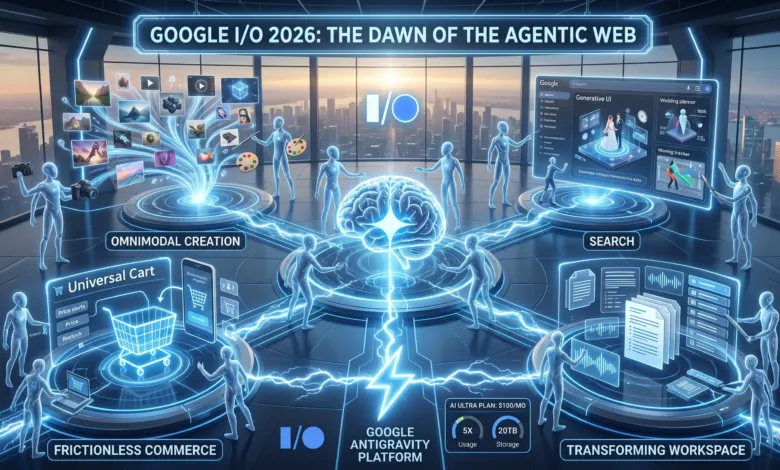
The spotlight was on Gemini 3.5 Flash, a frontier-level model built for extreme speed and complex reasoning. It serves as the engine for Google Antigravity, a new agent-first development platform. Developers can now easily define instructions for AI agents to execute code, manage sandboxed files, and process live data. This is the infrastructure that will power the next generation of dynamic web applications.

2. A Radical Reimagining of Search
Google Search just received its biggest update in 25 years. AI Mode, powered by Gemini 3.5 Flash, is now the global default.
- Information Agents: Users can deploy custom, persistent agents that scour the web 24/7 for updates on specific topics, synthesizing findings into actionable alerts.
- Generative UI: Search will no longer just return a list of blue links; it will dynamically generate custom user interfaces, like interactive dashboards or mini-apps, tailored on the fly to help users manage ongoing projects.

3. Omnimodal Creation is Here
Google introduced Gemini Omni, a model capable of generating any output from any input. Most notably, it brings a deep understanding of physics, history, and culture to video generation. This is integrated into the Google Flow creative studio, where multi-step AI agents can now act as creative partners to brainstorm, batch-edit assets, and ensure character consistency across scenes.

4. Frictionless Commerce with the Universal Cart
E-commerce takes a leap forward with the Universal Cart. This persistent, intelligent shopping hub follows users across Search, YouTube, and Gmail. It works in the background to track price drops, alert users to restocks, and proactively flag product incompatibilities before checkout, effectively turning the entire Google ecosystem into a unified storefront.

5. Transforming the Workspace
The daily grind is getting an AI overhaul. Docs Live and Talk to Keep allow users to draft documents and organize lists entirely by voice, with the AI pulling contextual data from existing Drive files and emails. Meanwhile, the new AI Inbox in Gmail not only prioritizes tasks but surfaces the exact documents needed to complete them, alongside context-aware draft replies.

6. New Tiers for Power Users
To support advanced developers and digital publishers, Google launched an AI Ultra Plan for $100/month. This tier offers 5X the usage limits of the Pro plan, 20TB of cloud storage, and access to the most advanced developer tools, ensuring that those building the future of the web have the necessary bandwidth to innovate.
Google I/O 2026 made one thing abundantly clear: the tools required to build smarter, more intentional digital experiences are now in the hands of developers and creators. The next chapter of the web has officially begun.