Ethos raises $22.75M to fix AI’s hiring problems
▼ Summary
– Ethos, a London-based AI expert-matching platform founded by ex-DeepMind and ex-McKinsey alumni, raised a $22.75m Series A round led by Andreessen Horowitz to address a hiring market where AI has made it easier to appear qualified but harder for employers to verify candidates.
– The platform uses a voice agent to interview experts and AI to ingest their work portfolios, creating richer profiles than static CVs, then autonomously matches them to consulting, research, AI data-labelling, and full-time roles.
– Over 5,000 experts join Ethos weekly across fields like accounting, law, and skilled trades, with the average expert earning £4,500 monthly and top earners making over $200 per hour.
– The round is led by Andreessen Horowitz with continued backing from General Catalyst, reflecting investor confidence in the founders’ mix of McKinsey commercial strategy and DeepMind technical expertise.
– Key risks include competitive pace in a network-effects-driven market, the quality of voice-AI interviews for senior professionals, and potential EU AI Act regulations classifying the matching engine as high-risk.
A London-based startup founded by former DeepMind and McKinsey professionals has secured a substantial $22.75 million Series A to tackle one of the most visible problems AI has created in the labor market: the collapse of trust in hiring. The round is led by Andreessen Horowitz, with returning support from seed-stage lead General Catalyst.
In roughly two and a half years, generative AI has flipped the hiring equation. It is now trivially easy for a candidate to appear qualified, churning out frictionless CVs, polished cover letters, and AI-enhanced portfolios. Yet the tools employers rely on to separate signal from noise,screening, interviews, references,have not kept pace. The result, by mid-2026, is a market where the cheapest input (applications) has scaled fastest, while the most expensive one (a recruiter’s time) is overwhelmed.
Ethos positions itself as a direct answer to this asymmetry. The startup is an AI-driven expert network, distinct from legacy players like GLG and Guidepoint, which have spent decades building human-curated rosters of consultants and domain specialists. Ethos uses AI to do the curation from the ground up.
The company’s process is two-pronged. First, a voice agent conducts an extended interview with each expert, capturing the nuance of their professional knowledge in a way a static CV cannot. Second, Ethos ingests the expert’s full portfolio,academic papers, code repositories, blog posts, podcast appearances, conference talks,to build a richer, more accurate profile. That combined profile is then matched autonomously against opportunities from the platform’s customer base.
Those opportunities span an unusually broad range: consulting engagements, expert calls, market research surveys, AI data-labeling projects, and full-time roles. The AI-data line is structurally important. Frontier model labs need high-quality, domain-specific training data in fields like finance, medicine, law, and advanced engineering, areas where general web scrapes fall short. Ethos offers a route to verified domain experts at scale.
The traction figures are designed to justify the round’s size. Ethos reports that more than 5,000 experts join each week across accounting, banking, consulting, law, technology, and healthcare, as well as skilled tradespeople like electricians and plumbers. This cross-collar reach is unusual for an expert network and underscores Ethos’s thesis that the unit of value is verified expertise, regardless of the credentialing path.
On earnings, the average expert on Ethos makes £4,500 per month in additional income, with the top 10% earning over £7,000. Since January, the number of experts earning income through the platform has grown six-fold. Independent reviews report per-hour rates between $105 and $225, materially higher than standard AI-training pay tiers.
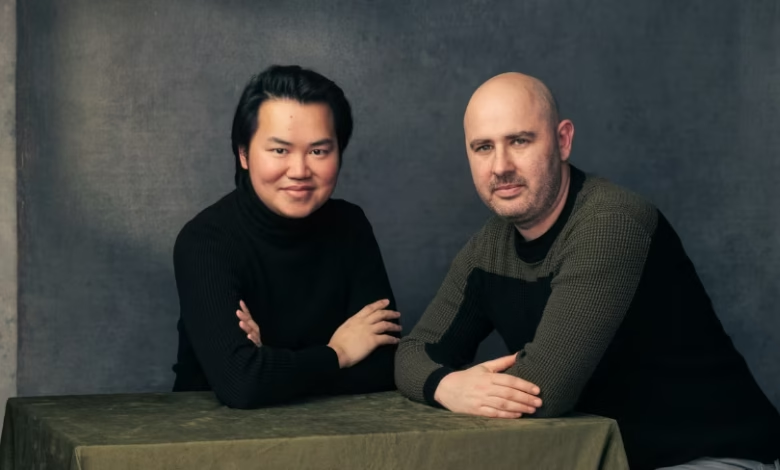
The founders bring complementary strengths. James Lo, the CEO, was a strategy consultant at McKinsey and an investor at SoftBank’s Vision Fund. Daniel Mankowitz, the CTO, was a research scientist at Google DeepMind, where he worked on AlphaZero. This pairing,a commercial brain from McKinsey and SoftBank paired with a systems-design brain from DeepMind,is exactly the kind a16z has historically backed for enterprise-AI bets requiring both customer-development discipline and serious technical underwriting.
General Catalyst’s continued participation is also significant. Jeannette zu Fürstenberg, who led the seed round, is a consequential European AI investor with board roles at Mistral and Helsing. Her decision to follow into the Series A signals confidence and helped attract Andreessen Horowitz’s lead.
The wider labor-market context explains why Ethos’s pitch landed. White-collar professional roles are simultaneously the easiest to apply for (thanks to AI automation) and the hardest to evaluate (because AI has homogenized applications). Demand has fragmented: companies that once hired one full-time analyst now want fractional access to ten experts in different domains. The matching layer between supply and demand is what has broken, and Ethos aims to rebuild it.
Risks remain. Competitive pace is critical, as expert-matching rewards the operator that reaches scale first and consolidates customer relationships. Voice-AI quality depends on the willingness of senior professionals to spend extended time talking to a machine. And regulatory scrutiny is growing, with the EU AI Act’s high-risk classifications for employment-adjacent AI systems coming into force later this year.
Lo framed the mission concisely. “A CV is a poor proxy for what someone is truly capable of,” he said. “AI is reshaping the labor market faster than our tools for valuing human expertise can keep up. Ethos is built to change that.”
The $22.75 million Series A provides runway to test that thesis. The next twelve months will indicate whether the tools, finally, can keep up.
(Source: The Next Web)