ServiceNow targets $30B by 2030, one-third of ACV from AI
▼ Summary
– ServiceNow projected $30bn in subscription revenue by 2030, with Now Assist contributing roughly 30% of that ACV.
– The investor-day pitch framed ServiceNow as a “Control Tower” for coordinating enterprise AI, countering AI-SaaS displacement concerns.
– Now Assist ACV grew from $600m at end-2025 to $750m in Q1 2026, with a near-term target raised from $1bn to $1.5bn.
– The $30bn target requires sustained 19% compound annual growth, above legacy SaaS consensus but below recent quarterly rates.
– Key factors for achieving the target include Now Assist’s quarterly ACV trajectory, competitive friction with AI-native services, and margin sustainability amid compute cost scaling.
ServiceNow used its 4 May 2026 investor day to lay out an ambitious vision: $30 billion in subscription revenue by 2030, with its flagship AI product, Now Assist, contributing roughly 30% of that annual contract value (ACV). The presentation was a deliberate counter to growing concerns that AI-native tools could displace traditional SaaS platforms.
By 2026, ServiceNow has become a closely watched bellwether for whether enterprise software companies can harness the AI revolution or be overtaken by it. On Monday, the company delivered its most definitive response yet. According to Bloomberg, CFO Gina Mastantuono projected $30 billion in subscription revenue by decade’s end, attributing about 30% of that 2030 ACV to Now Assist.
The framing was strategic. Coverage from The Cerbat Gem described the pitch as a “Control Tower” narrative , positioning ServiceNow not as a workflow software vendor vulnerable to disruption by general-purpose AI models, but as the orchestration layer where enterprise AI is coordinated, governed, and operationalized. Mastantuono also raised the company’s near-term AI ACV target from $1 billion to $1.5 billion. Current Now Assist ACV stood at roughly $750 million as of Q1 2026, up from $600 million at the close of 2025.
Why the pitch matters now
Throughout 2026, ServiceNow has had to address a structural investor concern. Fortune reported in April that even strong earnings failed to fully quiet the anti-SaaS narrative , the idea that AI agents and direct model deployments could erode the middleware where ServiceNow has long operated. The same day as ServiceNow’s announcement, TNW covered the launch of new enterprise services from Anthropic and the finalized OpenAI Deployment Company. Both are AI-native deployment vehicles structurally aimed at the same customer base ServiceNow has cultivated for two decades.
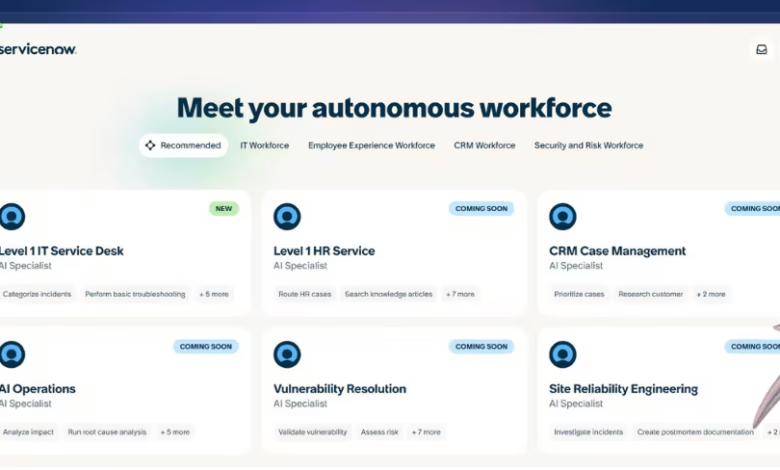
ServiceNow’s rebuttal is clear: it positions itself as the operating system for enterprise AI deployments, not the software being replaced. Now Assist is marketed as the orchestration layer, ACV growth as proof that customers buy into that vision, and the $30 billion target as the revenue story that ties it all together.
The numbers in context
ServiceNow expects its 2026 subscription revenue to land roughly $500 million above its prior $15 billion target, achieved organically. The trajectory from there to $30 billion by 2030 implies sustained compound annual growth of about 19% , well above industry consensus for legacy SaaS, though below ServiceNow’s recent quarterly rates. The upside scenario Mastantuono presented, $32 billion by 2030, would require Now Assist to scale not just in dollar terms but as a share of total ACV, ultimately reaching about one-third of all subscription revenue.
Whether that’s achievable depends on factors that will invite public-market skepticism. TNW has tracked the broader AI-multiple-compression dynamic through spring 2026, with Palantir’s drawdown and Citi’s price-target cuts as notable markers. ServiceNow’s own stock has been caught in that trade. The investor-day projection is partly a counter-argument: that the company’s customer base and AI product traction justify a different valuation trajectory than the one the broader AI-SaaS sector currently receives.
Three signals to watch
Three factors will determine if the $30 billion pitch becomes reality. First, Now Assist’s quarterly ACV trajectory: moving from $600 million at end-2025 to $750 million in Q1 2026 to $1.5 billion by year-end requires compounding growth that, in enterprise software, rarely happens by accident. Second, competitive friction: how many enterprise customers, when asked whether they want AI orchestrated by ServiceNow or by Anthropic-Blackstone or OpenAI’s DeployCo, choose the workflow-software incumbent. Third, margin sustainability: ServiceNow’s AI products have so far run near company-average gross margins; maintaining that as compute costs scale will determine whether the $30 billion figure generates the cash flows the multiple demands.
None of these questions are settled by an investor-day slide. But they are the right questions, and ServiceNow , based on available evidence , is willing to be measured against them. In 2026, that willingness is itself a competitive signal.
(Source: The Next Web)