Dreame Rocket Car Hits 0-60 in 0.9 Seconds
▼ Summary
– Dreame, a Chinese appliance company, announced a rocket-powered electric car called the Nebula NEXT 01 Jet Edition, claiming it can accelerate from 0 to 60 mph in 0.9 seconds.
– The article states that a sub-one-second 0–60 time is likely physically impossible for a street car because modern tires lack the grip to transfer that much force to the road without slipping.
– Dreame claims the car uses custom solid rocket boosters delivering 100 kilo-Newtons of force to achieve this acceleration, but the author notes this ignores real-world traction limits.
– An engineer who examined the car at an expo said the rocket boosters appeared fake, with no visible air inlets or outlets, raising doubts about its functionality.
– The Chinese EV market is rapidly contracting due to a price war, making it difficult for niche brands like Dreame to succeed as automakers.
A vacuum cleaner company building a rocket-powered electric vehicle that claims to hit 60 mph in under a second sounds like something out of a sci-fi novel. When I first heard the news, my mind jumped straight to James Dyson and his well-known automotive ambitions. But this time, the appliance maker turning heads in the supercar world is Dreame, a relatively obscure Chinese firm with bold plans to dominate global consumer electronics.
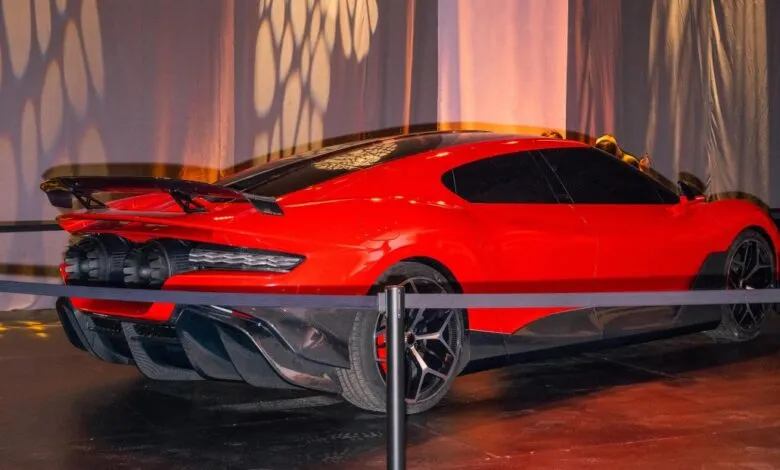
Dreame held a product showcase in San Francisco this week, and among the flurry of announcements was a vehicle that defies belief. The company is no stranger to attention-grabbing stunts; last January at CES, it unveiled a four-door concept car with four electric motors generating 1,399 kW (1,876 horsepower) and a claimed 0-to-100 km/h time of 1.8 seconds. Now, just five months later, Dreame has returned with the Nebula NEXT 01 Jet Edition, which it says can accelerate from 0 to 60 mph in 0.9 seconds using a pair of “rocket engines.”
That figure is not only faster than any production car in history, it likely violates the laws of physics. Modern tires simply cannot generate enough grip to handle such extreme acceleration. Even the most advanced hypercars are traction limited, meaning they have the power to spin wheels endlessly but are constrained by how much force rubber can transfer to the pavement before breaking loose. To reach 60 mph in under a second, a car would need to apply immense torque instantly. Street tires on normal roads would just burn out. Drag racers approach these speeds using sticky rubber and specially prepared tracks, but a road-legal vehicle faces fundamental limitations.
Dreame’s answer is custom-built dual solid rocket boosters delivering 100 kilo-Newtons of force. Mathematically, that could provide enough thrust, but the real-world challenge remains: how do you transfer that force to the ground without losing traction? In a vacuum or on a surface with infinite grip, it might work. On asphalt, physics still applies.
There is precedent for sub-one-second 0–60 times. A few years ago, students from the Academic Motorsports Club Zürich and Swiss universities built an ultra-light racecar weighing about 300 pounds that did it in 0.956 seconds. But that car had no roof and was built for a single purpose. The Nebula NEXT 01 is supposed to be a street vehicle.
An engineer from The Autopian attended Dreame’s expo and examined the car up close. His verdict: “feels like horseshit.” He noted that the rocket boosters appeared to be fabricated for show, with no visible air inlets or outlets, raising serious questions about how they could function in the real world.
Ambition is admirable, and Dreame clearly wants to make a splash. But 0–60 times have become a silly metric for judging performance. They are easy to understand and market, but as automakers and startups keep trying to outdo each other, the numbers have become absurd. Dreame faces an uphill battle if it wants to become a serious automaker. The Chinese EV market is contracting amid a vicious price war, making it hard for niche players to survive.
Dreame is not alone in chasing rocket-powered dreams. The long-delayed Tesla Roadster is supposed to offer an optional “SpaceX package” with cold-gas thrusters for sub-one-second acceleration. Elon Musk promised a reveal in April 2026, but that month came and went without a car. So the question remains: if a vaporware car accelerates to 60 mph in under a second and no one is around to see it, does it really exist?
(Source: The Verge)