Google AI Max Performance: 23 Tests Revealed

▼ Summary
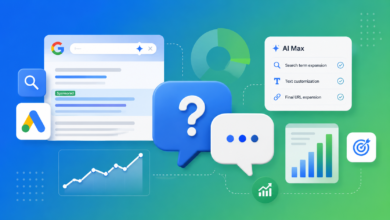
– AI Max campaigns perform best when all three core features, search term matching, text customization, and URL optimization, are enabled simultaneously, yielding a 40% higher success rate.
– Text customization demonstrably improves campaign performance, enhancing return on ad spend (ROAS) and increasing Quality Score, particularly for ad relevance.
– For accurate testing, adopt an account-wide approach to AI Max, as much of its traffic is not net-new and enabling it only in select campaigns can disrupt search term funneling.
– Avoid evaluating AI Max success solely by cost per acquisition (CPA) by match type; instead, assess its impact through macro, account-wide performance metrics.
– AI Max’s capabilities overlap significantly with Dynamic Search Ads (DSA), and successful tests typically occur in accounts with low or no DSA adoption, suggesting a need for strategic campaign consolidation.
After nine months of rigorous analysis across 16 established advertisers, we conducted 23 distinct tests to uncover the most effective strategies for Google AI Max campaigns. The findings provide a clear roadmap for maximizing performance with this powerful campaign type. Your own experience may differ, and we encourage further discussion, but these replicable insights offer a strong foundation for your own testing.
Certain prerequisites are essential before launching an AI Max test. First, your campaigns must bid on a meaningful conversion action for your business. Ensure your conversion tracking is impeccable using tools like Enhanced Conversions. While value-based bidding is advantageous, any automated targeting can function. Second, your campaigns cannot be budget-constrained. There’s little value in expanded targeting if your daily budget prevents you from competing in those new auctions. Ensure sufficient budget headroom or set more conservative bid targets.
With these foundations in place, our tests revealed several critical lessons.
The first major finding is that AI Max delivers its strongest performance when you fully commit. Campaigns that activated all three core features, search term matching, text customization, and URL optimization, saw a 40% higher success rate compared to those using only the baseline search matching. Partial adoption limits potential.
Text customization proved to be a particularly powerful driver of results. By analyzing the ‘Added by’ segment in the assets report, we observed that AI-edited assets consistently delivered a better return on ad spend and extracted more value from each impression. This held true for both headlines and descriptions, even though the AI modified headlines far more frequently. Beyond raw performance, text customization demonstrably improved Quality Score. In a like-for-like analysis of queries targeted before and after activation, the weighted average Quality Score rose from 6.8 to 7.3, with ad relevance seeing the most significant boost. This logical outcome, showing the best ad to each user, validates the feature’s power. Despite this, adoption remains cautious; only half of our test cases used text customization, and fewer enabled URL optimization. While compliance may restrict some brands, our data strongly suggests testing the full suite if possible.
The second key insight advocates for an account-wide rollout from the outset, which may seem counterintuitive. A campaign-level view showed AI Max driving a +7% increase in conversion value from new queries. However, an account-level analysis revealed that only 46% of those queries were genuinely new to the account; the rest were simply being reallocated from other campaigns. This still yields a valuable ~3% incremental uplift, but it highlights two crucial points. Enabling AI Max in only some campaigns can disrupt your search term funneling, especially since brand inclusion lists are now exclusive to AI Max campaigns. Furthermore, testing in isolation muddies performance assessment; you must evaluate the net-new impact across your entire account to understand true success.
Avoid the common pitfall of judging AI Max solely by cost per acquisition (CPA) by match type. This reveals internal attribution, not whether the tool improves your overall return on incremental investment. Look at macro, account-wide efficiency instead. Also, monitor how AI Max interacts with other campaign types. In our analysis, every successful AI Max test occurred in accounts with minimal use of Dynamic Search Ads (DSA), as their capabilities now largely overlap. Marketers must thoughtfully define the role of each campaign type within their overall strategy.
For those already comfortable with AI Max, the next frontier involves looking beyond it. Search Bidding Exploration (SBE) is a significant, yet under-discussed, bidding innovation that pairs naturally with AI Max, as both aim to reach incremental customers. AI Max also invites a reevaluation of traditional account structures, potentially shifting the optimal balance between segmentation and consolidation. Early signs of successful hyper-consolidation are emerging, though it’s too soon for definitive conclusions.
The paid search landscape is evolving rapidly, with AI Max at the center of considerable experimentation. For later adopters or those seeking to improve previous attempts, the path forward involves a full-feature commitment, an account-level perspective, and a strategic view of how this tool integrates with your broader marketing ecosystem.
(Source: Search Engine Land)