OpenAI Unveils Prism: AI Workspace for Scientific Research
▼ Summary
– OpenAI has launched Prism, a free AI-enhanced word processor and research tool for scientific papers that is integrated with GPT-5.2.
– The tool is designed to accelerate human scientists’ work by assisting with tasks like assessing claims and revising prose, not to conduct independent research.
– OpenAI sees a high volume of advanced science queries in ChatGPT and believes AI-assisted research, like Prism, represents a major upcoming trend.
– Prism integrates with LaTeX and uses GPT-5.2’s visual capabilities to help create diagrams, offering deeper project context management than standard ChatGPT.
– The company views Prism’s combination of powerful AI models and deep workflow integration as key to its potential, similar to the impact seen in software engineering.
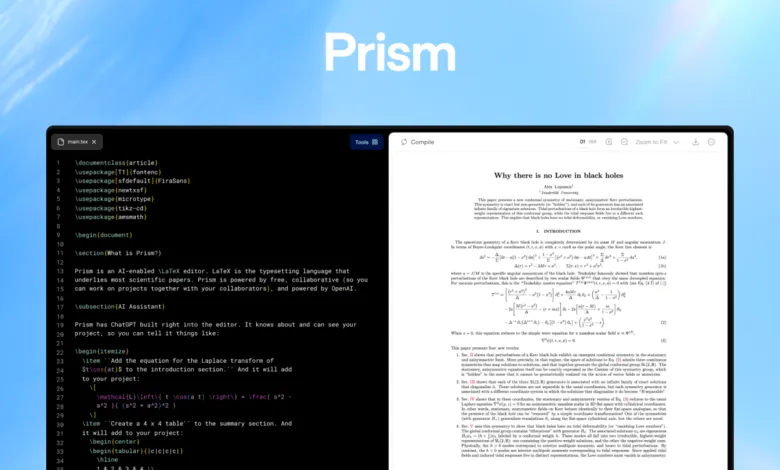
OpenAI has introduced a new, freely accessible scientific workspace named Prism, integrated directly with ChatGPT accounts. This AI-enhanced word processor and research tool is built to assist human scientists by leveraging the capabilities of GPT-5.2 for tasks like evaluating claims, refining academic prose, and searching through existing literature. The company positions it not as an autonomous researcher, but as a powerful accelerator for scientific work, drawing a parallel to how AI coding assistants have transformed software engineering.
Executives believe this tool will significantly speed up the research process. Kevin Weill, OpenAI’s Vice President for Science, suggested that the impact of AI on scientific discovery could soon mirror its recent transformative effect on software development. The launch responds to a noticeable surge in advanced scientific queries within consumer products like ChatGPT, which reportedly handles millions of complex messages weekly across the hard sciences.
The adoption of AI in academic research is already gaining momentum. In fields like mathematics, AI models have contributed to solving persistent problems by reviewing literature and applying known techniques in novel ways. A notable example occurred last December, when researchers used GPT-5.2 Pro to develop new proofs for a fundamental statistical theory axiom, with humans primarily guiding and verifying the model’s output. OpenAI highlighted this as a promising template for future human-AI collaboration in theoretically grounded domains.
Prism operates as a web application and integrates seamlessly with LaTeX, the ubiquitous open-source system for formatting scientific documents. However, it extends far beyond typical LaTeX editors. A standout feature utilizes the visual reasoning of GPT-5.2, allowing researchers to convert rough online whiteboard sketches into structured diagrams, addressing a common frustration with current tools.
A key advantage is its sophisticated context management. When a researcher uses ChatGPT within the Prism environment, the model can access the entire context of the ongoing project. This leads to responses that are more relevant and insightful than those from a standard chat interface. While a technically adept user might replicate some functions, OpenAI is betting that a streamlined, purpose-built interface will attract the scientific community more rapidly.
The value proposition hinges on combining powerful AI models with deep workflow integration, a strategy that proved highly effective in software engineering. By reducing friction in the research process, Prism aims to become an indispensable workspace for scientists navigating complex theoretical landscapes.
(Source: TechCrunch)