Google I/O’s SEO Threat Isn’t What You Think

▼ Summary
– Google announced AI-driven updates including a new search box accepting images and files, Gemini 3.5 Flash as the default AI model, and information agents that monitor the web for users.
– Google confirmed that traditional web results and “blue links” remain accessible, including through a Web tab, despite claims that the era of blue links is over.
– The real risk identified is reduced need to click through to websites, as AI Overviews and information agents synthesize content and deliver answers within Google, decreasing site visits.
– A field experiment showed AI Overviews reduced organic clicks on triggered queries by 38%, with no change in user experience ratings, indicating users get what they need without extra clicks.
– Google lacks specific Search Console filters to differentiate AI Mode or AI Overview traffic from organic reports, making it difficult for websites to measure the impact of these changes.
The panic following Google I/O 2026 has been loud and predictable. Headlines declared the death of Search, the burial of the “ten blue links,” and the end of SEO as we know it. Google’s own messaging pushed back, insisting that AI Search still relies on the web and traditional ranking fundamentals. The truth, as always, sits in the uncomfortable middle. But the risk most commentators are screaming about is the wrong one.
TechCrunch proclaimed that “Google Search as you know it is over.” Time warned of industry disruption. LinkedIn feeds flooded with “SEO is dead” takes within minutes of the keynote. Yet Google’s Liz Reid directly stated that users would still see a range of results, just like today. These reactions all missed a critical distinction.
What Google Actually Announced
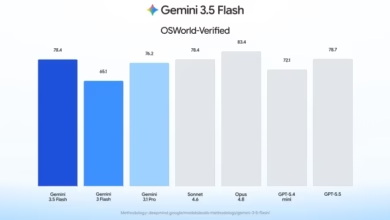
Google rolled out substantial updates. The new Search box now accepts images, files, videos, and Chrome tabs alongside text. AI suggestions anticipate your intent, and the box expands to handle longer, more complex prompts. Gemini 3.5 Flash became the default AI model globally, with AI Mode surpassing one billion monthly users and queries doubling every quarter.
Perhaps the biggest shift was the introduction of information agents. These are proactive tools that monitor the web for you, sending alerts when apartment listings or product updates match your saved criteria. Starting this summer, these agents will roll out to Google AI Pro and Ultra subscribers, alongside generative UI features, mini apps, and dashboards, primarily in the U. S.
Where the Panic Overreached
TechCrunch’s lede declared the end of the “ten blue links.” That line captured the new visual emphasis on AI answers, but it was factually premature. Google did not announce the removal of web results. Traditional results remain accessible, including through the dedicated Web tab. Blue links aren’t gone; they are being pushed further from the default experience’s center.
Google responded directly the next day. The official @NewsFromGoogle account posted on X: “AI Mode is not the default experience in Search. Our new search box helps you describe exactly what you’re looking for, but using it does not mean that you will only get AI features , you’ll continue to get a range of results on Search.”
That statement is more definitive than anything in Reid’s blog post. It draws a clear line: the new Search box does not funnel every query into AI Mode.
The claim that “Google is replacing human content with AI” is misleading. Google’s own optimization guide states that generative AI features depend on ranking systems and the Search index, emphasizing clickable links to supporting pages. The guide specifically highlights non-commodity, self-created content as key for eligibility.
The “SEO is dead” cycle is a ritual after every Google announcement. Jess Joyce, an SEO consultant, posted on LinkedIn after I/O: “Tomorrow your feed will be full of search is dead takes. It isn’t.” Her full post listed three specific changes worth watching. She wasn’t dismissing the announcements; she rejected the idea that the keynote nullified indexing and citation-worthiness overnight.
Where Google’s Messaging Contradicts Itself
The calmer reading should not defend Google’s position blindly. Four days before I/O, Google released an optimization guide for generative AI in Search, treating AEO and GEO as SEO, and listed five tactics to skip, including llms.txt and content chunking.
Then, the I/O keynote showcased file and tab acceptance, an interactive UI, background agents, and mini-apps. Andrew Holland, Director of SEO at JBH, argued that Google’s claim it’s “just SEO” is a category error. Its guidance is system-level correct but underestimates the massive user interface differences.
Google’s stance on llms.txt has been mixed. The Search team has said it’s unnecessary, yet Lighthouse has included an llms.txt audit. The documentation contradicts itself: Search Central advises skipping it, while Chrome suggests considering it. This creates confusion for site owners. Meanwhile, Google updated its spam policy to address manipulation of AI responses, expanding its scope as it integrates more AI into Search. This is conflicting messaging at best.
The Real Risk: Fewer Reasons to Click
The core concern from I/O is whether people still need to leave Google to access content. Glenn Gabe, SEO consultant at G-Squared Interactive, wrote on LinkedIn: “For publishers, information agents can hit ad revenue big-time as less people will be visiting websites.” Independent analyst Matthew Scott Goldstein posted: “Not one mention of the publishers and creators whose work feeds every product they announced.”
Information agents synthesize and notify without requiring a site visit. They monitor the web, package updates, and deliver them inside Google. The publisher’s content is consumed, but they may not receive a visit.
Google’s AI Mode data shows that the average query is three times longer than in traditional search, with follow-up queries up 40% month over month. Planning queries grew 80% faster, indicating users are delegating more research to Google. A field experiment showed that AI Overviews reduced organic clicks on triggered queries by 38%, with no change in user experience ratings. Users got what they needed without extra clicks.
That pattern has persisted for over a year. As noted in a Q1 recap, Google’s Robby Stein said that if people don’t engage with an AI Overview, Google might remove it for that query. The most vulnerable pages are simple answer pages like store hours or return policies, which AI can often satisfy without a click. Information agents go further, monitoring ongoing needs and providing synthesized updates over time, potentially replacing multiple search sessions.
The post-I/O panic should have named this risk: fewer users needing links, not links disappearing.
Why This Matters Now
Simple-answer content is now the most exposed category. AI Overviews and AI Mode can answer queries without redirecting users to your site. This has been true for a year, and the I/O announcements accelerate it.
Original analysis, primary data, and expertise that AI can’t synthesize remain separate. Google’s guide highlights this, emphasizing non-commodity content as the only type an AI must cite, not just summarize. The gap between these two categories widens. Content that repeats existing pages is increasingly served by AI without a click. Content offering unique information still drives visits because the system must show its source.
Google lacks specific Search Console filters to differentiate AI Mode or AI Overview from organic reports. You can see overall impressions and clicks, but isolating AI-driven traffic is impossible. This makes it hard to gauge how I/O changes impact your site. Information agents create a new measurement problem: if they monitor your content and provide a synthesis, it may not show up in analytics, even if the content was consumed. The visit didn’t happen.
People opposing “SEO is dead” are correct about fundamentals. Those warning about traffic economics are right about outcomes. The I/O keynote explained why both can be true simultaneously.
Looking Ahead
Information agents launch this summer for premium subscribers, likely expanding access over time. As agent-mediated search grows beyond paid tiers, the click demand issue becomes more significant. Google hasn’t explained how it will report agent-driven content in Search Console or Analytics. Until then, websites lack complete data on this major change announced this year.
(Source: Search Engine Journal)