Robot Sets Half-Marathon Record, Outpaces Human Runners
▼ Summary
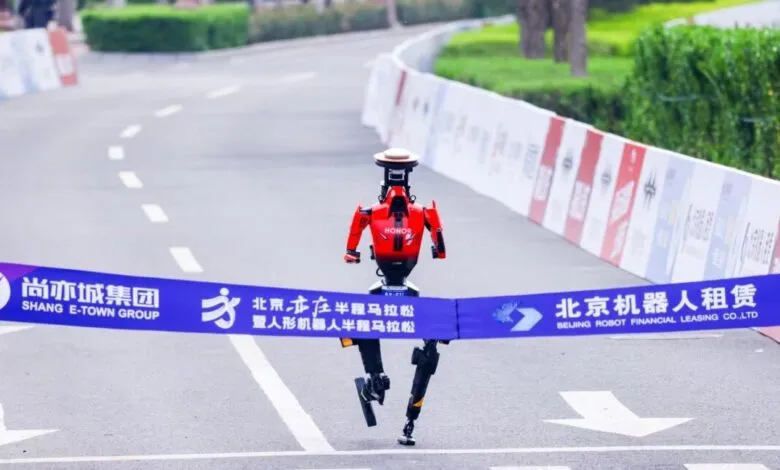
– A humanoid robot from Honor won a Beijing half-marathon on April 19 with a time of 50:26, beating the human world record.
– The winning robot featured long legs inspired by human athletes and a custom liquid-cooling system adapted from consumer electronics.
– All top three robots used Honor’s “Lightning” model to run autonomously, finishing faster than 12,000 human runners on a parallel track.
– This year’s winning robot was vastly faster than last year’s robotic winner, showing rapid improvement in speed and autonomy.
– The event highlights major Chinese and US investments in developing general-purpose humanoid robots for human workplaces.
A new benchmark for robotic mobility was set in Beijing, as a humanoid machine not only outpaced thousands of human runners but also shattered the official world record for a half-marathon. This event highlights the accelerating pace of development in humanoid robotics, a field where China’s tech sector is aggressively pursuing mass production and real-world applications. The winning robot, developed by the smartphone company Honor, completed the 13-mile course autonomously in 50 minutes and 26 seconds. That remarkable time easily surpassed the human world record of 57 minutes and 20 seconds, held by Ugandan athlete Jacob Kiplimo.
The design philosophy behind the record-setting machine took direct inspiration from elite human physiology. According to Honor test engineer Du Xiaodi, the robot features exceptionally long legs measuring about 37 inches, mimicking the stride of a top athlete. Xiaodi also highlighted its custom liquid-cooling system, a technology adapted from consumer electronics that could find future uses in industrial settings. All three top-finishing robots were based on Honor’s “Lightning” platform, operating without human intervention on a course parallel to the one used by 12,000 human participants.
The year-over-year progress in this niche is striking. In the inaugural robotic half-marathon last year, the fastest machine required over two and a half hours to finish. The latest results demonstrate a dramatic leap in robotic speed and endurance, cutting that time by more than half in just twelve months. This rapid improvement underscores the intense research and development fueling the sector.
However, navigating a predefined racecourse is a far cry from operating in the unpredictable real world. Experts caution that success in this controlled demonstration does not guarantee immediate practical utility. Humanoid robots still face significant challenges in adapting to complex, unstructured environments where chaos and unexpected obstacles are the norm. Proving reliability and versatility outside such curated events remains a formidable hurdle.
The Beijing competition, which featured 300 robots from roughly 100 teams, reflects a much larger global contest. Both Chinese and American tech industries are investing billions to advance humanoid robot technology. The current generation of industrial robots is typically highly specialized, built for single, repetitive tasks. The industry’s ambitious bet is that a new class of AI-powered humanoid robots can eventually integrate seamlessly into human-centric workplaces, using artificial intelligence to handle a diverse and flexible range of duties. The race in Beijing was just one early indicator of how that broader technological race is progressing.
(Source: Ars Technica)