Humanoid Robot Shatters Half-Marathon World Record in Beijing
▼ Summary
– A humanoid robot named Lightning autonomously completed the Beijing half-marathon in 50:26, beating the human world record by nearly seven minutes.
– The event saw massive growth from its 2025 debut, with over 100 teams competing in autonomous navigation, a category dominated by Honor’s robots.
– The winning robot was built by smartphone maker Honor, which has committed $10 billion to AI and developed the robot from scratch in one year.
– China is heavily investing in the industry via a state-backed trillion-yuan fund and a national plan prioritizing robotics as a top strategic sector.
– The article questions if superior running speed translates to practical utility, noting Western firms often prioritize manipulation skills for real-world tasks.
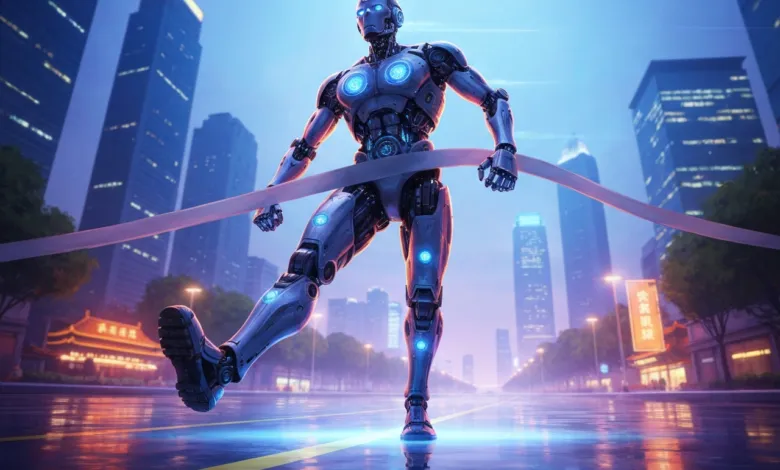
In a stunning display of technological progress, a humanoid robot has decisively broken the world record for a half-marathon. The machine, named Lightning, completed the 21-kilometer Beijing E-Town course in just 50 minutes and 26 seconds, outpacing the human record by nearly seven minutes. Developed by Shenzhen Honor Smart Technology Development Co., the robot navigated the route using autonomous navigation powered by multi-sensor fusion and real-time decision-making. A second, remotely controlled unit finished even faster at 48 minutes and 19 seconds, further highlighting the rapid engineering advances in this field.
The event, the second Robot World Humanoid Robot Games Half-Marathon, featured a separate lane for robotic competitors alongside roughly 12,000 human runners. The winning autonomous robot stands 169 centimeters tall with a leg design optimized to mimic elite athletes. It generates 400 newton-metres of peak torque and employs a sophisticated liquid cooling system with a heat exchange flow rate exceeding four liters per minute, technology adapted from Honor’s smartphone division. The human race was won by Zhao Haijie of China with a time of 1 hour, 7 minutes, and 47 seconds.
This year’s competition marked a dramatic turnaround from its problematic inaugural run. Last year, only six out of 21 robots finished, with the winner taking over two hours and forty minutes. In stark contrast, the 2026 edition saw 112 teams from 26 brands enter more than 300 robots, including five international teams. Approximately 40% competed in the autonomous category. To incentivize true autonomy, remotely controlled robots had their net times multiplied by a 1.2 coefficient. All three podium finishers in the autonomous category were Honor robots, each beating the human world record. While incidents occurred, such as Lightning colliding with a barricade near the finish, the overwhelming success rate signaled a major leap in robotic reliability and endurance.
Honor, the smartphone maker spun off from Huawei, is a newcomer to humanoid robotics but has made a massive commitment. It unveiled its program in March and has pledged $10 billion over five years to AI development. The company states that Lightning’s running speed of four meters per second is 14% faster than Boston Dynamics’ Atlas robot. Engineer Du Xiaodi emphasized the event’s role in technology transfer, noting that advancements in structural reliability and thermal management could soon be applied in industrial settings, forcing rapid progress in locomotion, balance, and navigation.
The marathon serves as a powerful showcase for China’s strategic push into advanced robotics. The industry is a priority in the national 15th Five-Year Plan, designated as one of ten key “new industry tracks.” The government has established a one-trillion-yuan state-backed fund to support humanoid robots, industrial automation, and embodied AI. A new standard system, drafted by over 120 institutions, aims to establish Chinese specifications for international adoption by 2028. The Ministry of Industry and Information Technology calls humanoids “the next groundbreaking innovation,” with the domestic market projected to surpass 20 billion yuan this year.
Chinese manufacturers already lead in production volume. Companies like AGIBOT, Unitree Robotics, and UBTech shipped thousands of units in 2025, collectively accounting for nearly 90% of global shipments. For comparison, Western leaders like Boston Dynamics and Figure AI each shipped only about 150 units in the same period. This divergence highlights a strategic fork in the road. Western firms, including Tesla and those partnering with BMW, often prioritize dexterity and manipulation for tasks like assembly. Chinese companies have focused intensely on bipedal locomotion and speed, creating spectacular demonstrations but potentially addressing a narrower set of practical applications.
The central question now is whether sprinting prowess translates to real-world utility. Projections for the global humanoid robot market by 2030 vary widely, from $6.5 billion to $15 billion, reflecting uncertainty about when these machines will perform economically valuable work. Industrial pilots are progressing, such as a Figure robot moving thousands of components in a BMW factory, but a gap remains between controlled deployments and versatile, general-purpose robots. Lightning’s record run is an undeniable engineering feat, proving capabilities in endurance, thermal management, and recovery that were absent just a year ago. The true test for China’s massive investment will be finding applications that justify the expenditure before global competitors, pursuing different technical paths, can close the gap.
(Source: The Next Web)