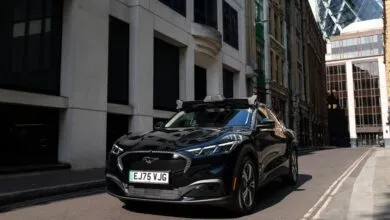
Wayve launches $85M employee tender offer at $8.5B valuation
▼ Summary
– Wayve is offering an $85 million tender offer for employees to sell vested shares, based on its $8.5 billion valuation from February.
– This is the company’s second employee liquidity event, following a similar offer alongside its $1.05 billion Series C in May 2024.
– Wayve’s tender offer reflects a trend among AI startups using such events as a retention tool to prevent employee turnover.
– Wayve uses an end-to-end neural network that learns to drive from data, unlike most self-driving programs that rely on prebuilt maps.
– The company plans robotaxi pilots with Uber in 2025 and aims to integrate its AI into Nissan’s driver-assist systems by 2027.
Wayve, a British developer of autonomous driving technology, is granting its workforce a chance to cash in on some of their vested shares. The $85 million employee tender offer gives staff the opportunity to sell equity back to investors at the company’s current $8.5 billion valuation. Existing and new backers are leading the buyout.
That valuation was locked in this February, when the nine-year-old firm closed a massive $1.2 billion Series D round. Eclipse, Balderton, and SoftBank Vision Fund 2 led the raise, with participation from Ontario Teachers’ Pension Plan, Baillie Gifford, Microsoft, Nvidia, and Uber.
This marks Wayve’s second liquidity event for employees. The startup ran a similar tender offer alongside its $1.05 billion Series C in May 2024.
Wayve’s move fits a broader pattern across the AI sector. Instead of making workers wait indefinitely for an IPO or acquisition, high-growth startups are using tender offers as a retention strategy. The logic is simple: give employees a meaningful payout now, and they are less likely to bolt to a competitor or found their own company once their options vest.
Other startups have recently followed suit. Decagon, which builds AI agents for enterprise customer service at companies like Duolingo and Hertz, ran a tender. So did ElevenLabs, the AI voice-generation powerhouse behind much of the internet’s synthetic speech and dubbing tools. Linear, a project-management platform built for software teams, and Clay, a sales and marketing automation tool, have also offered liquidity. Clay has conducted two tenders in the last nine months alone.
These companies can offer such liquidity because investors are eager to buy more equity in fast-growing AI businesses, often at a premium, betting the firms will be worth significantly more in the future.
Wayve’s technology takes a distinct approach to self-driving. Rather than relying on prebuilt, high-definition maps like most autonomous driving programs, its software uses an end-to-end neural network that learns to drive purely from data. The company argues this is closer to how humans learn to drive through experience.
In its push to create a “general-purpose” AI driver that could work across different countries, cars, and road conditions, Wayve has more than doubled its headcount to 1,200 employees over the past year.
The company is targeting robotaxi pilot launches in partnership with Uber later this year. Separately, it plans to integrate its AI software into Nissan’s next-generation driver-assist systems starting in 2027.
(Source: TechCrunch)