Roomba founder returns with a furry robot companion
▼ Summary
– Colin Angle, founder of iRobot and Roomba, is launching a new company, Familiar Machines & Magic, to create a dog-sized robotic pet companion called a “Familiar” that resembles a cross between a bear, barn owl, and golden retriever.
– The Familiar uses generative AI and an on-device model to form emotional connections and develop a distinct personality, designed for roles like companionship, eldercare, and parental support.
– The robot communicates through nonverbal sounds, facial expressions, and body language rather than speech, and it can move around the home independently on all fours.
– The Familiar will not be available until 2025 at the earliest, with a cost comparable to pet ownership, and its initial use cases focus on families with young children and elderly companionship.
– Angle aims to create a robot that is not a toy but a “creature” that learns routines and encourages healthier activities, though success depends on consumer acceptance and overcoming the challenge of past failed companion robots.
Colin Angle, the visionary behind the Roomba who helped place 50 million household robots into homes worldwide, is launching a radically different kind of machine. His new venture, Familiar Machines & Magic, introduces a dog-sized robotic companion designed not for chores but for emotional connection.
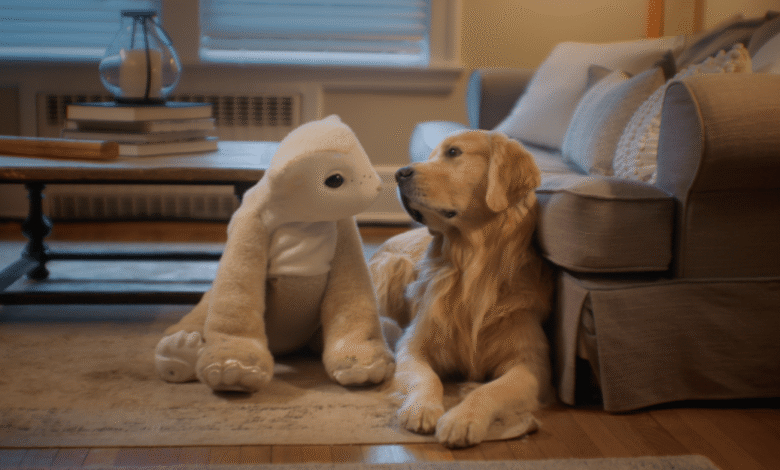
This new robot, described as a cross between a bear, a barn owl, and a golden retriever, features an expressive face with movable eyebrows, ears, and eyes. Dubbed a “Familiar” , a nod to folklore about supernatural companions , the quadruped robot can navigate your home independently, much like a living pet. Angle previewed the device ahead of its debut at the WSJ Future of Everything conference, where a demo video showed it moving on all fours.
Angle calls the Familiar a “physically embodied AI system” that leverages generative AI through an on-device model. Its purpose is to forge a genuine emotional bond with its owner, developing what Angle describes as “a distinct personality.” He argues that robots capable of reacting and responding to humans will excel in “high human connection roles” such as companionship, entertainment, hospitality, smart home management, eldercare, and parental support. “The next era of robotics is not just about dexterity or humanoid form , it’s about machines that can build and sustain human connection,” Angle explained.
Internally codenamed Ami, the Familiar won’t hit the market until next year at the earliest. Pricing remains vague, but Angle says it will cost “around the same as pet ownership.” Initial applications focus on families with young children, elderly companionship, and combating the global loneliness epidemic. For a man who built his career on floor-cleaning robots, this represents a dramatic pivot.
Angle insists his entire three-decade career has been building toward this moment. iRobot, founded in 1990, was originally named Artificial Creatures Inc., but the technology to create artificial life simply didn’t exist back then. “Finally, I get to do what I originally set out to do,” he said. “It’s not just about building cool animatronics. Now is finally the time where the tech exists , if properly and responsibly used , to start creating Familiars.”
After iRobot’s failed sale to Amazon, Angle stepped down as CEO in 2024. He and cofounders Ira Renfrew and Chris Jones, both iRobot veterans, have assembled a team from Disney, MIT, Boston Dynamics, Amazon, Bose, and Sonos. Their goal is to create something far beyond a toy or a chatbot embedded in plastic, which they saw everywhere at CES this year.
The Familiar is designed to learn household routines and interact with humans to encourage healthier behaviors. It might prompt playtime, nudge its owner for a walk (though it’s not waterproof), or assist with wellness activities. From the start, the team dismissed humanoid forms as unnecessarily complicated. Ami is deliberately unidentifiable because, Angle says, a specific animal shape would trigger preconceived expectations about its abilities.
Notably, the Familiar doesn’t speak. Instead, it uses nonverbal sounds like meowing and purring, as demonstrated at the WSJ conference. “By design, it will avoid giving factual advice about things that maybe it shouldn’t be giving factual advice about,” Angle said, referencing the pitfalls that LLM-powered chatbots often encounter. Communication relies on expression and body language, powered by a camera-based vision system and microphone array. With 23 degrees of freedom, the robot can move its head, neck, ears, eyes, and eyebrows, and walk at a slow human pace. It cannot grip objects or climb stairs, but its four legs provide stability to reduce the risk of falls.
Familiar Machines’ core goal is using AI to create a robot that learns from its owners, remembers patterns, and adapts to routines, fostering long-term engagement. Angle wants to avoid the fate of earlier home robots like Jibo, Aibo, Vector, and Astro, which often ended up abandoned in closets. “If this is a toy, we’ve failed,” Angle said. “If this is a creature that you want in your world, then we’ve knocked it out of the park. It’s kind of one way or the other.”
The Familiar runs on Nvidia’s Jetson Orin chip. “Its onboard edge AI stack is powered by a custom small multimodal model optimized for social reasoning, combining vision, audio, language, and memory to create socially responsive behaviors in real time,” Angle explained. The device doesn’t require an internet connection, though it can connect, and it doesn’t stream audio or video to the cloud , a deliberate privacy and latency choice. Still, it remains a device with cameras and microphones in your living space.
Why would anyone want this robot at home? Angle believes an AI-powered companion could address the growing loneliness crisis and offer an alternative to screen-based technology. “If your Familiar gets you up and out of your room and walking around , that’s a real way to try to address isolation and loneliness,” he said. Most companion robots fail what Angle calls the “plate of glass test.” “If a sheet of glass between you and the device wouldn’t change the experience, it should just be a screen.” This is why Ami can nudge and hug its owner, and features a “luxurious” touch-sensitive coat.
The demo video showed a boy putting down his tablet to pet the robot, a man stopping doomscrolling after a nudge, an elderly woman walking Ami, and a younger woman doing yoga beside it. The idea is that if the robot encourages activity away from screens, it could foster more human interaction.
Still, it’s going to take a lot more than a robotic pet to unglue my teenager from TikTok. While non-screen-based interactive technology could help counter our screen-obsessed culture, the link to more human interaction remains tenuous. A robot is still not a human. By offering a substitute for some aspects of companionship, it could just as easily become another barrier to real social interaction.
Even if Angle and his team succeed with the robotics and personality, success depends on consumer acceptance and cost. The first Roomba was a hit because it cost under $200 and vacuumed floors. “Pet ownership costs” covers an enormous range. While Angle claims interest in the Familiar is “higher than what we saw with Roomba,” the lack of a clear, compelling purpose feels like a problem.
The strongest use cases Angle hinted at are as a parent support tool , a device that interacts with children when parents can’t, offering a better alternative than a tablet or TV , and elder support, helping with loneliness, medication routines, and movement. This mirrors one of the few successful companion robots, Intuition Robotics’ ElliQ, on whose board Angle sits.
Many will say, “I’d rather have a real dog or a cat.” As a devoted pet owner, I know I would prefer my cat, dog, or chickens to a machine. Angle points out that pet ownership drops to just 9 percent after age 68, when caring for an animal becomes harder. For those who want a companion but can’t have one, the Familiar could be an interesting alternative.
Angle demoed two Familiars on stage at the WSJ conference, showing them moving, walking, and interacting with people while making meowing and purring sounds. The units were partially operator-controlled. Angle didn’t specify to what extent, but he says the Familiar will be fully autonomous by next year’s launch. “This is a demo, but it’s a demo on its way to a product; we’re already in factories,” he told the audience.
Even so, it’s unclear how close the final product will be to Angle’s vision. These are enormous promises in a field littered with failures and sky-high expectations, and all we’ve seen so far are tightly controlled demos. What is clear is that Angle believes his team has made significant strides toward creating artificial life. “It’s not a toy. It’s a real robot,” he said. “There is enough to it that it’s beautiful, wonderful to pet and give a hug to, and it can keep up with you. It’s the agency. For some definition of alive, it’s alive.”
(Source: The Verge)