Freshpet’s GEO & AI Playbook for Building Trust
▼ Summary
– Freshpet discovered that strong traditional SEO rankings did not guarantee visibility in AI assistant recommendations, prompting a strategic shift.
– The company collaborated with Intero Digital to develop a generative engine optimization program focused on helping machines understand brand context.
– Marketers were advised to move beyond generic AI writing advice and address strategic, editorial, technical, and measurement factors for better AI alignment.
– The initial step for improving AI visibility involves observing actual AI responses to customer questions to identify gaps or misrepresentations.
– Key areas for improvement include relevance through intent-matching content, authority via credible citations, structural clarity, and user engagement metrics.
The Gap Between Search Rankings and AI Visibility
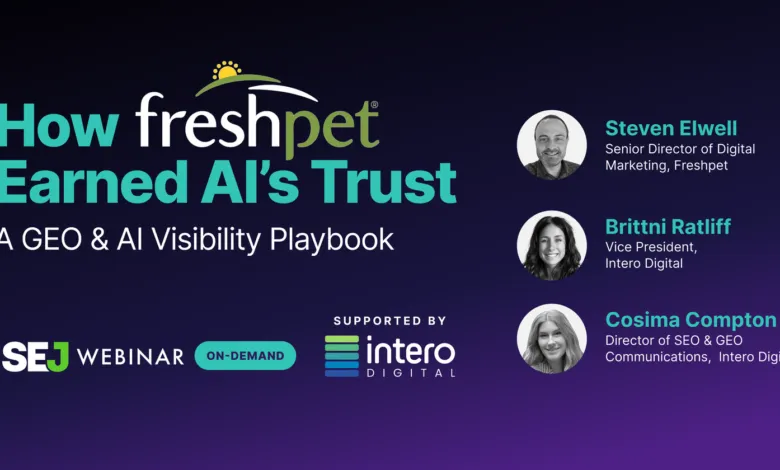
A brand that dominates traditional search engine results can still remain invisible when a consumer asks an artificial intelligence assistant for a recommendation. This disconnect was the central challenge Freshpet faced as AI Overviews and large language models began to reshape how products are discovered online. In a recent on-demand webinar, Brittni Ratliff and Cosima Compton from Intero Digital joined Steven Elwell of Freshpet to detail how their teams assessed the brand’s presence in generative search and constructed a deliberate Generative Engine Optimization (GEO) strategy.
The conversation moved beyond superficial advice about simply writing for algorithms. It explored the strategic, editorial, technical, and measurement decisions required to help machines understand a brand in context while maintaining utility for human readers. The session highlighted that strong historical SEO is no longer a guarantee of AI relevance.
Why Traditional SEO Falls Short for LLMs
Elwell noted that Freshpet entered the initiative with years of established content, third-party coverage, and significant visibility in the pet food sector. He initially assumed this foundation would naturally translate into relevance for AI-generated responses regarding fresh pet food. That assumption proved incorrect.
This gap demonstrates why marketers cannot treat AI visibility as an automatic extension of existing rankings or brand awareness. Compton explained that LLMs try to understand industries, concepts, and relationships between entities, not simply reproduce a conventional search results page. A recognized brand may therefore be absent from AI responses if the available content does not clearly establish its connection to a user’s specific question.
Freshpet’s experience underscores the importance of observation over assumption. Brands must actively ask the questions their customers are likely to pose, record what systems return, and identify where the brand is missing, misrepresented, or supported by outdated information.
The Four Pillars of AI Visibility
Intero Digital presented a framework focusing on four practical areas that influence how AI systems perceive a brand: relevance, authority, structure, and engagement.
Relevance requires publishing content that directly answers current audience questions and matches the intent behind them. Compton recommended reviewing pages regularly, especially when they contain changing statistics or other time-sensitive details. Outdated data can severely damage credibility in the eyes of both users and algorithms.
Authority depends on providing claims with sufficient context and support to be trusted. This involves clear author credentials, citations to reputable sources, relevant industry coverage, directory listings, and third-party mentions that reinforce what the brand is known for.
Structure ensures important information is accessible to both crawlers and readers. Clean HTML, strong page speed, descriptive headings, concise passages, lists, tables, schema markup, and direct answers all help systems parse a page effectively.
Engagement involves monitoring how customers and experts discuss the brand across reviews, forums, social platforms, and industry publications. These conversations expose concerns and language that deserve well-sourced answers on the brand’s own site.
The framework is most effective when these areas support one another. Compton argued that onsite content, SEO, earned media, and social strategy should reinforce the same priority topics instead of operating as disconnected channels.
Writing for Extractability and Clarity
One of Elwell’s key observations was that much of Freshpet’s legacy content was written like magazine articles. It was designed to guide a person through a narrative from beginning to end. While this serves human readers, it makes it difficult for LLMs to extract key facts buried within long passages.
The solution is not to strip away brand voice or write awkward copy for robots. Instead, speakers recommended organizing complex ideas into focused sections that can stand on their own. A page can remain natural while using descriptive headings, direct answers, short paragraphs, and meaningful lists.
Elwell described the shift as writing content that can be quoted, not merely read. For Freshpet, this meant revisiting page templates, formatting rules, and wording. The team simplified blog presentation elements, cleaned up HTML, and made it easier to apply appropriate schema.
The webinar also highlighted a critical technical issue: valuable content can exist on a page but remain inaccessible to crawlers. Freshpet discovered that product reviews and Q&A content delivered via JavaScript were not readily visible to LLMs. The takeaway is to audit the rendered experience, not just the editorial inventory. Teams must check crawler controls, JavaScript dependencies, robots directives, page speed, and whether the most important answers are available in parseable HTML.
Leveraging Contextual Authority and Community Insights
Speakers drew a useful distinction between having backlinks and building contextual authority. A mention in a major publication can still be valuable, but an industry-specific source may do more to establish a brand’s relationship to a specialized topic. Elwell noted that a credible pet industry publication can reinforce Freshpet’s expertise in ways a broad national outlet may not.
Ratliff added that the surrounding coverage matters. If every mention uses the brand name as anchor text and points to the homepage, LLMs receive less context about the specific subjects the brand should be associated with. Earned media works harder when the article itself accurately explains the brand’s expertise and supports a relevant onsite resource.
Community platforms like Reddit matter because customers use them to exchange candid opinions, and LLMs can draw from those conversations. However, the webinar did not recommend that every brand jump into every thread. Freshpet takes a listening-first approach. Elwell said pet nutrition can be as emotionally charged as conversations about baby food, so arguing with individual users would not serve the brand. Instead, the team looks for recurring questions or misconceptions that its experts can address with authoritative content elsewhere.
This distinction is crucial: Community monitoring is not only reputation management. It can become an input for content planning. When the same concern appears repeatedly, marketers can create a clear, evidence-backed resource that customers and AI systems can both find.
Building a Prompt Set and Measuring Progress
Compton outlined a manual starting point for teams that do not yet use a dedicated AI visibility platform. She advised building a representative set of at least 20 to 30 prompts covering core market questions. Running these prompts across systems such as ChatGPT, Gemini, and Claude allows teams to record whether the brand appears, which sources are cited, and whether the response is accurate. Comparing weak areas with corresponding pages helps evaluate relevance, authority, structure, and engagement. Fixes should be prioritized for topics closest to revenue, conversion, or major customer objections.
Freshpet’s program is larger, with Elwell noting the team tracks 475 prompts across major LLMs, grouped into topic categories. This structure lets the team spot clusters of weak answers, create content for related questions, and involve subject matter experts where their credentials can strengthen the response. The goal is not to copy Freshpet’s prompt count but to build a set broad enough to represent the customer journey, then organize findings to lead to specific work.
Measuring progress requires acknowledging that AI visibility does not map neatly to old models of ranking, click, and conversion. Elwell explained that Freshpet’s primary site often sends customers to retailers, making direct revenue attribution difficult. Its subscription business is easier to measure because users can complete transactions in a logged-in ecommerce experience. The team watches referral traffic from LLM citations, downstream actions, and modeled relationships between AI exposure and direct visits. Elwell cautioned against getting too far ahead of observable clicks with projected attribution. This serves as a useful standard for any GEO program: combine directional indicators, visibility trends, and business events, but be explicit about what the data can and cannot prove.
Integrating GEO with Existing SEO Strategies
During the Q&A, Compton emphasized that teams should not expect GEO improvements to create a negative relationship with traditional SEO. Keyword alignment, headings, crawlability, credible sourcing, and clear site architecture remain valuable. Better-structured pages may support both AI visibility and conventional search performance, even as zero-click behavior changes traffic patterns.
Other practical approaches included updating useful legacy pages when LLMs cite stale information rather than creating overlapping pages about the same subject. For complex topics, using a pillar-and-cluster structure ensures each subtopic has a clear home and supporting pages connect logically. Teams should also expect prompt type and freshness to affect whether an LLM relies on trained knowledge or conducts an active search. Finally, while AI tools can critique content, they must be provided with enough business, audience, search, and competitive context for the feedback to be meaningful.
Freshpet’s experience shows that GEO is not a single markup change or content format. It is a coordinated process: learn how the brand appears, make its expertise easier to verify, remove technical barriers, build contextual authority, and measure outcomes with appropriate caution.
(Source: Search Engine Journal)