This Robot Mower Finally Earned My Trust
▼ Summary
– Robot lawnmowers have improved significantly, with network RTK navigation, fallback systems, and all-wheel-drive reducing issues like getting stuck, but they still require oversight to avoid lawn damage or wandering.
– The Segway Navimow X430 ($2,499) was the top pick, never getting stuck, handling rough terrain, and mowing faster than competitors, though its rain sensing and NetRTK setup had minor drawbacks.
– The Dreame A3 AWD Pro 2500 ($3,099.99) is a strong lidar-based alternative for yards without clear GPS, but lidar was less reliable and it occasionally declared jobs incomplete or dug sandpits.
– The Husqvarna Automower 420 IQ ($3,299) suits large, tree-free yards with its long warranty and easy controls, but lacks a camera for obstacle detection and requires boundary wire in GPS dead zones.
– The Roborock RockNeo Q110H ($1,299) is a budget option for smaller yards, offering RTK and vSLAM navigation, though its lack of all-wheel-drive limits it on uneven terrain, and edge cutting remains unresolved across all models.
After two decades of testing connected home technology, I can say this with confidence: robot lawnmowers have finally crossed the threshold from expensive novelty to genuinely useful tool. The latest generation of autonomous mowers is dramatically better at navigation, obstacle avoidance, and handling real-world terrain, but they still require a watchful eye. They are not yet the hands-off solution manufacturers would have you believe, but with a bit of supervision, they can eliminate one of the most tedious chores of homeownership.
My testing grounds this summer were a flat, three-quarter-acre property in coastal South Carolina, characterized by sandy soil, centipede grass, and a dense canopy of oak trees. The contrast with last year’s trials could not have been starker. The most significant improvement? The bots simply stopped getting stuck. This year’s models navigated my challenging landscape with far greater competence, and the results are visible across my lawn. It has never looked healthier, and my spouse, who previously swore off robotic mowers after a mishap, has now parked his riding mower for over a month.
The consistency of these machines is their greatest asset. Mowing daily and trimming only millimeters at a time, they produce a noticeably denser, lusher lawn. I walked across it barefoot this morning for the first time ever. They operate quietly at all hours, undisturbed by and undisturbed to my pets, the local wildlife, and my neighbors. The crisp, professional-looking mowing lines are a welcome aesthetic bonus. My backyard, once a patchy, dusty expanse, now looks healthier after just three months of robotic attention. My chickens remain unimpressed, but I am delighted.
Several key technological leaps define this new crop of mowers. The most important is the widespread adoption of network RTK (real-time kinematic positioning), a satellite navigation technology that provides centimeter-level accuracy. Unlike older GPS systems, RTK uses ground-based reference stations to correct signal errors. Most mowers now come with a physical RTK antenna that must be installed with a clear view of the sky, but the new option of NetRTK taps into a cloud-based network of stations, requiring only a Wi-Fi or 4G connection on the mower itself. This was a game-changer for my property, where spotty GPS coverage had previously rendered all RTK mowers useless. The new models also incorporate secondary navigation systems, such as lidar or vSLAM, to maintain their course when the satellite signal drops out. This redundancy meant I no longer spent my summer rescuing confused robots from under my oak trees.
However, significant flaws remain. These are autonomous machines with spinning blades, and leaving them unattended carries inherent risks. One mower spent three days methodically destroying a patch of damp lawn before I noticed. Another chewed through two outdoor extension cords. Several dug unsightly sandpits in bare areas, and one attempted to climb a small tree. Obstacle detection has improved across the board, but it is far from perfect. Hoses, cables, and cars remain a challenge, and my family now knows to check under the wheels before driving away. Gates are another unsolved problem; I still have to manually open mine for the mower to cover the entire property. And while all manufacturers currently advertise free lifetime NetRTK coverage, relying on a cloud service for something as fundamental as mowing is a long-term concern. Finally, these machines are expensive, and questions about their long-term durability remain.
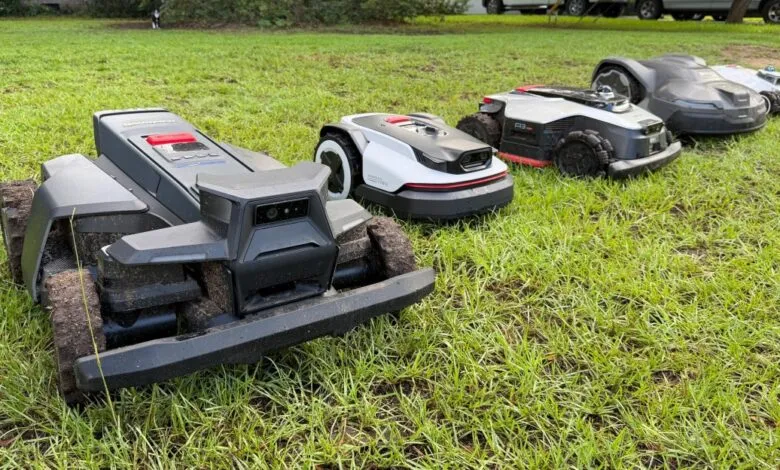
To find the best mower for my challenging terrain, I tested four top-tier models: the Husqvarna 420 IQ ($3,299), the Mammotion Luba 3 AWD 3000 ($2,799), the Navimow X430 ($2,499), and the Dreame A3 AWD Pro 2500 ($3,099.99). I also tried the more budget-friendly Roborock RockNeo Q110H ($1,299) on my front lawn. All these models are currently unaffected by the new FCC ban on robot devices, but the future of new models is uncertain.
The clear winner for my yard was the Segway Navimow X430. This 60-pound machine, which resembles Darth Vader’s dog, was the only mower tested that never got stuck. Its four-wheel drive and impressive suspension rolled over potholes, sticks, rocks, and even small branches. It navigated around my chickens and traversed the uneven transition between my front and back yards, the only bot capable of mowing both in a single trip. Using a combination of RTK, vSLAM, and vision-based tech, it covered my entire property without getting lost. Its “xero-turn” maneuverability allowed it to pivot smoothly without damaging the grass, and its wide cutting deck covered my backyard in under three hours, nearly twice as fast as the competition. The remote-control mowing feature was also a handy tool for tidying edges and sensitive areas. Its only quirks were a tendency to miss a few blades of grass at speed and an over-reliance on internet weather data, which often prevented it from mowing when rain was merely predicted. Setup was slightly awkward, as the charging station required a clear view of the sky.
If your yard has unreliable satellite coverage, the Dreame A3 AWD Pro 2500 is the best alternative. Its lidar and camera-based navigation performed nearly as well as the Segway, only getting stuck a couple of times. It requires no clear view of the sky, so it can be placed anywhere, and its edge-cutting deck worked slightly better than the Segway’s. However, lidar was the least reliable navigation technology in my testing, and the A3 occasionally declared a job complete when it wasn’t. It also struggled with smooth turns and dug several sandpits in bare spots. Its “Garden Guardian” mode, which uses the camera as a roaming security guard, was a fun and effective feature, startling more than a few dog walkers.
The Husqvarna Automower 420 IQ is a solid, albeit expensive, choice for a standard, uncomplicated yard. It offers the longest warranty, the best app, and a modular design for longevity. Its large wheels handled uneven terrain well, but it requires a physical RTK antenna and backup boundary wire for satellite dead spots. Its radar-based obstacle detection, with no camera, was less effective at dodging objects, and it ran into bushes and tried to climb a small tree during testing. For a large, tree-free property, however, it is a reliable option backed by a strong support network.
The Mammotion Luba 3 AWD 3000 is ideal for properties with spotty GPS, as it combines RTK, lidar, and vision navigation. However, its lower ground clearance and weaker suspension made it less nimble than the other AWD models. While it cut the grass well, it had serious issues with turns and soft ground, tearing up grass and digging sandpits. Mammotion acknowledged this issue, attributing it to a recent software update that caused the mower to turn too sharply on wet or thin grass. While they have deployed fixes, relying on software updates to solve fundamental design problems is a concern for such an expensive purchase.
For smaller yards, the Roborock RockNeo Q110H is my budget pick. This rear-wheel-drive mower was impressive on my flat, treed front lawn, though large tree roots could stop it in its tracks. It offers RTK and vSLAM navigation with both antenna and NetRTK options. It features better obstacle detection than its predecessor and can handle steeper slopes. Edge cutting remains a work in progress across all models, so plan to keep your manual trimmer handy.
Robot lawnmowers have improved dramatically over the last 18 months. The navigation advances have solved the main pain points from my previous testing, and larger, more capable machines are now better suited to the varied terrain of American yards. The right bot will maintain your lawn beautifully with minimal effort. They still need oversight and the occasional rescue, and they haven’t solved every problem, but they have taken a significant amount of work out of yard maintenance.
(Source: The Verge)