China to Block US Investment in Top AI Firms Without Approval
▼ Summary
– China plans to require its top AI companies to obtain government approval before accepting US capital, mirroring US outbound investment rules.
– The Trump administration announced a crackdown on Chinese firms using US AI models through distillation, targeting an alleged unfair competitive advantage.
– Both moves escalate the US-China AI conflict from chip and export restrictions into capital controls and model access restrictions.
– The US distillation crackdown lacks a specified enforcement mechanism, as preventing cross-border training data use is technically and legally complex.
– Despite export controls, China’s AI capabilities are improving rapidly, as shown by DeepSeek V4’s near-frontier performance using Huawei chips, narrowing the capability gap.
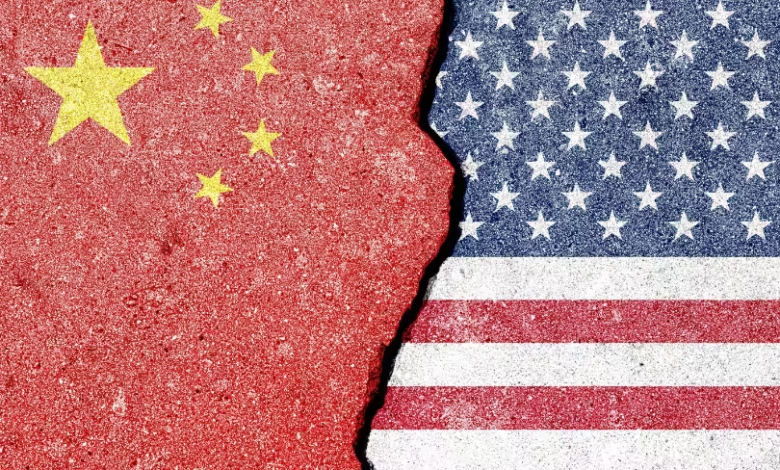
Within the span of a single day, the United States and China have each announced new restrictions that fundamentally reshape the landscape of the global AI industry. The dual moves signal a decisive escalation of the ongoing technology rivalry, shifting the battleground from hardware and export controls to capital flows and model development.
According to a Bloomberg report on Friday, China is preparing to require its leading technology companies,including top-tier AI startups,to obtain government approval before accepting investments from the United States. While no official confirmation has come from Beijing, the proposed policy would represent a major structural change. It would effectively place US venture capital under the same regulatory framework that already governs sensitive technology exports, data transfers, and foreign acquisitions of Chinese assets.
The timing of this potential policy is no coincidence. Just one day earlier, the Trump administration announced a crackdown on foreign firms, specifically targeting China, for what it described as the “exploitation” of American artificial intelligence models through a practice known as model distillation.
White House Science and Technology Policy Director Michael Kratsios framed the US move as the first major government response to complaints from Silicon Valley. US companies have alleged that Chinese developers are using open-source or commercially available American AI models,such as Meta’s Llama series,as training data to build rival systems. This approach, they argue, allows Chinese labs to close the capability gap without investing in foundational research and development.
Bloomberg characterized the US action as targeting Chinese firms that are “improperly” using American AI models.
Taken together, the two announcements depict a 24-hour period in which both governments moved simultaneously to sever the remaining channels of AI technology and capital transfer. The US is attempting to prevent its models from being used to train Chinese competitors. China, in turn, is trying to stop American money,along with its intangible benefits like managerial expertise, talent networks, and strategic access,from flowing into its AI national champions without state oversight.
Each move is a direct response to the other’s prior actions, and each creates the conditions for the next round of retaliation.
The backdrop to China’s reported capital controls is the existing US outbound investment rule that took effect on January 2, 2025. That rule prohibits US persons from making equity investments in Chinese companies involved in advanced semiconductors, quantum computing, or certain AI systems without Treasury Department approval. China’s reported plan is, in structural terms, the inbound mirror of that rule: requiring government approval before Chinese AI companies accept capital from the country that has also been restricting chip exports to Beijing since 2022.
The model distillation issue is the more technically novel of the two moves. Chinese developers have used DeepSeek-R1, Meta’s open-source Llama models, and other accessible US models as training signals for their own systems. While this practice is currently legal under open-source licenses, US AI companies argue it gives Chinese labs an unfair structural advantage.
DeepSeek V4-Pro, released earlier today and covered separately by TNW, was trained using Huawei chips and claims near-frontier performance. Whether it also incorporated distillation from US models is a question the administration’s new framework would directly address.
The enforcement mechanism for the distillation crackdown has not been specified publicly. The question of how a government would prevent training data from crossing borders remains technically and legally unsettled.
The commercial implications for Chinese AI startups are significant but uncertain. Companies like Moonshot AI, Zhipu AI, MiniMax, and the entity formerly known as Manus AI have been navigating a capital environment already constrained by US regulatory signals. If the approval requirement is implemented, it would add a formal layer of Chinese government oversight to any US venture capital investment in those companies. This could potentially chill investment further or drive more of China’s AI capital formation through domestic channels.
The Chinese government has been increasing state investment in AI infrastructure and has made no secret of its preference for domestic AI champions over internationally capitalized ones. A formal approval regime for US investment would be consistent with that preference.
What neither measure resolves is the underlying dynamic driving this escalation: China’s AI capabilities are improving faster than the export controls are degrading them. DeepSeek V4, released today, claims near-frontier performance on coding and mathematics using Huawei chips, not Nvidia ones.
The US controls on chip exports and investment were premised on a widening capability gap. That gap is narrowing. The question both governments are now answering is not “how do we maintain the current technological order” but “how do we shape the terms of a competition that is already fully joined.”
(Source: The Next Web)