HP OmniBook 5 14 OLED Review: Almost Perfect
▼ Summary
– The HP OmniBook 5 is a $700 laptop offering a rare combination of an OLED screen and long battery life, which are premium features at a budget price.
– Its key strengths are the quality OLED display and exceptional battery life, but it has significant flaws including mediocre speakers, a subpar trackpad, and a processor that can feel sluggish.
– The laptop’s Snapdragon X Plus processor is power-efficient for all-day use but is not particularly fast and can struggle with multitasking compared to similarly priced competitors.
– For its regular price, the reviewer suggests considering faster alternatives like the Microsoft Surface Laptop or M4 MacBook Air, but finds the OmniBook 5 a compelling value when on sale, especially below $500.
– The overall assessment is that the OmniBook 5 is a likable budget laptop for light computing if you prioritize its screen and battery, but requires accepting compromises in performance, audio, and input devices.
Finding a laptop that balances a stunning display with impressive battery life often feels like searching for a unicorn, especially without breaking the bank. The HP OmniBook 5 14 OLED challenges that notion by offering a beautiful OLED screen and marathon endurance for a starting price of just $700. This combination is rare and compelling, making it a standout option for budget-conscious buyers who prioritize visual quality and all-day productivity.
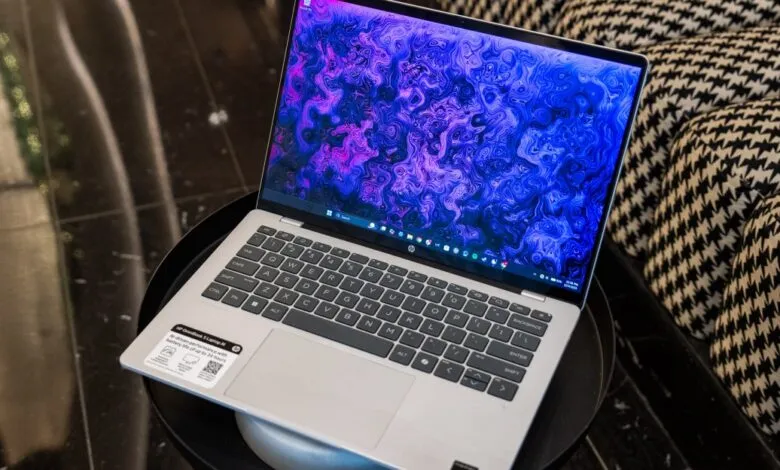
The model I tested is the most affordable configuration, featuring a Snapdragon X Plus processor, 16GB of RAM, a 512GB SSD, and that headline-grabbing 14-inch OLED display. For the money, this is a remarkable package. Laptops with OLED panels typically command prices well over $1,000, so finding one at this price point feels like a minor miracle. The 1920 x 1200 resolution is perfectly crisp on a 14-inch screen, delivering the deep blacks and vibrant contrast that make OLED technology so desirable. The trade-offs are a standard 60Hz refresh rate, no HDR support, and a peak brightness of 300 nits. While this makes outdoor use a bit challenging, the screen quality indoors is excellent for the cost.
Two other strengths define the experience: a comfortable keyboard and exceptional battery life. Typing feels responsive and tactile, even during long sessions, though the keys lack a backlight. The real star is the 59Whr battery. This is a laptop you can confidently take to work or class for a full day without a charger. It easily lasts from morning well into the evening with typical use involving web browsing, messaging apps, and media streaming. The only time I saw the battery drain quickly was during intensive use of AI features, which weren’t particularly useful anyway.
Performance from the Snapdragon X Plus chip is a mixed bag. It’s incredibly power-efficient, which fuels that great battery life, but it isn’t particularly fast. During testing, it occasionally felt sluggish when rapidly switching between numerous open applications across multiple desktops. It never crashed, but the hesitation was noticeable. Interestingly, the same processor felt more responsive in Microsoft’s Surface Laptop. Compared to similarly priced Chromebooks with MediaTek chips or the frequently discounted M4 MacBook Air, the OmniBook 5 isn’t a speed demon. It handles light tasks comfortably but can be pushed to its limits.
Unfortunately, the laptop has some notable flaws. The mechanical trackpad functions adequately but has an irritating quirk: sometimes when you place your finger down to click, you hear an audible tick and feel a vibration before the actual click registers. It’s a distracting false click that happens intermittently but is consistently annoying.
The speakers are a more significant letdown. They sound muddy and lack clarity, firing downward from beneath the wrists and relying on the surface below to bounce sound upward. This design is ineffective on soft surfaces like your lap. They’re acceptable for video calls but do a disservice to music or podcasts.
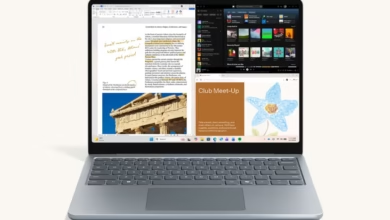
Port selection is basic but functional, with two USB-C ports, a USB-A port, and a headphone jack. The design is inoffensive, a marked improvement over last year’s higher-end OmniBook model, though it comes adorned with a large, easily removable sticker.
For its regular $700 price, the OmniBook 5 faces stiff competition. You can often find a faster Microsoft Surface Laptop or an M4 MacBook Air discounted to around $750. If your workflow allows for ChromeOS, the Lenovo Chromebook Plus 14 offers a similar OLED and great battery life with better performance and speakers. However, when the OmniBook 5 goes on sale, it has recently dipped to $480, the value proposition shifts dramatically. At that price, its compromises become much easier to forgive, especially if a gorgeous screen and all-day battery are your top priorities.
(Source: The Verge)