Apple Unveils M5 Pro and M5 Max: Next-Gen Power
▼ Summary
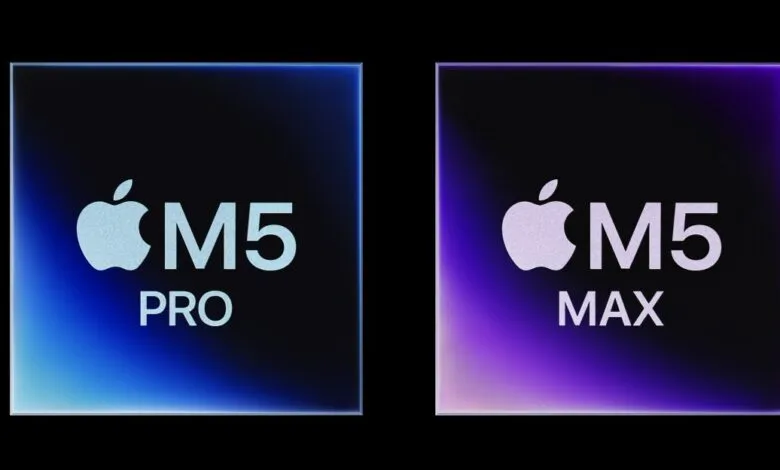
– Apple has announced the M5 Pro and M5 Max processors, featuring an 18-core CPU and a new “Fusion Architecture” that integrates two 3nm dies into a single SoC.
– The chips deliver up to 2.5 times higher multithreaded performance than the M1 Pro/M1 Max and feature a neural accelerator in every GPU core for improved AI compute and ray-tracing.
– The M5 Pro offers up to a 20-core GPU, supports up to 64GB of unified memory, and provides up to 20% higher graphics performance than the M4 Pro.
– The M5 Max is targeted at professionals and offers up to a 40-core GPU, support for up to 128GB of unified memory, and 30% better ray-tracing performance than the M4 Max.
– Both chips include a faster 16-core neural engine, Thunderbolt 5 support, and will be available in a new MacBook Pro for preorder on Wednesday ahead of a March 11th launch.
Apple has officially introduced its next-generation silicon, the M5 Pro and M5 Max processors, designed to power the latest MacBook Pro models. These new chips represent a significant leap forward, built on an advanced 3-nanometer process and featuring a novel “Fusion Architecture” that combines two separate dies into a single, powerful system-on-a-chip. This architectural shift is central to delivering the substantial performance gains Apple is promising.
The heart of both new chips is an 18-core CPU configuration. This setup pairs six high-performance cores with twelve efficiency cores, engineered to provide a major boost in power-efficient, multithreaded tasks. According to Apple, this design results in up to 2.5 times higher multithreaded performance compared to the older M1 Pro and M1 Max chips. A key innovation is the integration of a neural accelerator within every single GPU core, which dramatically enhances capabilities for ray tracing and artificial intelligence workloads. This approach yields more than four times the peak AI compute performance of the previous chip generation.
Focusing on the M5 Pro, this processor combines the 18-core CPU with a graphics processor that scales up to 20 cores. It incorporates an enhanced shader core with second-generation dynamic caching and hardware-accelerated mesh shading, technologies aimed at optimizing graphics memory usage and rendering complex geometry. The chip supports up to 64GB of unified memory and is stated to deliver graphics performance up to 20 percent faster than the M4 Pro, making it a formidable option for creative professionals and demanding users.
For those with even more intensive needs, the M5 Max is positioned as the ultimate solution. Tailored for 3D animators, software developers, and AI researchers, it boasts a GPU that can be configured with up to 40 cores and supports a massive 128GB of unified memory. This allows for handling extremely large projects and datasets directly on the device. Furthermore, it provides a 30 percent improvement in ray-tracing performance over the M4 Max, enabling more realistic lighting and reflections in rendered scenes at faster speeds.
Both new silicon variants come equipped with additional advanced features. These include a faster 16-core Neural Engine for accelerated on-device machine learning, support for the high-bandwidth Thunderbolt 5 connectivity standard, and Apple’s Memory Integrity Enforcement for enhanced security. The chips will debut in Apple’s newly announced MacBook Pro laptops, which are scheduled to open for pre-order soon, with availability beginning on March 11th.
(Source: The Verge)