OpenAI’s ChatGPT Health Now Integrates Medical Records
▼ Summary
– OpenAI has launched ChatGPT Health, a separate, sandboxed tab within ChatGPT designed for secure, personalized health-related questions, encouraging users to connect medical records and wellness apps.
– The company explicitly states the product is not for diagnosis or treatment, acknowledging past incidents where AI gave dangerous health advice and that many healthcare queries occur outside clinic hours.
– OpenAI reports over 230 million people weekly ask ChatGPT health questions and has consulted with more than 260 physicians to refine the product’s responses across 30 health areas.
– The company carefully addressed mental health concerns, stating the product can handle such conversations but will direct users to professionals, while also noting safeguards to avoid alarming users with health anxiety.
– ChatGPT Health features enhanced privacy measures, with conversations not used for model training by default, but it is not HIPAA-compliant as it’s a consumer product, and data could be accessed under legal orders.
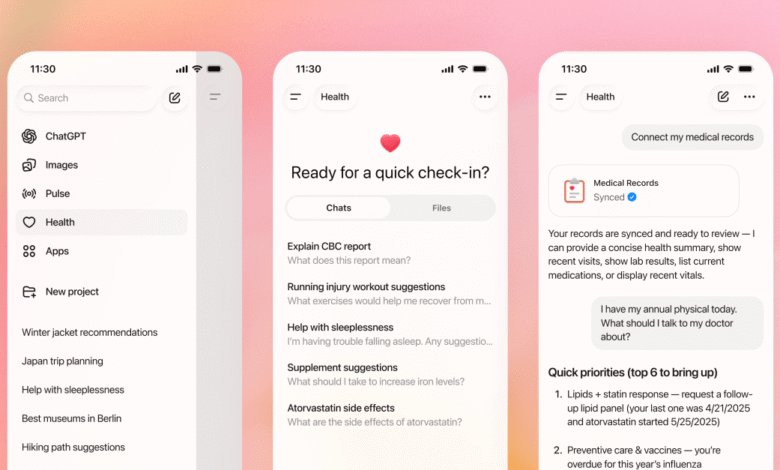
OpenAI has unveiled a new feature called ChatGPT Health, a dedicated space within its chatbot designed for users to ask health-related questions. This move signals a significant push by the company into the personal wellness arena, aiming to provide a more secure and tailored environment for sensitive conversations. The feature operates with a separate chat history and memory from the main ChatGPT interface, and OpenAI is actively encouraging users to connect their personal health data for more customized responses.
Users can link a variety of wellness apps and medical records, including Apple Health, Peloton, MyFitnessPal, WeightWatchers, and Function. The company suggests this integration allows ChatGPT to analyze lab results, visit summaries, and clinical history from medical records, while pulling in data on nutrition, movement, sleep, and activity patterns from connected apps. For medical record integration specifically, OpenAI has partnered with b.well, a platform that works with millions of healthcare providers to facilitate secure data uploads. Access to ChatGPT Health is currently through a waitlist as it begins a beta phase, with plans to gradually roll out to all users.
The company is careful to state that ChatGPT Health is “not intended for diagnosis or treatment.” However, it acknowledges the reality of how people use AI for health guidance, noting that in some underserved communities, users send nearly 600,000 healthcare-related messages weekly. The potential for misuse remains a critical concern, highlighted by past incidents where AI chatbots have provided dangerous medical advice. OpenAI claims its product is shaped by extensive feedback from over 260 physicians, who have reviewed model outputs more than 600,000 times across various medical topics.
One notable omission from the initial announcement was a detailed discussion on mental health support, despite many people turning to chatbots for such conversations. When questioned, OpenAI’s CEO of applications, Fidji Simo, confirmed the product can handle mental health topics but emphasized a focus on directing users in distress to professional help or other resources. The company also addressed concerns about potentially exacerbating health anxiety, stating the model is tuned to be informative without being alarmist and to guide users toward the healthcare system when necessary.
On the critical front of data security and privacy, OpenAI asserts that ChatGPT Health operates as a separate, protected space with enhanced privacy measures and purpose-built encryption. Conversations within this tab are not used to train its foundational AI models by default. The company has experienced security breaches in the past, however, and officials noted that data could still be accessed if required by a valid court order or in an emergency. Regarding regulatory compliance, OpenAI clarified that consumer-facing products like this are not subject to HIPAA regulations, which govern clinical healthcare settings.
(Source: The Verge)


