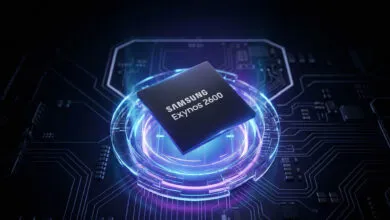
Exynos 2600 Debuts as World’s First 2nm Phone Chip

▼ Summary
– Samsung has announced the world’s first 2nm mobile chip, the Exynos 2600, manufactured using its 2nm GAA process and featuring new heat dissipation technology for sustained performance.
– The chip’s 10-core CPU uses only high-performance Arm cores, delivering a 39% performance uplift over its predecessor, the Exynos 2500.
– Its NPU provides a 113% AI performance improvement and can run larger on-device AI models, while also featuring advanced security with virtualization and Post-Quantum Cryptography.
– The Xclipse 960 GPU offers double the computing performance and 50% better ray-tracing, with AI frame generation for efficient, high-frame-rate gaming.
– The integrated ISP supports high-resolution cameras and video recording, includes AI-powered image enhancement features, and consumes 50% less power than the previous generation.
Samsung has unveiled a landmark achievement in mobile technology with the Exynos 2600, marking the debut of the world’s first 2nm smartphone processor. Fabricated on Samsung Foundry’s advanced 2nm Gate-All-Around (GAA) process, this chipset introduces a novel thermal management system alongside significant upgrades to its CPU, GPU, and AI capabilities, aiming to deliver a substantial leap in sustained performance and efficiency.
At the heart of the Exynos 2600 is a distinctive 10-core CPU configuration built on Arm’s latest v9.3 architecture. Departing from conventional designs, it forgoes traditional low-power cores entirely. Instead, the setup comprises one high-frequency C1 Ultra core at 3.8GHz, three C1 Pro cores at 3.25GHz, and six additional C1 Pro cores running at 2.75GHz. This architecture is engineered to provide a 39% overall CPU performance increase compared to its predecessor, the Exynos 2500.
Artificial intelligence receives a massive boost from a next-generation Neural Processing Unit (NPU). Samsung claims it delivers a staggering 113% improvement in AI performance, enabling the on-device execution of larger and more complex AI models. A key innovation is its integration of virtualization security and hardware-backed hybrid Post-Quantum Cryptography (PQC), a first for any mobile NPU, enhancing data protection for AI workloads.
For graphics, the integrated Xclipse 960 GPU promises to double the computing performance of the previous generation while offering a 50% enhancement in ray-tracing for more realistic gaming visuals. A feature called Exynos Neural Super Sampling (ENSS) leverages AI for intelligent frame generation and upscaling, aiming to deliver smooth, high-frame-rate gameplay without excessive battery drain.
Photography and videography are also major focuses. The Image Signal Processor (ISP) now supports camera sensors up to 320 megapixels and can capture 108MP images with zero shutter lag. For video, it handles 8K recording at 30fps and 4K at 120fps with HDR, and supports Samsung’s own APV codec, designed to compete with professional formats like Apple’s ProRes for superior editing flexibility. An AI-powered Visual Perception System (VPS) enables real-time detection of elements like eye blinks for better shots, while a Deep Learning Video Noise Reduction (DVNR) system cleans up footage in low light. Notably, this new ISP is also 50% more power-efficient.
Addressing a longstanding criticism of Exynos chips regarding thermal throttling, Samsung has implemented a new Heat Path Block (HPB) technology. This system uses a specialized High-k EMC material to dramatically improve heat dissipation from the core silicon, a crucial innovation intended to allow the chip to maintain peak performance for extended periods under heavy workloads, directly tackling past overheating issues.
The Exynos 2600 supports the latest UFS 4.1 storage and LPDDR5X RAM, and can drive 4K displays at 120Hz with support for HDR10+ video and gaming. Interestingly, the chip appears to lack an integrated 5G modem, as well as Bluetooth and Wi-Fi connectivity, suggesting it will be paired with a separate companion chip for wireless communications in upcoming devices.
(Source: Sam Mobile)