My Daily Tracking Routine
▼ Summary
– The author, a wearables reviewer, describes her intensive daily tracking routine for evaluating products like continuous glucose monitors, smart rings, scales, and smartwatches, which includes syncing data, noting battery life, and comparing sleep and readiness scores across multiple devices.
– Her morning routine involves weighing herself on multiple smart scales before drinking water, reviewing fasting glucose, and manually logging step counts and weight into a notebook, a process that takes about an hour.
– During workouts, she starts each device in the same order, checks metrics like distance and heart rate at intervals, and weighs herself again post-workout to assess consistency and dehydration, using the Polar H10 chest strap as a control for heart rate accuracy.
– At night, she reviews long-term trends, tags factors affecting sleep in apps like Oura and Eight Sleep, and notes that AI-generated insights are often inaccurate, such as claiming she is “dying” or suggesting alcohol for snoring.
– She emphasizes that her system is not for normal people, advises that more data and devices are not better without a clear purpose, and takes planned 48-to-72-hour breaks between testing blocks to avoid data fatigue.
Welcome to Optimizer, a weekly newsletter from Verge senior reviewer Victoria Song that breaks down the latest gadgets and wellness products promising to transform your life. After a two-week hiatus, Optimizer will shift to Wednesdays starting August 12th. Subscribe here.
My For You page is convinced I love “What I eat in a day” videos. Truthfully, I watch them mostly to spot emerging wellness trends. But they also offer a fascinating glimpse into what people consider healthy eating,even if many are likely staged for engagement. Similarly, Verge readers have long asked to see what I track daily as our senior wearables reviewer.
I understand the curiosity. Social media has sold the idea that copying “experts” leads to success. That’s why influencer meal diaries are so popular. But I’m a wearables reviewer, which means I self-quantify in ways I’d never recommend for average users. I track health metrics to evaluate products and their claims. That involves checking GPS accuracy, seeing how workout intensity affects battery life, or determining whether metabolic data from a $600 scale measuring foot sweat correlates with a continuous glucose monitor (CGM). I’m also figuring out the most practical ways to integrate a device into everyday life. Most people track fitness to improve their health,not to test gadgets.
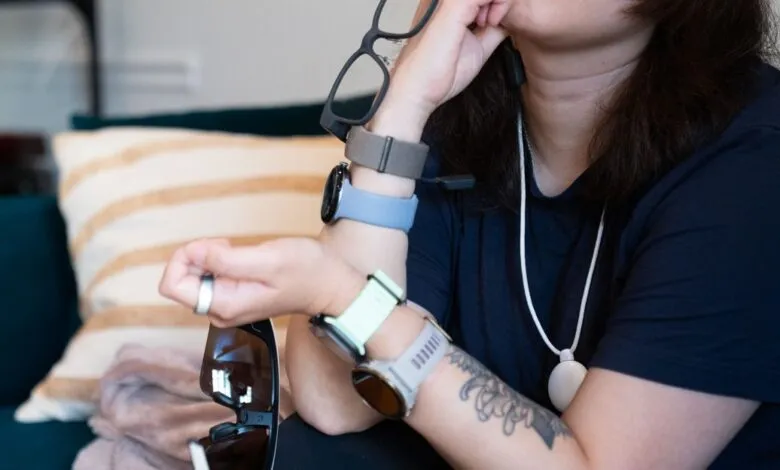
What I track shifts with the seasons. Winter through early spring is lighter, as product launches slow. Summer through late fall? I’m a walking barnacle field of wearables. And as health companies explore bodily fluids, my regimen has never been more intense. Right now is a particularly chaotic moment: my doctor cleared me to resume training, product launch season is ramping up, and for the past few weeks, I’ve been building a digital twin of my metabolism using Twin Health. That system combines a CGM, blood tests, and various sensors. So, let’s dive in.
The Current Roster
I test in product blocks. Currently, I’m focused on metabolic technology. Ideally, you need control devices. If I’m testing a new smart ring, I compare it to the Oura Ring, the benchmark most people will use. Whenever possible, I also long-term test the Oura against other sleep trackers in different form factors,like a smart bed and a smartwatch. And so on.
Right now, my roster includes screenless fitness trackers, smart scales, and sleep trackers,key components for metabolic tracking. For example, the Dexcom G7 (a CGM for diabetics), the Twin Health scale, the Apple Watch Ultra 3, and a Medline blood pressure cuff all feed data into the system creating my metabolic digital twin. Since Garmin released the Cirqa (a screenless tracker), I’m comparing it to the Oura Ring and Fitbit Air,both Whoop competitors. And because Withings just launched its $600 BodyScan 2, I’m comparing it to their other scales and the Twin Health scale I’m already using.
This testing block includes:
- Apple Watch Ultra 3 (left wrist, general baseline)Morning RoutineWearable testing is all about comparison. The first thing I do after hitting snooze is sync all devices and check battery levels. Whenever I add a new gadget, I compare its first 24 hours of battery use to the initial charge time. This week, I got the Garmin Cirqa. It hasn’t been on my wrist a full day yet, but tomorrow morning I’ll note remaining battery after sleep and set an alarm for the 24-hour mark.After syncing, I open each device’s app to log sleep duration. Today, that means the Apple Watch Health app, Oura app, Google Health app for Fitbit Air, and Eight Sleep app as a control. I check which trackers accurately marked nighttime disturbances,like a cat smothering my face at 2:30 AM because my spouse broke bedtime rules. I also compare readiness scores and skim AI-generated daily insights. Lately, all metrics say the same thing. If there’s a major deviation or an AI suggests something absurd (like a smart bed telling my spouse to drink alcohol for snoring), I flag it for deeper investigation.Before getting out of bed, I open the Dexcom G7 app to note my fasting glucose level and any overnight patterns.Next, I pee but avoid drinking water. Then I remove all wearables and pajamas for smart scale testing. First, I step on the Twin Health scale to feed my digital twin. (This takes at least three months, so expect a story this fall.) Then I hit the Withings Body Smart, BodyFit, and BodyScan 2. Unless you’re a health tech reviewer, there’s no reason to weigh yourself this much! Once a week, I also take blood pressure with a cuff that syncs to Twin Health, then input the reading into Apple Health, Oura, and Withings apps. After that, I put all wearables back on.Before starting work, I note the Apple Watch Ultra 3’s previous day step count and morning weight comparisons in an analog notebook for future reviews.The final morning step is breakfast. Building my digital twin requires logging meals to see how foods affect glucose. After eating, I set a two-hour timer to check the Dexcom G7 results. Then I can finally start my day. Total time: about an hour.Daytime and Workout TrackingAfter the morning review, I mostly ignore my wearables unless I’m testing something specific or get an alert. These days, that means meals, workouts, low glucose notifications, or anomalous heart rate alerts (which rarely happen).Meals follow the same routine. After a year of CGM testing, I’m much more relaxed about food logging. I allow myself occasional Cheetos and cake. Workouts require more effort.Before a workout, I open all apps and navigate to the correct screens so I can quickly start each activity on each device. I start and end workouts in the same order, left to right. Hopefully, nothing goes wrong mid-workout. Several times during a run, I check metrics: distance, average pace, heart rate zone, and heart rate at every half-mile interval. After syncing, I log everything into a spreadsheet. This adds 20 to 30 minutes to my workout. Afterward, I check how the workout affected glucose levels and weigh myself on all three scales to see how they measure dehydration and body composition. Most of this tests consistency and rarely makes it into the final review unless something is seriously off (like the original OnePlus Watch).For new gadgets, I wear the Polar H10 chest strap as a control to ensure heart rate accuracy stays within 5 to 10 beats per minute. (Some devices have slight latency, but that’s acceptable.)Sometimes I mess up,like forgetting to get a proper GPS signal before a run. Then I lightly bang my head against a wall and wail, because it means a repeat test.Nighttime RoutineNight is for long-term trend comparison and tagging. Once in bed, I review medication logs in Apple Health and Twin Health, daily step counts across devices, and metrics like stress. I also check AI summaries of my day. Lately, all my wearables think I’m dying and my body is falling apart. (AI insights are often hilariously wrong.)If an app has tagging or journaling features (like Oura and Eight Sleep), I mass-log them. Tagging helps identify factors affecting sleep quality,like a late night or sleeping with a cat. By the time I’m done, I’m usually exhausted and pass out, ready to start again tomorrow.No System Is PermanentAfter over a decade of this, I’ve gotten efficient. But you can see why I constantly warn about data fatigue. Testing ebbs and flows. It’s most intense at the start and end of a block. Next week, I’m starting a whole new batch of wearables. But between blocks, I take a 48-to-72-hour break where I wear nothing and track nothing except workouts.Some say that ruins data integrity. I say that to survive this wearable life long-term, I need planned breaks or I’ll lose my mind. Life happens, and unsustainable rigor can’t adapt to new circumstances. This is only what I track right now. I adapt based on products and long-term goals.But if you take one thing from this, let it be: More data and more devices aren’t better. Without a purpose, this is just busywork. Be intentional about what you track, why, and which tool fits your goal. My chaotic routines are not what I’d recommend for normal people. Don’t let biohackers, hyper-optimizers, or tech companies tell you otherwise.