Why People Are Pretending to Be AI Chatbots
▼ Summary
– A website called “Your AI Slop Bores Me” is a fake chatbot where human users respond to requests instead of an algorithm, and it has received millions of visits.
– People are using the site for playful connection, with users role-playing as AI to answer questions or create simple drawings within a time limit.
– The site’s creator and a cartoonist user suggest it taps into nostalgia for a more human, friendly early internet, contrasting with today’s AI-saturated web.
– Comedian Ben Palmer runs a different type of prank site where users sometimes believe they are interacting with a real AI like ChatGPT.
– An investor notes that while humans pretending to AI is comedic, it highlights the distinct communication style evolving for interacting with bots.
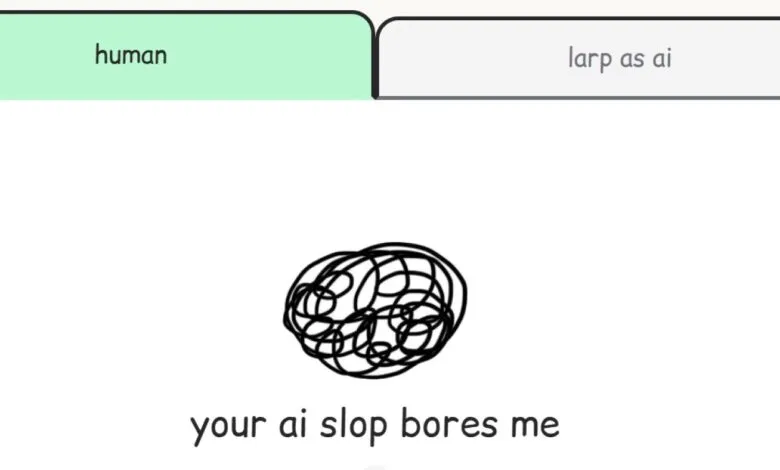
A surprising online trend has millions of people choosing to act like AI chatbots for entertainment. This phenomenon highlights a growing desire for human connection in a digital space increasingly dominated by automated systems. One prominent example is the website Your AI Slop Bores Me, a platform designed to look like a standard AI interface but powered entirely by people. Its creator, 17-year-old Mihir Maroju from India, reports the site has attracted over 25 million unique visitors and hundreds of millions of hits in just one month, far exceeding his expectations for its addictive appeal.
On this site, users submit requests as they would to ChatGPT or Gemini, but the responses are crafted by another person within a 75-second time limit. This constraint, mimicking AI response speed, leads to charmingly rough sketches and spontaneous text replies. Cartoonist Amy Kurzweil, who has interacted on the platform, described the joy of receiving a request to draw a bat eating a strawberry and the fun of asking others what they are reading. For her, the site’s nostalgic use of the Comic Sans MS font evokes an earlier, friendlier era of the internet. She believes this trend is a reaction to widespread frustration with AI-generated content, allowing people to reclaim the magic of genuine, unpredictable online interaction.
To maintain a positive environment, the site’s administrators have implemented filters to block harmful content, successfully reducing early issues with spam. The platform is transparent about its human core, offering users a choice between a “human” tab or to “larp as ai,” engaging in live action role-play as an artificial intelligence.
However, not all human-as-AI experiments are so upfront. Comedian Ben Palmer created fake websites with URLs similar to real AI services after ChatGPT’s launch. In one notable instance, a user in China, where ChatGPT is banned, unknowingly asked his fake site to write an article on climate change. Even after Palmer revealed the prank, the user insisted on his help, leading the comedian to use the real ChatGPT to fulfill the request before translating it. Palmer notes that while some users were angry, others were entertained and continued the conversation. He acknowledges a dark side to this masquerade, such as fielding requests for explicit material, which he declines. His goal is to inject human unpredictability into an online world he sees as becoming sterile and corporate.
Industry observers see this trend as a natural cultural reflection of our AI-integrated lives. An OpenAI spokesperson stated that the humor emerging from these interactions is part of what makes watching people adopt ChatGPT so enjoyable. Investor Brianne Kimmel, who backs AI startups, agrees. She views humans pretending to be AI as a form of sketch comedy that underscores the distinct communication protocols developing for human-bot interaction, rather than a sign of rejecting the technology. This playful role reversal ultimately serves as a reminder of the enduring value of human creativity and connection.
(Source: NPR)