SEO uncertainty opens doors for challenger brands
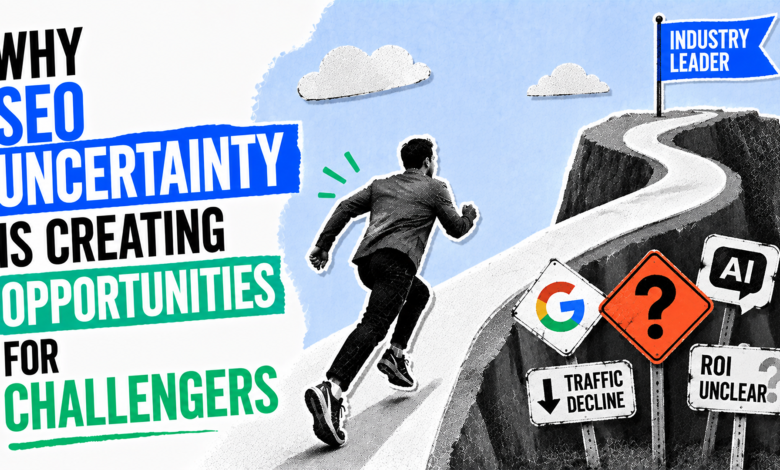
▼ Summary
– Google and AI platforms are reducing referral traffic, making traditional ROI measurement unreliable, yet visibility still influences branded searches, direct traffic, and conversions.
– Market leaders maintain dominance through accumulated authority, but shifting search behavior and uncertainty weaken their scale-based advantages, creating opportunities for challengers.
– Businesses facing uncertainty choose between risk of continued investment or risk of falling behind, with doubling down seen as a chance to close gaps faster than in stable markets.
– Instead of replicating a leader’s past assets, invest in proprietary data, expert voices, customer proof, PR, and technical foundations that are defensible and costly to replicate.
– Waiting for certainty is riskier than investing now, as even small intentional investments during market shifts can create outsized advantages over hesitant competitors.
We are deep into 2026 now, and the anxiety is palpable across the industry. Personally, I am watching my own forecasts from the start of the year play out in real time.
Google continues to answer queries directly within its own interface, keeping users on the platform rather than sending them out to websites. Meanwhile, AI search platforms remain the center of attention, though they have yet to produce significant referral traffic. Attribution models are still unreliable, and a growing number of executives are questioning whether their search budgets are justified.
Here is the reality: I have two clients navigating this exact scenario with completely opposite strategies. The first is reducing its SEO spend because the returns no longer match historical performance. The second is increasing its investment, viewing the current volatility as a chance to chip away at a competitor that has ruled their niche for over a decade.
Both approaches carry substantial risk. The distinction lies in their focus. One is preoccupied with the downside of continued spending; the other is fixated on the upside of aggressive moves while rivals retreat.
Stable markets protect market leaders
In a predictable environment, catching an industry leader is nearly impossible. These companies benefit from established brand equity, massive content inventories, superior link authority, and a treasure trove of first-party data. They also hold the financial resources, staffing, and historical insights to continually extend their lead.
When the rules are static, the leader’s advantage compounds. Simply adding a few blog posts or tweaking category pages will not close a decade-long gap. At best, you maintain the distance.
To truly disrupt them, you cannot rely on good intentions or outdated link-building tactics. You need a fundamental shift in the market itself and in what the algorithms reward.
That shift is happening right now.
Doubt creates opportunity
Consumer research is no longer contained within Google’s ecosystem. Buyers have an expanding array of channels to find information, and no single company has mastered all of them.
This ambiguity erodes the advantages that market leaders have relied upon. Their massive content libraries and proven playbooks were built for scale, but they were also built for a more predictable search landscape.
Ironically, the very size that made them dominant is now a liability. They have more legacy content to audit, more internal stakeholders to convince, and more existing revenue to protect. When every dollar is scrutinized for direct ROI, investing in unproven channels becomes a bureaucratic nightmare.
The leader is still ahead, but the track has changed. We are all learning the new course simultaneously. That is a rare and exciting opportunity for challengers.
You don’t need to recreate their last five years
Closing the gap does not require mirroring the leader’s every move. You do not need to match their article count, link profile, or keyword list. Much of what worked in the past five years is unlikely to deliver the same value in the next five.
Instead, focus on building assets that genuinely matter and get them in front of your audience wherever they are researching:
- Proprietary research and original data.These are not just “SEO assets” or “GEO assets.” They are evidence that your business deserves attention, trust, and citations. This goes beyond an E-E-A-T strategy to improve rankings. It is about creating legitimate value that generates brand advocates, with organic visibility as the natural result.You do not need to replicate the leader’s history. You need to build for where the market is today.Stop using referral traffic as the only scoreboardHere is an uncomfortable truth: AI platforms may not deliver meaningful referral traffic for a while, and Google’s reassurances about clicks should be taken with a grain of salt.This does not mean visibility is worthless. It means referral traffic is an incomplete metric. Attribution has always been a weak point for organic marketing, so this is not entirely new.Clicks still matter, but so do branded search volume, direct visits, assisted conversions, brand mentions, answer placements, and sales conversations that started with your content. We should also look at whether the traffic we do earn converts better because customers encountered the brand earlier in their journey.The goal is not to create softer metrics to justify declining traffic. It is to acknowledge that last-click sessions alone no longer reflect the full impact of visibility on purchasing decisions.The biggest risk is waiting with everyone elseHesitation feels safe when the entire market is frozen. But when competitors pause, even modest, deliberate investments can yield significant advantages.Warren Buffett’s famous advice is more relevant than ever: “Be fearful when others are greedy, and be greedy when others are fearful.”This is not an argument for reckless spending on AI content or chasing guaranteed “AI rankings.” It is about investing in research, expertise, proof points, brand awareness, and technical quality that your competitors will desperately need once the market stabilizes.By then, those assets will be impossible to replicate with a slightly longer article or a few extra data points. They become defensible resources that are costly and time-consuming to duplicate, which means most competitors will not even try.Uncertainty does not remove risk. It forces you to choose between the risk of investing now and the risk of falling further behind.Build for the next five yearsYou likely cannot outspend the market leader or instantly replicate their success. You certainly will not close the gap by copying their playbook or seeking shortcuts.But you may never get a better chance than right now, when consumer behavior is shifting, old strategies are failing, and the competition is paralyzed by indecision.You do not need to recreate the last fifty years of their success.You just need to start winning the next five.If you prefer to keep cutting marketing budgets for short-term gains, go ahead. Your competitors will appreciate the help in putting you out of business.