Coval Secures $28M to Stress-Test AI Voice Agents
▼ Summary
– Coval has raised $28 million in Series A funding to provide AI voice agent testing, led by Norwest with participation from Base10, Twilio Ventures, and Y Combinator.
– Founder Brooke Hopkins, a former Waymo engineer, applies simulation-based safety testing from autonomous vehicles to voice agents, which combine transcription, response generation, and speech models.
– Coval runs tens of millions of simulated tests on voice agents to catch failures like accents, background noise, and off-script calls before customer exposure, and continues monitoring in production.
– Customers including Zoom and Deepgram use Coval, reporting up to 30 times less manual QA work and 10 times faster agent deployment.
– Twilio Ventures invested instead of building its own tool, signaling demand for independent, platform-agnostic voice AI evaluation as the sector attracts over $7 billion in funding.
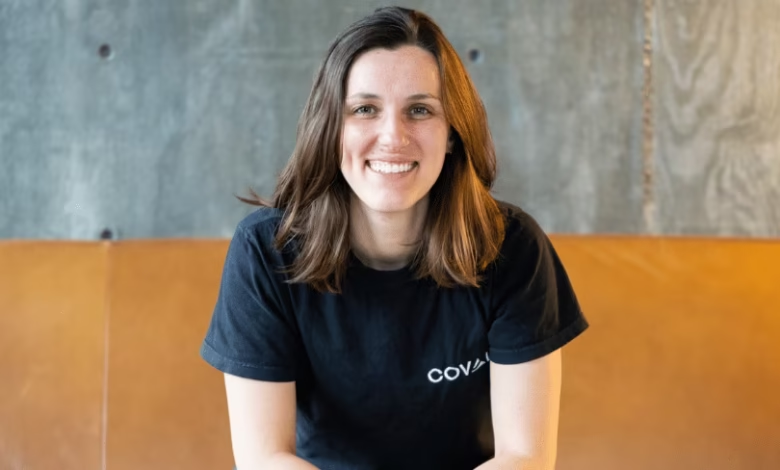
Coval has raised $28 million to put AI voice agents through rigorous testing before they ever reach a live caller. The company’s founder previously built similar safety infrastructure for Waymo’s self-driving cars, and she argues that voice technology demands the same level of scrutiny.
An AI voice agent can sound flawless in a controlled demo, then crumble during an actual call. It stumbles over accents, struggles with background noise, or freezes when a caller goes off script. Coval aims to catch those failures before a customer ever experiences them. Investors are betting the approach will pay off.
The San Francisco startup closed a Series A round led by Norwest, with participation from Base10 Partners, Twilio Ventures, and Y Combinator. The deal brings Coval’s total funding to $31 million since its 2024 launch. The company is a Y Combinator graduate.
The pitch is straightforward. As more businesses deploy voice agents for customer-facing roles, they need a reliable way to prove those agents actually work. Coval provides that proof.
From autonomous vehicles to phone calls
The concept is borrowed directly from self-driving technology. Founder and CEO Brooke Hopkins built evaluation infrastructure at Waymo, Alphabet’s autonomous vehicle unit. There, her team ran millions of simulated miles for every code change, because failure on a public road was never acceptable.
Hopkins believes voice agents need the same discipline. A voice agent runs multiple models simultaneously. One transcribes speech, another generates a response, and a third speaks it aloud. That mirrors the perception, planning, and control systems in a self-driving car.
The conclusion follows logically. You cannot test either system manually at scale. Simulation is the only practical approach. Coval applies the simulation-first methodology Hopkins learned at Waymo to the unpredictable world of phone calls.
What Coval actually does
Coval runs tens of millions of simulated tests on a voice agent. It probes for the specific issues that break real calls: accents, interruptions, background noise, and unexpected or unscripted requests. All of this happens before any customer is exposed.
The work doesn’t stop at launch. Coval continues monitoring agents in production and automatically feeds failed calls back into the testing process. A bank, for example, can simulate thousands of callers who give conflicting details or hang up early, all before a single real customer dials in.
The company says the payoff is substantial. Customers reduce manual quality-assurance work by up to 30 times. They deploy agents up to 10 times faster. More than 60 organizations now use the platform, including Zoom and the voice-AI infrastructure firm Deepgram.
Those two endorsements carry weight. Both Zoom and Deepgram have extensive experience with how voice AI fails. Their adoption signals that the problem Coval targets is real.
Why voice AI needs a referee
The timing is no accident. Investment in voice AI is surging. Coval points to data showing more than $7 billion flowed into the sector in the first quarter of 2026 alone. One forecast projects the market will exceed $20 billion by 2031.
That boom has its own momentum. Startups like Bland have raised tens of millions to build the agents themselves, and Twilio’s voice-AI revenue has been climbing fast. As more agents go live, more will fail in public. Testing becomes the unglamorous but essential work beneath the hype.
Coval is not alone in chasing this opportunity. Rivals include Hamming, which focuses on regulatory edge cases in healthcare and finance, and Roark, another Y Combinator startup that has replayed more than 10 million minutes of calls with updated logic. Coval argues it offers the full stack instead, from pre-launch simulation to live monitoring and human review.
The category itself echoes a familiar pattern. Other startups, such as Solidroad, are building quality-assurance tools for AI support agents across chat and email. Coval is making the same bet, but for the harder problem of live audio.
The Twilio question
One investor on the cap table deserves a closer look. Twilio Ventures backed the round, and Twilio sells the voice infrastructure many of these agents run on. It could have built its own testing tool. It chose to invest in Coval instead.
“Trust is critical to scaling these experiences,” said Andy O’Dower, a field chief technology officer at Twilio. He called comprehensive evaluation tools “foundational” to the current wave of voice AI. The vote of confidence comes from a company that sees the entire market flow through its pipes.
That choice hints at a bigger industry question. Will voice-AI testing remain independent, or get absorbed by the platforms it monitors? Twilio backing an outside tool, rather than building one, suggests at least one major player wants evaluation kept separate.
There is logic to that separation. A referee that works for one team is not much of a referee. An independent evaluator can test agents built on any model or platform, which is exactly what enterprises juggling multiple vendors say they want.
What happens next
The new funding is aimed at growth. Coval will hire across its sales and solutions-engineering teams. It will also deepen the product, with richer simulation, more integrations, and stronger human-review and monitoring tools.
The momentum appears real. Coval says revenue has grown tenfold over the past year, though it has not disclosed actual revenue or headcount targets. Voice agents are spreading across customer service, sales, financial services, and healthcare, and each one is a potential customer.
The deeper bet is about where voice AI is heading. Hopkins believes every company will eventually run a voice agent the same way it now runs a website or an app. “Most enterprises don’t have the infrastructure to deploy these systems with confidence,” she said.
Norwest is convinced she can provide it. “She helped prove self-driving cars could work,” said partner Scott Beechuk, “and now she’s tackling voice AI.” The comparison is flattering, but it cuts both ways. Self-driving took far longer and cost far more than anyone promised. Whether voice agents earn the trust to handle a real call, at the scale Coval imagines, is the question this round leaves open.
(Source: The Next Web)