Aseon Labs raises $10M for robotaxi charging pods
▼ Summary
– Aseon Labs raised $10 million in a seed round led by Crane Venture Partners to build automated service pods for robotaxi fleets.
– The pods aim to eliminate deadhead miles by using robotic arms and computer vision to charge, clean, and inspect robotaxis at parking-space-sized urban locations.
– Co-founders George Kalligeros and Dan Keene previously built battery-swapping networks for micromobility fleets at Pushme, which was acquired by Tier Mobility.
– The seed funds will be used to build five prototypes, grow the team, and secure real estate for an initial pod network.
– Aseon Labs has not signed contracts with robotaxi operators yet, and the pods are still pre-product, with real-world deployment needed to validate their economic projections.
A Redwood City startup called Aseon Labs has secured $10 million in seed funding to deploy parking-space-sized automated pods that can charge, clean, and inspect robotaxis, cutting down on the costly empty miles these vehicles log between fares. The round was led by Crane Venture Partners, with participation from Y Combinator, Uber co-founder Garrett Camp’s firm Expa, Robin Hood Ventures, and Founders Capital. Angel investors include Mercury founder Immad Akhund, Zimride co-founder Rajat Suri, and operators from Anthropic, Nuro, Turo, and Revolut.
The company is targeting one of the robotaxi industry’s most expensive inefficiencies: deadhead miles. Every time a self-driving taxi needs a charge, a wash, or a sensor check, it drives empty to a central depot that may be 10 to 15 miles outside its service zone. That burns time and money without generating any passenger revenue. An MIT study found that Waymo’s California fleet runs roughly 44 percent of its miles with no rider on board.
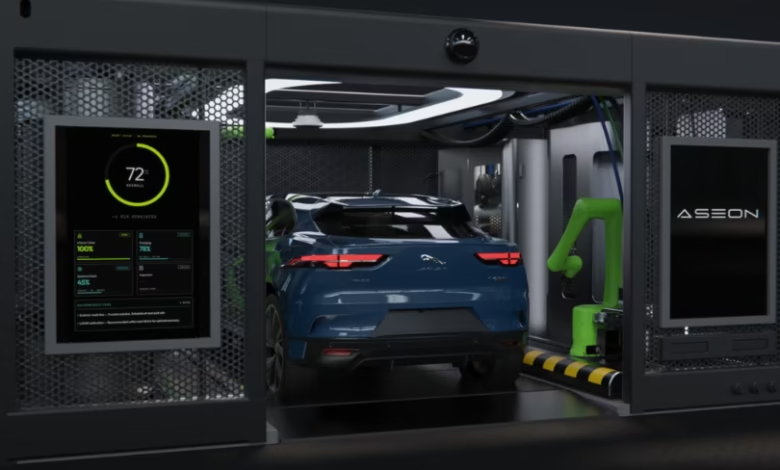
Aseon Labs wants to solve that by scattering parking-space-sized automated pods throughout cities. Each pod uses robotic arms and computer vision to charge vehicles, wash exteriors, clean interiors, retrieve lost items, and inspect sensors without human labor. Because the pods are classified as temporary structures, they can be installed in a day at parking lots, gas stations, or charging hubs, and moved if a location underperforms.
Co-founders George Kalligeros and Dan Keene have built similar infrastructure before. They founded Pushme in 2016 to create battery-swapping networks for micromobility fleets in Europe. Tier Mobility acquired the company in January 2020, after which Kalligeros led Tier’s 100-person hardware team. Before Pushme, he worked as a mechanical design engineer at Bentley Motors and Tesla.
“In order to reach economic parity with ride-hailing, you need the robotaxi in continuous operation during the entirety of the demand curve of the day,” Kalligeros told TechCrunch. The seed funds will go toward building five prototypes, expanding the six-person team to roughly a dozen, and securing real estate for the initial pod network.
The pods rely on vision-language-action models to recognize problems they should not attempt to fix. If a camera spots melted chocolate on a backseat, the robotic arm stands down rather than risk making the stain worse, and the vehicle is sent to a central depot for human attention. Early versions will be staffed, though the units are designed to operate autonomously, powered by a propane generator or an existing electrical connection through partnerships with EV charging companies.
The timing reflects how fast robotaxi operations are scaling. Waymo recently launched its cheaper Ojai robotaxi and now delivers more than 500,000 paid rides per week across ten US cities, targeting one million weekly rides by the end of 2026. Tesla has begun robotaxi operations in Austin, Amazon’s Zoox is expanding in San Francisco and Las Vegas, and Goldman Sachs predicts the global robotaxi market will reach $415 billion by 2035, growing from roughly 7,000 vehicles today to six million.
But scale requires infrastructure that does not yet exist. Autonomous fleets keep roughly a third of their vehicles offline at any given time for servicing, according to Aseon Labs. The company estimates that its pods could reduce reset costs by 50 percent and downtime by 65 percent while increasing per-vehicle revenue by more than $50,000 annually.
Aseon Labs has not signed contracts with any robotaxi operator yet. “Pretty much everyone wants to try it,” Kalligeros said, without naming specific companies. The startup is still pre-product, with five prototypes as its immediate milestone. The gap between a prototype pod and a reliable urban network is significant, meaning whether the economics work as advertised will depend on real-world deployment, not projections.
(Source: The Next Web)