Hands on: Sony Bravia 7 II Review
▼ Summary
– Sony’s new Bravia 7 II uses ‘True RGB’ technology with independent red, green, and blue LEDs, claimed to offer up to four times the color volume of OLED and exceed Mini LED brightness.
– The Bravia 7 II has a new ‘mirage stand’ with a transparent plastic strip to hide wires, a backlit remote with USB-C charging made from 80% recycled plastic, and a plastic bezel.
– It features Sony’s X Wide Pro for consistent colors at wide angles, supports Dolby Vision but not HDR10+, and has two full-bandwidth HDMI 2.1 ports.
– A brief preview showed the Bravia 7 II delivering punchy, detailed colors and bright, three-dimensional images in Vivid mode compared to a rival LG OLED, though no serious testing was done.
– UK pricing starts at £1899 for the 50-inch model and goes up to £6999 for the 98-inch, reflecting a price hike over the previous Bravia 7 series.
It is far too soon to deliver a final verdict on Sony’s Bravia 7 II, but the initial glimpse of its ‘True RGB’ technology and thoughtful design has certainly piqued our interest. We are eager to put this set through rigorous testing in our dedicated review rooms.
Sony has been aggressively rolling out new products, from the Xperia 1 VIII smartphone to the 1000X The Collexion wired headphones. Home cinema enthusiasts are not being left behind, with a fresh wave of televisions arriving this year.
Among them is the Sony Bravia 7 II, positioned as the more accessible sibling to the Sony Bravia 9 II. Both models spearhead Sony’s first foray into RGB LED TV technology, branded as ‘True RGB’. Sony claims this delivers “up to four times the colour volume of the OLED” while surpassing Mini LED brightness, describing the result as “virtually infinite in colour, brightness and depth”.
Those are bold promises. During a preview at Sony’s European headquarters, I got a brief hands-on experience with the Bravia 7 II. While I could not conduct any serious measurements, the demonstration offered a taste of what to expect when the unit arrives in our lab.
Pricing
Sony has announced UK pricing for the Bravia 7 II, which shows a noticeable increase over its predecessor. The inclusion of the new ‘True RGB’ panel is clearly a factor. While US and Australian prices are still pending, a similar hike is expected in those markets.
| Size | Bravia 7 II | Bravia 7 | | :— | :— | :— | | 50-inch | £1899 | N/A | | 55-inch | £1999 | $1899 / £1899 / AU$2999 | | 65-inch | £2299 | $2299 / £2199 / AU$3499 | | 75-inch | £2999 | $2799 / £2799 / AU$4499 | | 85-inch | £3999 | $3499 / £3499 / AU$5499 | | 98-inch | £6999 | N/A |
Two new screen sizes are also available: a smaller 50-inch model and a massive 98-inch option. For context, the LG C6 OLED launched its 65-inch version at £2500 / $2699 / AU$3999 and earned a five-star review for its rich picture and brightness.
Design
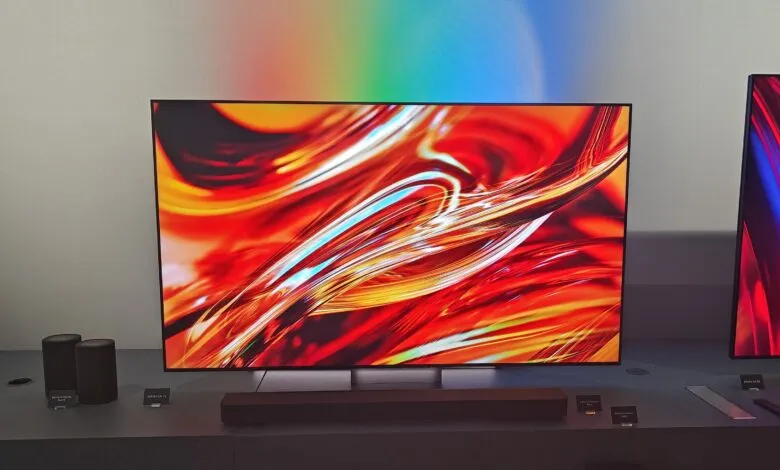
The Bravia 7 II marks a clear design departure from its predecessor, particularly with its stand. Instead of two separate feet, Sony uses a ‘mirage stand’ featuring a transparent plastic strip that conceals cables beneath the screen. This creates a tidy, clutter-free look. The stand is available on all models except the 98-inch version.
A new remote control accompanies the TV. It is sleek and practical, with a backlight for easy use in dark rooms, a USB-C rechargeable port, and construction from 80% recycled plastic.
Overall, the TV feels solid. The bezel is plastic rather than the metal found on the premium Bravia 9 II, so it feels slightly less luxurious to the touch, but the build quality remains sturdy.
Features
A key addition is Sony’s X Wide Pro feature, designed to maintain colour consistency at wide viewing angles. I tested this from challenging positions, and brightness and colour vibrancy held up impressively well. This is a clear improvement over the original Bravia 7, where backlight blooming became more apparent from an angle.
The headline feature is ‘True RGB’ technology. Instead of using blue LEDs converted with Quantum Dots, RGB Mini LED places independent red, green, and blue LEDs into an optical lens behind the LCD panel. In theory, this should deliver higher brightness and a wider colour gamut than both OLED and conventional Mini LED.
Sony has been tight-lipped on specifics like the number of dimming zones or peak brightness levels, only promising “exceptionally high peak brightness” and “precise luminance control”. The set is powered by Sony’s proprietary RGB Backlight Master Drive Pro, which the brand says drives each LED with high precision to improve brightness, reduce blooming, and produce purer colours.
Samsung, Hisense, LG, Philips, and TCL are all launching their own takes on RGB Mini LED this year, so competition in this space will be fierce.
The Bravia 7 II supports Dolby Vision but not HDR10+, a consistent omission across Sony’s TV lineup. It does offer “Studio Calibrated” modes for streaming platforms like Netflix and Amazon Prime Video.
Audio on the 65-inch model I saw includes two full-range drivers and two subwoofers, delivering 40W total power. Sony notes that the audio configuration varies by screen size, with larger models getting more powerful built-in sound.
Connectivity includes four HDMI ports, but only two are full-bandwidth HDMI 2.1 sockets. One of those doubles as the HDMI eARC port. This feels limited, especially since competing models from Hisense, Samsung, and LG offer four full-bandwidth sockets.
Picture
I saw the Bravia 7 II briefly side by side with the LG C6, both in Vivid mode. Without the ability to adjust settings, a proper comparison is impossible. Still, the demonstration offered hints.
In a scene from Angry Birds, Red’s feathers looked colourful and punchy, with slightly more detail than on the C6. However, shadow detail in his black monobrow was a bit clearer on the LG. In a scene from Aladdin in a spice market, the Bravia 7 II delivered a solid sense of three-dimensionality and impressive brightness. The difference between the two sets was minimal at this first look.
While not a definitive assessment, the picture appeared popping and detailed in Vivid mode.
Sound
I did not hear the Bravia 7 II’s built-in speakers. Audio at the event was routed through the new Sony Bravia Trio soundbar package. We do know the TV includes Sony’s AI-powered Voice Zoom 3, which lets you customise the volume of voices and ambient audio, and “evolved” 3D Surround Upscaling to expand stereo sound. The original Bravia 7 earned praise for its soundstage, so we hope Sony maintains that performance.
Early Verdict
It is simply too early to pass judgment on the Sony Bravia 7 II. We need to get it into our test room for a thorough evaluation. However, Sony’s entry into ‘True RGB’ is an exciting development. Our first look suggests promising vibrancy and three-dimensionality. Whether those strong first impressions hold up under scrutiny remains to be seen.
(Source: What Hi-Fi? US)