Sony’s 1000X The Collexion: A Luxurious, Pricey Celebration
▼ Summary
– Sony is releasing the 1000X The Collexion, a luxury anniversary edition of its headphones priced at $650, which does not replace the WH-1000XM6.
– The 1000X headphones feature an exposed metal headband and vegan leather ear cups, making them more comfortable but heavier (320 grams) than the XM6.
– Due to thinner ear cups, the 1000X have weaker passive noise isolation and shorter battery life (24 hours with ANC on) compared to the XM6.
– The 1000X offer slightly clearer sound with new carbon fiber drivers and added 360 upmix listening modes for music and games.
– The article concludes that while the 1000X are comfortable and stylish, their reduced noise canceling and high price make the WH-1000XM6 a better choice for most users.
A decade ago, Sony launched the MDR-1000X headphones, a model that redefined what wireless noise-canceling headphones could be. They blended active noise cancellation, impressive sound quality, sleek design, and comfort in a way that set a new benchmark. At the time, the Bose QC35 was the main rival, but the 1000X line quickly became the standard for comparison. Even now, a pair of WH-1000XM4s hangs at my desk as a testament to their lasting appeal. To mark this milestone, Sony is releasing the 1000X The Collexion , the “X” in the name nods to the decade anniversary. According to Sony, these headphones represent “the pinnacle of technology and design,” and the price tag certainly reflects that ambition.
These new 1000X headphones are not a replacement for the WH-1000XM6, which launched last year. Sony positions the XM6 as a functional workhorse, while the 1000X is a luxury-focused model prioritizing comfort and premium materials. That luxury comes at a cost: $650. That’s at least $200 more than the typical price of the WH-1000XM6 and $100 above the Apple AirPods Max 2. The question is, are they worth adding to your collection?
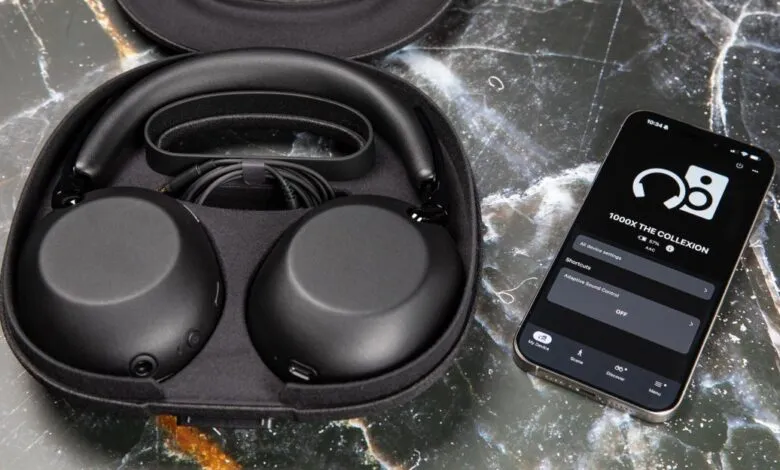
Visually, the 1000X borrows from both the XM6 and the original 1000X design. An exposed metal headband and ear cups wrapped in vegan leather give them a textured, refined look compared to the smooth plastic of the XM6. The same material covers the ear pads and headband cushion. Sony says the head cushion padding is about 40 percent thicker and 10 percent wider than the XM6’s, and the ear cushions offer a bit more interior space for a better fit. The ear cup housing is also 5mm slimmer, contributing to a sleeker profile. The padding is easily removable and replaceable, though replacement pricing is still undecided.
The build quality is noticeably upgraded. The stainless steel joints and headband support replace plastic, and the headband frame sits on the exterior of the padding rather than inside. The joints swivel but don’t fold, so the headphones lie flat like the WH-1000XM5, taking up a bit more space than the folding XM6. All buttons and cable ports are also metal, creating a cohesive, streamlined look. I wish Sony offered more than black and white, though. A restrained aesthetic is fine, but a few color options could make these a bolder accessory.
The metal headband adjusts smoothly, but the added structure comes with weight. The 1000X tips the scales at 320 grams, up from the XM6’s 253 grams. That’s still lighter than the AirPods Max 2’s 386 grams, but after about 90 minutes of wear, I felt noticeable pressure on the top of my head.
The design changes also affect noise cancellation. The 1000X uses the same QN3 processor and 12-mic system as the XM6, so active noise cancellation is identical. However, the thinner ear cups reduce passive isolation, especially in the midrange and higher frequencies. As a result, overall noise cancellation is weaker than the XM6.
The slimmer housing also means less space for the battery. Sony claims 24 hours of playback with ANC on, compared to the XM6’s 30 hours. Fast charging is less efficient too: a five-minute charge gives 1.5 hours of playback, while the XM6 gets three hours from just three minutes.
On the audio side, Sony has fitted the 1000X with newly designed unidirectional 30mm carbon fiber drivers, along with its “most advanced” DSEE sound processing and a new V3 integrated processor. The sound is slightly clearer in the lower midrange, and there’s a bit more sparkle at the high end compared to the XM6. On The Black Crowes’ “Sometimes Salvation,” the opening vocals cut through the guitar texture more cleanly, and the distorted guitar solo has greater presence. Still, the difference is subtle. Both headphones sound excellent.
Sony also added music and game 360 upmix modes to the cinema mode found on the XM6. This feature takes stereo audio and tries to create a 3D soundscape. I’m not a big fan , it tends to boost high frequencies and doesn’t feel as immersive as true spatial audio mixes.
The carrying case is another unique touch. It’s similar in size to the XM6’s case but has a cutout handle that makes it look more like a small bag than a typical headphone case. A magnetic clasp keeps it securely closed; even after vigorous shaking, the headphones stayed put.
The Sony 1000X are comfortable, stylish, well-built, and sound great. But I’m not entirely sure who they’re for. The XM series has always been synonymous with top-tier noise cancellation, but the redesign compromises that strength. The price puts them out of reach for most buyers. And maybe that’s the point. The 1000X are a celebration of a decade of innovation, not an evolution. If you want comfortable, functional, and great-sounding headphones, the WH-1000XM6 remain the smarter choice.
(Source: The Verge)