Voi founders’ AI startup Pit becomes Stockholm’s latest rising star

▼ Summary
– Pit is a Swedish AI startup, led by former Voi co-founders and backed by a16z’s $16 million seed round, targeting enterprise automation.
– Pit’s product uses Pit Studio and Pit Cloud to learn client processes and create custom software for automating back-office tasks.
– The startup is piloting with telecom, healthcare, and logistics firms, focusing on internal process automation rather than customer-facing AI.
– Pit is hiring solution engineers to embed with clients, emphasizing outcome-based value like productivity gains over job cuts.
– Pit’s European base offers an advantage in sales, with clients valuing its agnostic approach to using EU models and compute for sovereign tech needs.
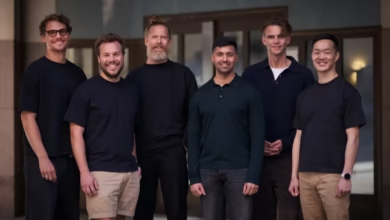
A Swedish startup called Pit, initially known for provocative social media posts, has quietly become one of Stockholm’s most promising new AI companies. Led by the co-founders of the European scooter giant Voi, including former CEO Fredrik Hjelm, and backed by top engineers from iZettle and Klarna, Pit has secured a $16 million seed round led by the venture capital powerhouse a16z. Stockholm, already home to the AI sensation Lovable, continues to attract top-tier investors searching for Europe’s next unicorn.
Pit focuses on enterprise AI, building software that learns how a client’s business operates and then creates custom tools to automate key processes. CEO Adam Jafer, who spent seven years at Voi scaling it to nearly 1,000 employees across 13 countries, explained that he left last summer after recognizing that AI had matured enough for serious corporate use. Initially, he saw an opportunity to replace simple SaaS tools with internal apps, but the vision quickly expanded.
“The aha moment for the bigger opportunity was when the models were no longer just chatbots that generate text, but became more agentic and could do things,” Jafer told TechCrunch. Unlike competitors offering AI agent-building or vibe-coding platforms, Pit positions itself as an “AI product team as a service.”
The startup enters a crowded market but aims to stand out with two core offerings. Pit Studio allows enterprise employees to guide the system through processes that could be automated with AI-generated software. Pit Cloud then delivers that software in a way that meets strict enterprise standards for governance, certifications, and auditability.
Testing began in mid-January with pilot customers in telecom, healthcare, and logistics, focusing exclusively on internal operations. “Nothing customer facing, no conversational AI, just pure back-office, service, and support functions that we turn into automations so that you can give back time to people to focus on your core business,” Jafer said.
Now preparing for commercial scale, Pit is hiring solution engineers and following the trend of AI companies embedding forward-deployed engineers to drive enterprise adoption. Jafer emphasized that the goal is not job cuts. “They’re looking to buy outcomes. They want processes to go faster. They want to see productivity unlock and time unlock,” he said. Success metrics include quality improvements and error reduction, not just cost savings.
However, Pit faced controversy a few months ago when Jafer posted on LinkedIn that the team had no junior engineers because “agents now do most of what junior engineers used to do.” He now says that stance has evolved. “It may have started like that, but you need a good mix as you scale,” he said with a smile.
Another early post from Hjelm acknowledged the all-male founding team, writing on X that Pit was “founded by tech bros, from Voi and Klarna,” but quickly added, “We have tech girls on the team as well, fyi.” That clarification was not immediately visible on LinkedIn, though TechCrunch confirmed one woman works at Pit in communications.
Still, the team reflects a reunion of Voi’s founding circle. Three of the four co-founders , Hjelm, Jafer, and Filip Lindvall , are now involved, along with Hjelm’s brother Andreas. Fredrik Hjelm remains CEO of Voi, which has been profitable since 2024 and is considered a potential IPO candidate. His role at Pit is likely less hands-on for now, but his connections proved valuable in securing a16z’s backing.
Hjelm explained on X that he had met a16z partners Ben Horowitz, Gabriel Vasquez, and Jen Kha “a few years ago when they came to Stockholm to understand what they could do for European tech. We stayed in touch. When it came to picking partners for Pit, we didn’t need the money to get going, but we wanted the strongest backers we could find. So we picked them, and they picked us.”
Jafer confirmed that Pit spent little time courting other investors. The round also included Pit’s founders, Lakestar, American tech executives, and wealthy Nordic families. This transatlantic cap table underscores growing interest in Stockholm’s AI ecosystem, which has solidified its position as one of Europe’s most active startup hubs.
Pit may also benefit from its European roots when selling to industrial clients. “We’re going after industrials, and there’s plenty of that in Europe,” Jafer said. He noted that clients appreciate the startup’s agnostic approach, using different AI and cloud vendors based on preferences. This flexibility aligns with the rising demand for sovereign technology in critical sectors. “EU models running on EU compute is top of mind for almost every CIO we’re meeting,” Jafer said.
(Source: TechCrunch)