Khosla-Backed Genesis AI Goes Full Stack With New Demo
▼ Summary
– Genesis AI raised a $105 million seed round and unveiled its first model, GENE-26.5, along with in-house designed robotic hands that mimic human hand size and shape.
– The company decided to build its own hardware to gain control over data collection and reduce the “embodiment gap” between human and robot actions.
– The robotic hand performs complex tasks like cooking, playing piano, and lab work, while a sensor-loaded glove collects human data for training.
– Genesis uses simulation to speed up model iteration, with data from human videos and potential third-party partners to build a “human skill library.”
– The startup has offices in Paris, California, and London, employs 60 people, and plans to release a full-body general-purpose robot while focusing on building the most capable robotic system.
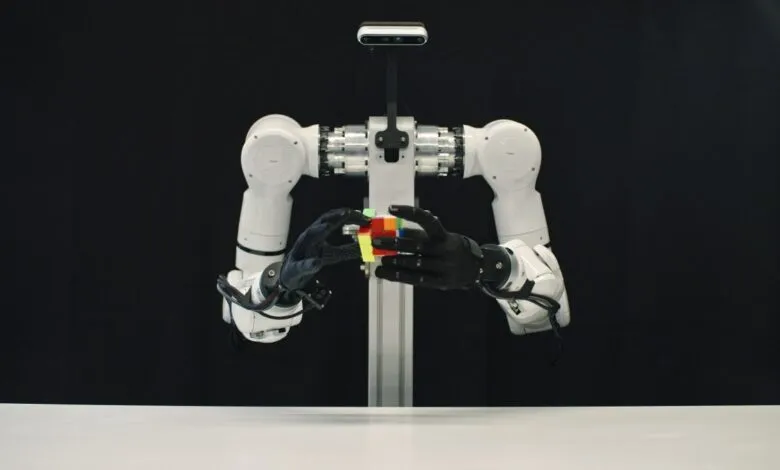
Genesis AI, the robotics startup that secured a massive $105 million seed round backed by Khosla Ventures, has stepped out of stealth mode with its first major reveal. The company introduced GENE-26.5, its foundational AI model for robotics, and it came with an unexpected feature: a fully functional pair of robotic hands designed entirely in-house.
In a newly released demo video, the system performs a wide range of complex physical tasks, from cooking and piano playing to lab work and solving a Rubik’s cube. While the model has always been the primary focus, co-founder and CEO Zhou Xian explained that the team quickly realized hardware limitations could not be ignored. “The model has always been the goal, because a better model means better intelligence,” Xian told TechCrunch. “So we decided to go full stack.”
Genesis now joins the ranks of other well-funded players at the intersection of AI and robotics, including Physical Intelligence and Skild AI. Xian acknowledged the crowded field, noting that “there’s probably 50 or 100 robotic hand companies out there.” Still, he and co-founder Théophile Gervet believe that building their own hardware gives them a distinct advantage.
What sets Genesis apart is the design of its robotic hand. Unlike the two-finger grippers commonly used in the industry, Genesis’ hand mirrors the size and shape of a human hand, narrowing the gap between simulation and reality. “That lets us collect a lot more data than was previously possible, to train a model that can do many more tasks,” said Gervet, a former research scientist at Mistral AI who now serves as Genesis’ president.
Among the tasks demonstrated, Gervet’s personal favorite is cooking, because it requires completing a long sequence of difficult actions, such as cracking an egg and slicing a tomato. Other demos include preparing smoothies, playing the piano, and the classic robotics benchmark of solving a Rubik’s cube. Some tasks, like lab work, point more directly toward commercial applications.
Behind the scenes, Genesis has also developed a sensor-loaded glove that acts as a real-world counterpart to its robotic hand. This glove collects data that can be directly transferred to the robot, bypassing what researchers call the “embodiment gap.” “Our idea was that if we could design a robotic hand that tries to mimic a human hand as much as possible, we can instantly unlock huge amounts of human data,” Xian said.
While other companies have attempted similar approaches, Genesis’ novelty lies in combining this hardware with its AI model. The current version, GENE-26.5, is named for May 2026, but Xian expects frequent updates thanks to the company’s simulation system. “The real bottleneck for the iteration speed of the model is evaluation. So this helps us speed up model training a lot,” he explained.
Data remains the key ingredient for improving robot performance. The glove, according to Gervet, is lightweight and comfortable to wear, unlike bulky data collection devices. “We’re in talks with a lot of customers right now,” he said. “For the first time, you can wear the data collection device when you’re doing your daily job, whether it’s a lab technician for pharma or for manufacturing.” This would be supplemented by egocentric video data from people filming themselves performing tasks.
However, questions remain about whether workers will be willing to wear the gloves and cameras that could train robots to eventually replace them, and whether they will receive additional compensation. Gervet acknowledged this is not yet resolved: “We haven’t nailed the details yet.” The startup could also pay third-party partners to collect data or rely on its model’s training on “massive amounts of human-based internet videos,” as stated in a press release that did not mention compensation.
Combined with its simulation system, these data sources could help Genesis lower costs for real-world applications. Eric Schmidt, former CEO of Google and an investor in the startup, called the demo “an important milestone for their team and the robotics industry more broadly.”
Genesis emerged from stealth in July 2025, just months after its founding, with a $105 million seed round co-led by Eclipse and Khosla Ventures. Other backers include Bpifrance, HSG, and individuals such as Xavier Niel, Daniela Rus, and Vladlen Koltun. The company has since grown its team to 60 people, with offices in Paris, California, and a new location in London. “One big reason we decided to be in Europe is there is a huge talent density across the whole continent,” Gervet said. The team is split roughly 40-45% in Europe and 50-55% in the U. S., and hiring is ongoing in all three locations.
Looking ahead, Genesis plans to reveal its first general-purpose robot, which Xian described as a full-body system, not just hands. Still, he emphasized that the company’s roadmap remains unchanged. “Our goal is to build the most capable robotic system,” he said.
(Source: TechCrunch)