DJI Avata 360 Drone Offers Enhanced Flexibility
▼ Summary
– The DJI Avata 360 is a new 360-degree drone that launches after a competitor’s model and faces a de facto sales ban in the US, preventing an official release there.
– Outside the US, it competes favorably by being faster, offering dual 360 and traditional FPV modes, and providing multiple control options including goggles and motion controllers.
– It is significantly cheaper than the Antigravity A1, starting at about $540 for the drone alone, though a full bundle with goggles and controller brings the price closer to $1,100.
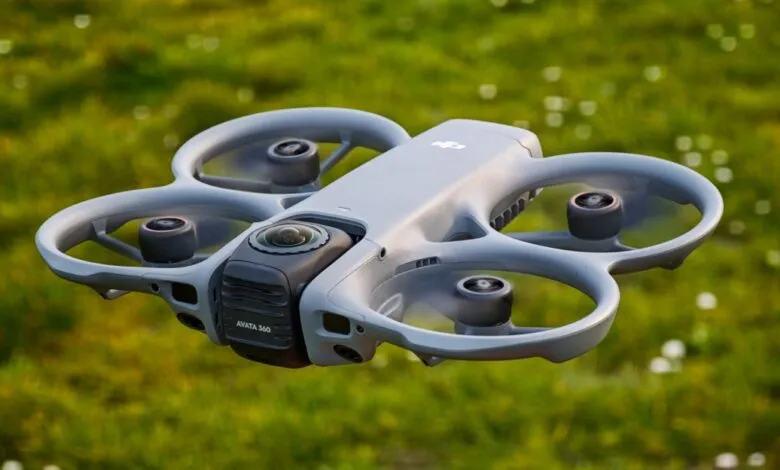
– Key technical features include user-replaceable lenses, built-in propeller guards, omnidirectional obstacle avoidance, and a swiveling gimbal that allows for single-lens forward filming.
– The drone is heavier (455g) than the foldable A1, placing it above a key 250g regulatory threshold, but it has a longer range and higher top speed.
The global drone market presents a complex picture for DJI’s latest release. The Avata 360 arrives as a compelling product for most international buyers, yet its launch is shadowed by regulatory hurdles and a competitor that beat it to market. For American consumers, the situation is particularly stark: this model is likely the final DJI drone to receive FCC clearance, meaning it won’t see an official stateside release, though importers may offer a path to ownership. Elsewhere, the Avata 360 makes a strong argument for itself against the pioneering Antigravity A1, blending superior performance with greater versatility at a significantly lower price point.
Available now in China with global shipments expected in April, the Avata 360’s pricing structure is a key advantage. The drone alone starts at approximately $540, far below the $1,599 entry point for Antigravity’s cheapest bundle, which includes goggles and a controller. DJI’s Motion Fly More Combo, priced around $1,100 with Goggles N3 and an RC Motion 3 controller, remains considerably more affordable. It’s worth noting that a bundle with DJI’s higher-end Goggles 3 isn’t offered, which would narrow the price gap with Antigravity’s premium headset.
Fundamentally, both drones serve the same core purpose: capturing immersive 8K 360-degree footage. They are compact flying cameras that let pilots record everything and creatively reframe shots in post-production. The similarities end there. The Avata 360 is heavier at 455 grams, placing it above the crucial 250g regulatory threshold that affects flight rules in many regions. Its body is fixed, not foldable like the A1, but this design incorporates built-in propeller guards for added durability.
Performance metrics favor DJI’s offering. The Avata 360 boasts a longer maximum range of 20 kilometers and a higher top speed of 18 meters per second in sports mode. This extra power translates to a more responsive, less floaty flight feel compared to the Antigravity drone. Battery life is nearly identical, with both models offering just over 20 minutes of flight time.
Where the Avata 360 truly differentiates itself is through enhanced flexibility. Its dual-camera system is mounted on a swiveling gimbal, allowing pilots to rotate both lenses to face forward for a traditional FPV drone experience. In this single-lens mode, it captures standard 4K footage at 60fps. The Antigravity A1 lacks this capability entirely, as its cameras are fixed in place solely for 360-degree capture. DJI also supports a wider array of control methods, from smartphone apps to traditional twin-stick controllers and motion-controlled goggles, catering to both beginners and advanced pilots.
Another significant advantage is user-replaceable lenses. Each of the two main lenses features an outer element that can be easily popped out and swapped using a basic, affordable tool kit from DJI. This simple process, taking mere minutes, dramatically improves the product’s long-term repairability and reduces the cost of potential accidents.
While the drone hardware excels, DJI’s companion app remains a noted weakness, particularly on Android devices where it can be buggy and unstable. For polished, intuitive editing of 360 footage, Antigravity’s software currently holds an edge. However, for most buyers outside the United States, the Avata 360’s combination of power, dual-use functionality, and lower cost presents a compelling package that is difficult to overlook.
(Source: The Verge)