New Magnetic Cloak Could Hide Sensitive Tech From Detection
▼ Summary
– Researchers have developed a concept for a magnetic “invisibility cloak” that can shield complex-shaped objects from external magnetic fields.
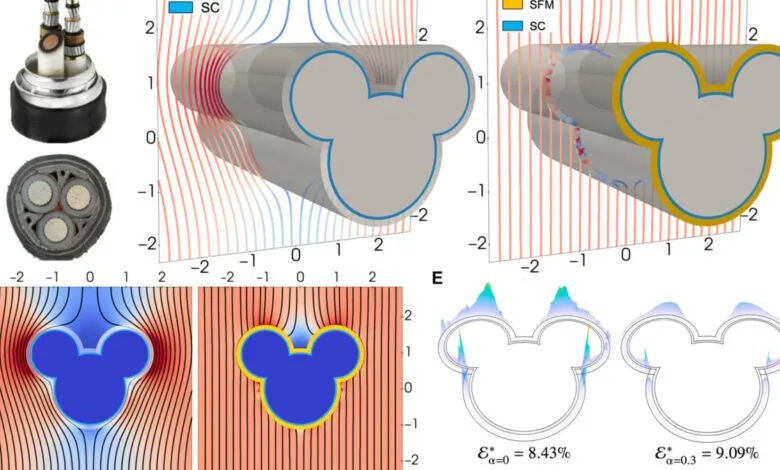
– This cloak combines superconductors to expel magnetic fields with soft ferromagnets to smoothly reroute the field lines, making the object undetectable.
– Unlike previous limited designs, this is the first demonstration of a cloak that works for any object shape, not just simple cylinders or spheres.
– The concept remains theoretical and requires extremely cold temperatures for the superconductors to function, though supporting cryogenic technology exists.
– The team’s next step is to physically fabricate and test these cloaks for potential real-world applications in science, medicine, and industry.
A new approach to magnetic cloaking promises to shield sensitive equipment from disruptive fields, offering a potential leap forward for industries reliant on precise electronic systems. This innovation moves beyond theoretical models to present a design adaptable to virtually any object’s shape, overcoming a major limitation of previous research. The concept could one day protect critical infrastructure in hospitals, power grids, and aerospace systems from the signal interference and data corruption caused by stray magnetism.
The core challenge lies in the pervasive nature of magnetic fields. As a fundamental force, magnetism is manipulated by technologies from MRI machines to data storage drives, but unwanted fields remain a significant source of operational problems. They can distort readings, introduce errors, and lead to equipment failure. Traditional attempts at magnetic cloaking have only succeeded with simple, symmetrical shapes like cylinders or spheres, which severely restricts their practical application.
This new blueprint breaks that mold by proposing a hybrid material system. The design strategically combines superconductors with soft ferromagnets to create an effective shield. The superconductor acts to repel incoming magnetic fields, while the ferromagnetic component smooths and redirects the distorted field lines around the cloaked object. The combined effect makes the external magnetic environment behave as if the protected item simply isn’t there, effectively rendering it magnetically invisible.
A key detail is that the superconducting materials involved require cryogenic, or extremely cold, conditions to function. The research team notes this is not a prohibitive barrier, as support industries for cryogenics and superconductivity are already mature and operational for other technologies. The immediate next phase involves moving from concept to physical prototype. Researchers plan to fabricate and test cloaks using high-temperature superconducting tapes and soft magnetic composites, with the goal of transitioning the designs into real-world testing environments.
This advancement signals a shift from idealized laboratory conditions to engineering solutions meant for complex, real-world geometries. By making magnetic cloaking a manufacturable possibility, the path is opened for next-generation shielding that could safeguard sensitive scientific instruments, improve medical imaging accuracy, and enhance the reliability of industrial control systems.
(Source: Gizmodo)