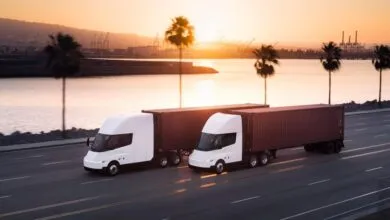
Tesla Cybertruck faces major infrastructure hurdles
▼ Summary
– Tesla CEO Elon Musk aims to rebrand the company as a robotics and autonomous vehicle firm targeting a $20 trillion valuation.
– Tesla officially launched high-volume production of the Tesla Semi at an invite-only event in Sparks, Nevada, focusing on fleet operators.
– The long-range Tesla Semi offers an estimated 500 miles per charge, matching the daily average for US long-haul truckers.
– Electric semis face challenges in the US market due to high upfront costs and a lack of widespread specialized charging infrastructure.
– Elon Musk did not attend the launch event, which coincided with his presence at a state dinner in China featuring President Xi Jinping.
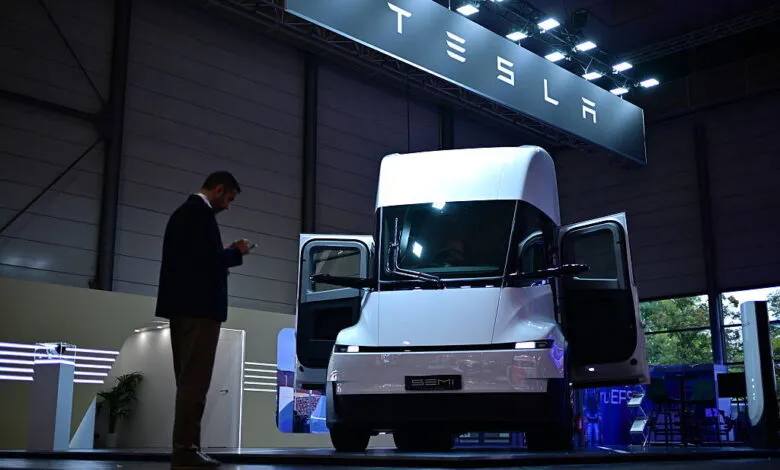
Tesla is attempting to pivot its identity from a mere car manufacturer to a leader in robotics and autonomous driving, a strategy that has fueled CEO Elon Musk’s ambition for the company to reach a staggering $20 trillion valuation. This figure, which would make Tesla nearly four times more valuable than semiconductor giant Nvidia, stands in contrast to the reality of Thursday’s event in Sparks, Nevada. Instead of discussing futuristic AI or humanoid robots, the spotlight fell squarely on a tangible product: the long-awaited Tesla Semi.
The electric truck’s journey began with a concept reveal in late 2017, but it took nearly a decade for the vehicle to enter high-volume production. The official launch occurred at an invite-only, livestreamed event held at Tesla’s factory, targeting fleet managers who are increasingly focused on reducing operational costs. A small group of early adopters was invited onto the stage to acknowledge their orders, set against a backdrop of pulsing techno music.
Musk did not attend the event personally, choosing instead to participate in a White House dinner with Chinese President Xi Jinping. His presence was felt through a pre-recorded message played during the ceremony. “It’s going to be, really, a driver’s truck. It’s like a sports car in truck form,” Musk stated in the video.
Technical specifications released at the event highlight significant improvements over previous estimates. Lars Moravy, Tesla’s vice president of Vehicle Engineering, confirmed that the long-range model will achieve an estimated 500 miles per charge. This range aligns closely with the average daily distance covered by US long-haul truckers. The standard version is expected to deliver approximately 325 miles on a single charge. These figures aim to compete with other electric vehicles in the market, which currently advertise ranges between 155 and 430 miles.
Despite these advancements, the Tesla Semi faces substantial infrastructure challenges. While electric heavy-duty trucks have captured nearly 30 percent of sales in China, adoption in the United States remains sluggish. Manufacturers struggle to justify the higher upfront costs, which can be two to three times greater than traditional diesel models. Furthermore, the lack of a robust charging network hinders widespread deployment. Large batteries require specialized megawatt chargers capable of replenishing energy in hours rather than days. Currently, only two such public chargers are operational in the Los Angeles area. However, Dan Priestley, who leads Tesla’s Semi program, announced plans to expand this infrastructure significantly, aiming to open 30 new stations by the end of the year.
(Source: Ars Technica)