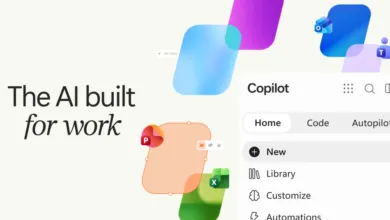
Microsoft Copilot app brings everything to one place

▼ Summary
– Microsoft has launched a unified Copilot client that serves both consumer and enterprise users, replacing its previously fragmented app lineup.
– The new application features three main tabs: Home, Code, and Autopilot, with the design remaining consistent across personal and work accounts.
– Enterprise functionality is powered by secure Work IQ APIs that provide compliant access to organizational data stored in Microsoft 365 services like Outlook and SharePoint.
– Executive VP Jacob Andreou emphasized that the product aims to deliver full enterprise-grade capabilities to consumers who pay for their own subscriptions.
– The company is adopting an evolving cost model that includes usage-based billing for key features as it expands the app from mobile to desktop environments.
Microsoft has consolidated its fragmented artificial intelligence offerings into a single, unified application for both consumer and business users. The latest release of this Copilot client introduces significant new capabilities, including dedicated tabs for coding and autonomous agents, while shifting toward an evolving cost model that incorporates usage-based billing for advanced features. For years, the company’s AI strategy was split between distinct interfaces for personal chatbots and enterprise tools, creating a disjointed experience. Now, with the desktop version joining earlier mobile releases, Microsoft aims to provide a cohesive platform centered on the Microsoft 365 ecosystem.
A Unified Interface for Enterprise and Consumer Needs
The newly redesigned Copilot app is built primarily with enterprise customers in mind, targeting organizations deeply integrated into Outlook, Teams, Word, Excel, and PowerPoint. It emphasizes secure data handling within controlled environments, ensuring that sensitive corporate information does not leave the organization’s cloud infrastructure. While the interface remains consistent regardless of whether a user signs in with a personal or work account, the underlying access differs significantly for business users. Work accounts utilize Work IQ APIs to grant compliant access to vast repositories of data stored in SharePoint, OneDrive for Business, Dynamics 365, and other enterprise services.
During a launch event for key customers, Jacob Andreou, Executive VP of Copilot, addressed the distinction between market segments. He highlighted that approximately 90 million consumers pay for Microsoft 365 subscriptions personally. These users seek robust functionality rather than simplified versions of enterprise products.
> “These folks don’t want some kind of dumbed-down consumer product; they want the full power that we offer to enterprise users, but in the context of their personal life.”
Andreou also noted recent improvements in the platform’s performance, stating:
> “In the last few months, Copilot has gotten actually really good. It’s faster, it’s more capable, it’s more coherent and unified than ever before. … And users have really noticed.”
The application now features three primary tabs: Home, Code, and Autopilot. This structure replaces the previous separation between Chat and Cowork functionalities, merging conversational AI with agentic task completion into a single workflow.
Enhanced Productivity and Secure Coding Environments
The Home tab integrates conversational queries with agentic actions, allowing users to generate document drafts or complete complex tasks without switching applications. A notable addition is the Office in Copilot feature, which enables users to create editable documents, spreadsheets, and presentations directly within the chat interface. Chief Marketing Officer Jared Spataro emphasized this capability as a key differentiator, allowing seamless collaboration alongside the AI conversation. Additionally, a proactive Today view is scheduled for private preview in October, offering a personalized command center for mail, calendar events, and tasks across Teams and Outlook.
For developers, the new Code tab provides a sandboxed environment powered by the same technology behind GitHub Copilot. Unlike competitors such as Anthropic’s Claude Code, which often runs locally in isolated containers, Microsoft’s solution hosts code generation securely within the Microsoft 365 tenant. This architecture appeals to regulated industries concerned about compliance and governance when data moves off-premise. Users can build apps, trackers, dashboards, and automations using prompts, with the resulting applications running on the Microsoft Copilot Managed Runtime. Broad availability for this feature is expected in the coming weeks for frontier customers, with wider access for Premium and Pro subscribers later this year.
The Autopilot feature, formerly known as Scout, represents Microsoft’s entry into the autonomous agent space. Described as a “digital teammate,” these agents possess memory, independent computing resources, and dedicated Outlook and Teams accounts. Crucially, they are managed by IT administrators through strict permissions and audit trails, mitigating risks associated with uncontrolled automation.
Shifting Financial Models and Cost Management
Microsoft is transitioning its pricing structure to accommodate these advanced capabilities, moving away from flat fees for certain high-intensity functions. The new financial framework consists of two models. A User Subscription License (USL) provides fixed monthly access to chat-based features, Office integrations, and model selection. However, agentic features including Cowork, Code, and Autopilot require usage-based billing (UBB).
This shift introduces complexity for enterprise finance teams responsible for profit and loss statements. To mitigate unexpected costs, UBB services are disabled by default. Administrators can establish spending policies and limits during deployment. Furthermore, Microsoft introduced Agent 365 tools under its FinOps for AI initiative, providing detailed spending reports for admins and real-time credit monitoring for end users. Despite these controls, the ultimate return on investment and total cost remain uncertain for many organizations. As the announcement concluded, no one can definitively predict the final financial impact of adopting these expansive AI capabilities.
(Source: ZDNet)