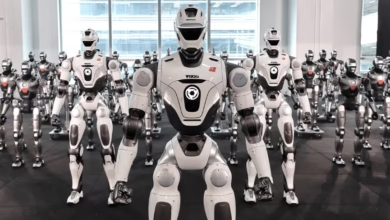
China’s Robot Games: Humanoids Beat Bolt, Master Tweezers

▼ Summary
– The World Humanoid Robot Games concluded in Beijing on August 26, featuring over 600 teams and 2,000 robots from China and fifteen other countries.
– Competitors showcased advanced hardware and algorithmic innovations through various challenges designed to accelerate the practical deployment of humanoid systems.
– Record-breaking athletic feats were highlighted, including Tiangong Ultra running the 100-meter dash in 8.86 seconds and Honor’s Lightning finishing in 9.47 seconds.
– The event balanced high-performance achievements with moments of robot malfunction, such as weightlifting failures, which drew significant online attention.
– Organizers utilized the competition to push manufacturers toward developing more reliable and deployable humanoid robots for real-world applications.
The World Humanoid Robot Games have firmly established themselves as a premier event in the technology calendar. Held in Beijing and concluding on August 26, this year’s competition demonstrated that the race toward practical humanoid deployment is accelerating rapidly. The event showcased not only record-breaking speed but also complex dexterity tasks, such as manipulating tweezers, while highlighting the ongoing challenges of reliability and balance.
Organizers reported an unprecedented scale for the inaugural games, with more than 600 teams and over 2,000 robots participating. The influx of talent included representatives from 15 other countries, joining the vast ecosystem of more than 100 domestic manufacturers based in China. This global convergence underscores the intense interest in humanoid robotics and the competitive drive to solve remaining engineering hurdles.
Speed Records and New Challenges
The competition featured a diverse array of tests designed to evaluate both raw performance and nuanced control. One of the most dramatic moments involved weightlifting attempts, where some machines failed spectacularly, providing a reminder of the difficulties in managing heavy loads. However, the focus remained largely on precision and speed.
A standout achievement was the performance of the Tiangong Ultra, developed by the Beijing Humanoid Robot Innovation Center. This machine completed the 100-meter dash in just 8.86 seconds, setting a new benchmark for humanoids. This feat surpassed the previous record held by Lightning, a robot from smartphone maker Honor, which clocked in at 9.47 seconds earlier in the week. These times rival those of elite human athletes, signaling significant progress in locomotion algorithms and hardware efficiency.
Beyond speed, the games introduced new challenges that hinted at future commercial applications. Tasks requiring fine motor skills, such as using tweezers, tested the robots’ ability to handle delicate objects without damage. These exercises are critical for transitioning humanoid robots from laboratory curiosities to useful tools in industrial and service environments. The inclusion of such varied contests reflects the industry’s goal of developing systems capable of operating safely and effectively in real-world scenarios.
As the dust settled on the opening ceremonies and initial heats, it became clear that the World Humanoid Robot Games are more than a spectacle. They serve as a crucial proving ground for companies striving to refine their technologies. With thousands of robots vying for supremacy, the event highlighted both the remarkable capabilities and the persistent glitches that characterize this emerging field. The data gathered here will likely influence development priorities across the sector, pushing engineers to address issues of stability, dexterity, and energy efficiency.
(Source: Wired)