Siemens Deploys Nvidia-Powered Humanoid Robot
▼ Summary
– Siemens, Nvidia, and Humanoid deployed an AI-powered wheeled humanoid robot in live logistics at a Siemens factory in Germany.
– The robot autonomously handled tote-destacking for over eight hours with a high success rate, integrated directly into Siemens’ production systems.
– The trial was significant for occurring in a live production environment alongside human workers, not in a controlled lab.
– The robot’s development used a simulation-first approach, compressing prototype development time to about seven months.
– The partnership aims to establish a replicable model for humanoid deployment to address manufacturing labor shortages.
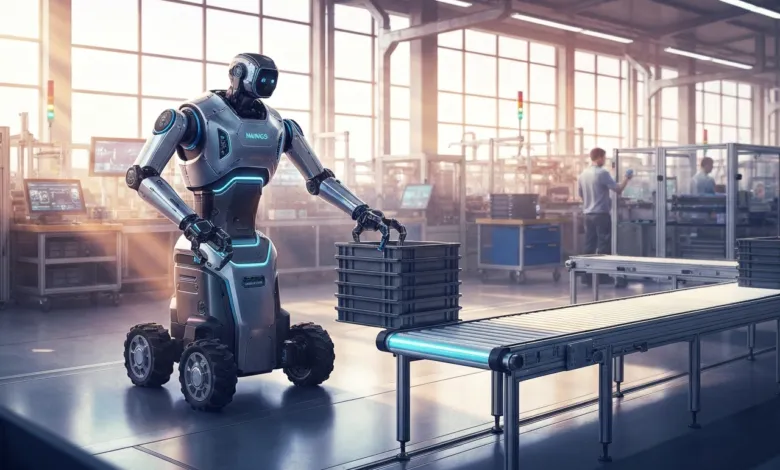
A major industrial milestone was reached earlier this year when a humanoid robot, powered by advanced AI, began operating autonomously within a live factory environment. In a significant collaboration, Siemens, Nvidia, and UK startup Humanoid successfully deployed the wheeled HMND 01 Alpha robot at a Siemens electronics facility in Erlangen, Germany. This was not a controlled lab test but a genuine production setting, where the robot performed logistics tasks for over eight hours with a pick-and-place success rate above 90%.
The robot’s task involved the repetitive but complex work of destacking storage totes, moving them to conveyor belts, and positioning them for human colleagues. This type of physically demanding logistics work has traditionally been difficult to automate fully due to unpredictable environments and the need for real-time coordination. The Erlangen deployment proved that AI-driven systems can now handle such variability while integrated directly into existing factory workflows.
Deep integration was key to this success. The robot was connected through the Siemens Xcelerator platform, which provided a digital twin, AI perception, and critical communication interfaces. This allowed the HMND 01 Alpha to coordinate seamlessly with other automated guided vehicles, production systems, and human workers on the floor. Stephan Schlauss, Global Head of Manufacturing Motion Control at Siemens, noted that the company used its own plant as “customer zero,” testing the technology internally before considering it for clients.
On the technology side, the robot leverages Nvidia’s physical AI stack, including the Jetson Thor system for edge computing and the Isaac Sim platform for simulation. A simulation-first development approach was crucial, enabling Humanoid to train and validate the robot’s behaviors in a virtual environment. This process reportedly compressed prototype development from a typical 18-24 month cycle down to roughly seven months.
Humanoid, founded in 2024, also produces a bipedal version of its robot. The wheeled model used at Siemens had previously completed a proof-of-concept with Schaeffler. The two-week trial in January, however, represented its most demanding real-world test to date. While the companies announced the results at Hannover Messe 2026, they were cautious about overpromising on future timelines, framing the event as a foundational milestone rather than announcing an immediate commercial rollout.
The broader implication is the creation of a replicable factory-grade model for humanoid deployment. This establishes a reference architecture that other manufacturers could follow. The initiative aligns with a growing industrial trend where humanoid robots are seen as a solution to labour shortages, particularly in manufacturing scenarios where fully rigid automation is impractical. These environments often require the flexibility to handle product variability, adhere to safety constraints, and enable true human-robot collaboration.
(Source: The Next Web)