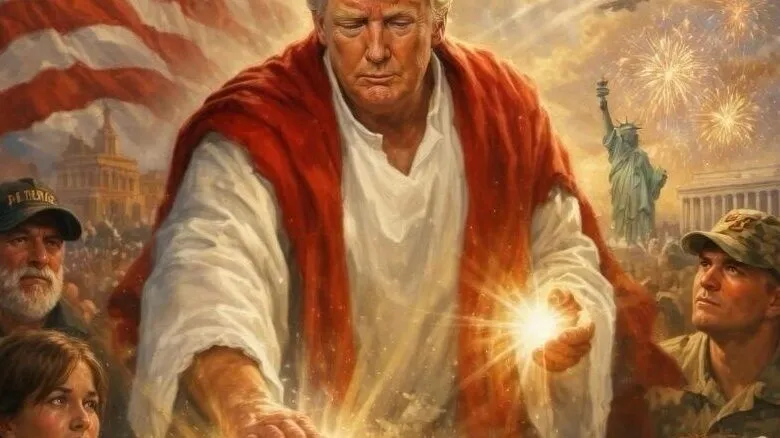
Trump Shares AI-Generated Art of Himself with Jesus
▼ Summary
– Donald Trump posted an AI-generated image of himself styled as Jesus Christ, which he later claimed he thought depicted him as a doctor.
– An analysis revealed the image was a modified version of an earlier post, with alterations including a figure transformed into a demon-like being and changes to details like hats and facial expressions.
– The scale and partnerships of White House Correspondents’ Dinner events signal media companies’ financial health, with tech firms often funding collaborations.
– Director Werner Herzog commented that the Trump administration’s meme use of a “deranged penguin” scene from his documentary was bizarre but a permissible, ephemeral internet phenomenon.
– A lengthy article searched for America’s best free restaurant bread, with the top choice located in Washington, DC, and a similar recipe shared for home bakers.
The intersection of political messaging and artificial intelligence took a surreal turn this week when a former president shared a digitally altered image depicting him in a divine role. Hours after criticizing the Pope, Donald Trump posted an AI-generated picture on his Truth Social platform showing him as a Christ-like figure healing the sick amid angels. When questioned by reporters, he claimed, “I thought it was me as a doctor.” The post drew sharp rebuke from some conservative commentators, with one suggesting it radiated “the spirit of Antichrist.”
Online investigators quickly noted the image was not original. A MAGA influencer named Nick Adams first posted a similar version in February. By the time it reached Trump’s feed, several strange alterations had been made. Most notably, a soldier in the clouds transformed into a faceless, spiky-headed winged creature many interpreted as a demon. Other subtle changes included extra stars on a flag, distorted fighter jets, blurrier background buildings, and more fearful expressions on every face, including Trump’s. One man’s hat even appeared to feature garbled text.
In Washington, the annual ritual of the White House Correspondents’ Dinner week offers a quiet barometer of media industry health. The scale and partnerships of surrounding events tell their own story. A downgrade from an embassy venue to a private reception signals trouble. Collaborations between media outlets and tech companies often mean the latter is footing the bill. This year’s notable pairings include YouTube and the financially strained C-SPAN hosting at a historic mansion, Washingtonian magazine co-hosting its lavish party with the Embassy of Qatar, and newsletter platform Beehiiv setting up a reception inside a retail watch store.
In a separate cultural moment, director Werner Herzog recently reflected on the unexpected online life of a scene from his 2007 documentary. Earlier this year, Trump administration social media teams used a clip of what Herzog calls a “deranged penguin” to create memes promoting nationalist ideology. In the film, the penguin that abandons its colony is described as running toward certain death, but the political memes reframed it as a symbol of nonconformist freedom. Herzog finds the phenomenon more puzzling than problematic. “Why is it that today after 18 years, all of a sudden, it explodes on the internet?” he asked. An advocate for free speech, he views the White House’s usage as “fair usage” and “rather hilarious,” noting the internet’s ephemeral nature made the trend vanish within days.
Finally, for culinary enthusiasts, a recent deep dive into America’s best free restaurant bread concluded with a winning choice located in Washington, D. C. The article sparked widespread discussion, and dedicated home bakers have since circulated a recipe said to be a very close approximation for those unable to visit the restaurant in person.
(Source: The Verge)