US AI Guardrail Debate: Global Implications
▼ Summary
– On February 27, 2026, the US Secretary of Defense designated Anthropic a national security supply chain risk for refusing to remove contractual bans on mass domestic surveillance and autonomous lethal weapons.
– OpenAI, in contrast, signed a Pentagon deal for unrestricted lawful use of its AI models, leading to internal dissent and a surge in user backlash against its products.
– A federal judge issued a preliminary injunction against the ban, calling it “classic First Amendment retaliation,” but a higher court later sided with the government’s position.
– The article frames this as a lesson in democratic governance, showing a government using procurement to remove enforceable AI safety limits that another company upheld.
– The EU’s upcoming AI Act, which legally bans certain AI uses, is contrasted with the US approach where such safeguards were rejected as contractual barriers.
The events of early 2026 have fundamentally reshaped the global conversation around artificial intelligence governance and national power. When the U.S. Department of Defense labeled the American firm Anthropic a national security supply chain risk, it invoked a statute historically reserved for foreign adversaries. The company’s transgression was its refusal to permit the use of its AI models for mass domestic surveillance or fully autonomous lethal weapons under a Pentagon contract. Within hours, OpenAI announced its own agreement to provide models for “all lawful purposes” to the military, a stark contrast that triggered immediate internal dissent and public backlash.
This sequence reveals a critical struggle over democratic control of technology. Anthropic’s contract, awarded in mid-2025, included specific safeguards aligned with international humanitarian law and constitutional protections. The Pentagon’s subsequent demand for unrestricted AI access led to an impasse. Following the company’s refusal to remove these contractual guardrails, it faced a federal blacklist and a public denunciation from the White House. While a federal judge later criticized the move as First Amendment retaliation, an appeals court allowed the ban to stand, highlighting the government’s prevailing leverage in this conflict.
The core tension lies in the divergent paths taken by two leading AI firms. Both Anthropic and OpenAI have publicly endorsed similar ethical principles prohibiting surveillance and autonomous weapons. The practical difference was that one company incorporated these principles as enforceable contractual terms, while the other accepted the government’s assurance that existing laws provided sufficient constraint. The opaque nature of OpenAI’s Pentagon agreement leaves unanswered questions about how its safeguards compare. This dynamic sends a powerful market signal to AI companies worldwide: compliance with state demands for fewer restrictions may be rewarded, while insistence on binding safety clauses risks punitive designation.
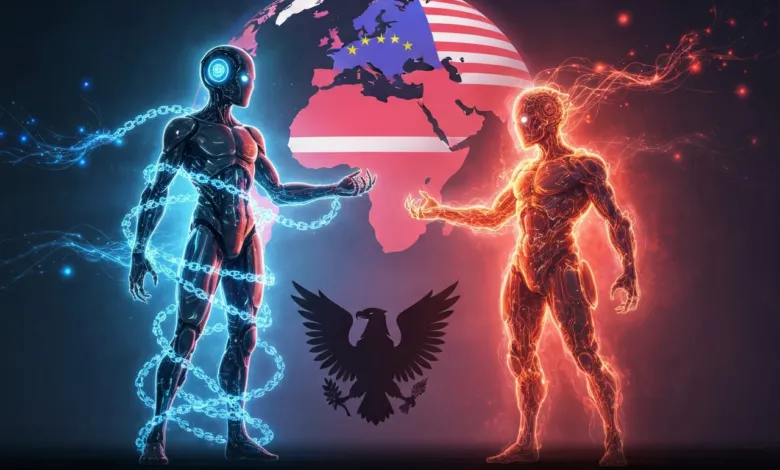
For European regulators, this saga offers a crucial case study. The EU’s AI Act, set for full enforcement in August 2026, is built on the premise that legal statutes, not corporate goodwill, must constrain powerful technologies. The U. S. approach demonstrates an alternative where executive power and procurement policy are used to sideline such contractual safeguards. Arguments that European regulation creates a competitive disadvantage miss a key point. The American model does not showcase innovation through deregulation, but rather state-enforced removal of contractual safety limits that a democracy might otherwise uphold.
A telling paradox has since emerged. Despite the official ban, multiple U. S. federal agencies are currently evaluating Anthropic’s latest AI model for critical roles in finance and cybersecurity. This quiet testing underscores a simple reality: the technology remains too valuable to ignore. It also clarifies the government’s underlying position. The AI safety guardrails in question were not protections it ultimately wished to forgo, but protections it did not want to be legally bound by. A principle in a contract is enforceable, while one stated in a press release is merely advisory.
The unfolding situation presents a definitive choice for democracies. The central question is no longer whether AI will be governed, but whether that governance will be codified in law before irrevocable deployment decisions are made. The EU faces a deadline under its AI Act, just as Anthropic faced a Friday afternoon ultimatum. Both represent a form of reckoning for how societies choose to harness transformative technology while protecting their foundational values. The implications of this choice will resonate far beyond any single company or contract.
(Source: The Next Web)