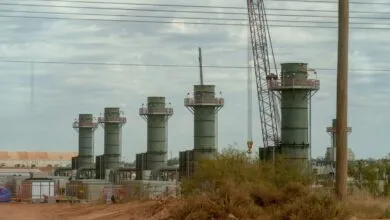
Nvidia’s $500B bet pays off for aging GPUs

▼ Summary
– Nvidia announced that Apollo, BlackRock, Blackstone, Brookfield, Goldman Sachs, and KKR may commit up to $500 billion to build AI data centers, with Nvidia guaranteeing up to 25% of any shortfall in GPU collateral value.
– The plan aims to create a secondary market for aging GPUs, ensuring their residual value and sustaining demand for Nvidia hardware over time.
– Nvidia faces “wrong way” risk, where its obligations increase as demand weakens, potentially squeezing revenues during downturns.
– Unlike Lucent Technologies, which collapsed after lending customers money, Nvidia shifts most capital and risk to institutional investors, only covering a portion of chip value losses.
– Huang promotes AI infrastructure as long-term “investable infrastructure,” likening servers to railroads, so that aging chips can be reused by different customers, protecting their value.
Nvidia this week revealed that Apollo, BlackRock, Blackstone, Brookfield, Goldman Sachs, and KKR have agreed to commit as much as $500 billion toward building AI data centers. The staggering figure captured headlines, but the more significant development lies in Nvidia’s push to establish a secondary market for older GPUs.
To win over those heavyweight financial backers, Nvidia has pledged its own capital to guarantee that chips used as loan collateral will hold their value over time.
Commentary has poured in describing the plan as unconventional, shrewd, and risky. It is all three. Bond markets grew uneasy enough that CEO Jensen Huang took to X and business television to clarify how Nvidia’s exposure would remain contained.
Yet beneath the financial engineering aimed at funding AI infrastructure, and keeping Nvidia’s revenue engine running, sits something arguably more compelling for startups and enterprises. Huang wants a thriving resale market for used AI hardware, one that keeps demand for Nvidia gear alive long after its newest silicon ships.
Here is how it works. If GPUs posted as collateral fail to retain their projected value, Nvidia has agreed to cover up to 25% of the shortfall. Should a data center operator default and a lender move to liquidate, but the chips fetch less than their book value, Nvidia steps in to bridge the gap.
The peril for Nvidia is what financiers call “wrong way” risk. As demand weakens, Nvidia’s obligations grow. And when demand fades, its revenues are likely to shrink too.
Still, the structure is deliberately distinct from the Lucent Technologies comparison that some observers have raised. Lucent, the telecom gear maker, soared and collapsed with the dotcom bubble after financing customer purchases of its own equipment.
Huang knows the Lucent shadow looms, and the comparison is not entirely unfair. Nvidia has committed billions to chip buyers, including frontier AI labs OpenAI and Anthropic, neoclouds such as CoreWeave, which pioneered using Nvidia chips as collateral, plus Nebius, Firmus, and Lambda. Bloomberg has calculated that Nvidia has been working on another $750 billion in circular deals this summer.
“Is this circular financing?” Huang wrote on X. “This initiative is designed to address that concern. We are bringing independent, long-term institutional capital into the AI infrastructure market.”
That much is accurate. Unlike Lucent, Nvidia is shifting the bulk of capital and risk onto others, simply by agreeing to protect a slice of its chips’ future value.
If the strategy succeeds, Nvidia will have unlocked fresh funding for AI data center construction just as traditional financing routes strain. Hyperscalers have already piled on debt, as Oracle has, issued new equity, as Google did, and burned through cash, as Meta continues to do.
The climate has grown tense enough that Microsoft CEO Satya Nadella recommended the book “1873” during his latest earnings call. It recounts the railroad-era financial schemes that crashed the U. S. economy.
The core risk is that today’s AI boom, where demand far outpaces supply, may not persist. What if enterprises and consumers temper their AI usage? What if new technologies make existing infrastructure more efficient, or render all of today’s AI hardware obsolete?
Then, like buggy whips facing the automobile, to borrow Danny DeVito’s Lawrence Garfield, demand collapses and everything comes tumbling down.
Huang argues that scenario won’t materialize. He frames AI as a long-term “investable infrastructure,” positioning his AI servers, which he calls “AI factories,” as assets akin to railroads or airlines rather than quickly depreciating gadgets like PCs.
“When needs change, the factory can be used by another customer, another cloud or another operator. This broad ecosystem gives NVIDIA compute a deep market of potential users and offtakers, helping protect residual value,” he promised.
In that vision, Nvidia cares as much about aging architecture as it does about new chips. Startups, enterprises, and researchers may tap into a wider range of hardware, each tuned to different AI workloads, much as they are already choosing affordable open-weight models alongside frontier options.
As the reigning king of AI, Nvidia holds the leverage, and the window, to make that happen.
(Source: TechCrunch)