How Xanadu’s CEO Became a Billionaire Without NVIDIA
▼ Summary
– Christian Weedbrook became a billionaire as Xanadu’s stock surged nearly fivefold after NVIDIA’s quantum computing announcements, though NVIDIA did not invest in the company.
– NVIDIA launched open-source AI models and a new hardware architecture to accelerate quantum computing by improving error correction, calibration, and GPU-QPU integration.
– Xanadu builds photonic quantum computers and reported $4.6 million in revenue against a large net loss, with its valuation far exceeding its current financials.
– Other quantum companies like IonQ and Rigetti also saw major stock gains, as NVIDIA’s move was seen as a sector-wide endorsement of near-term commercial relevance.
– Quantum computing stocks trade at extremely high revenue multiples despite projections that significant commercial applications are likely years away.
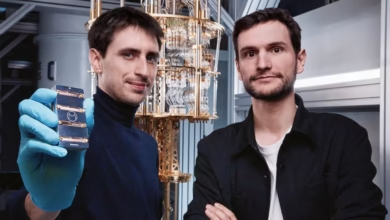
A Toronto-based quantum computing CEO has joined the billionaire ranks, and the catalyst came from an unexpected source. Christian Weedbrook, founder and CEO of Xanadu Quantum Technologies, saw his fortune surge past $1.5 billion this week, a direct result of his company’s stock multiplying nearly fivefold in just six trading sessions. The remarkable surge was not triggered by a company breakthrough, but by a strategic announcement from a technology titan in a different field. NVIDIA’s unveiling of new tools designed to accelerate quantum computing sent a shockwave through the entire sector, and Xanadu, as the sole publicly traded pure-play photonic quantum computing firm, became the most dramatic beneficiary of the rally.
Xanadu had only recently entered the public markets, completing a SPAC merger and listing on the Nasdaq and TSX in late March. Its shares were already trading above the IPO price when NVIDIA’s announcements began on April 14. What followed was a breathtaking ascent: gains of 17%, 28%, 29%, and then a staggering 70% in a single day, a move so volatile it prompted Canadian regulators to impose five separate trading halts. Since its debut, the stock has climbed roughly 194%.
The pivotal move from NVIDIA involved no direct investment in or partnership with Xanadu. Instead, the chipmaker made a series of announcements that collectively made the entire quantum computing field appear closer to practical utility than ever before, prompting the market to rapidly reprice every stock in the sector. The centerpiece was the launch of Ising, a suite of open-source AI models targeting the two core problems plaguing quantum advancement: error correction and calibration. NVIDIA claims these models are up to 2.5 times faster and three times more accurate than current standards, while reducing processor setup from days to hours. Simultaneously, the company introduced NVQLink, an open architecture for linking its industry-standard GPUs with quantum processing units, supported by a broad coalition of hardware builders and national labs. The implicit message was powerful: quantum computing is transitioning from pure research to an engineering challenge, and NVIDIA plans to be the essential bridge between classical and quantum systems.
While NVIDIA’s venture arm has placed direct bets on other quantum companies using trapped ion and neutral atom technology, it has not invested in Xanadu’s photonic approach. However, NVIDIA’s broad validation of the quantum sector and its specific release of enabling software were enough to ignite investor frenzy. Xanadu’s technology uses pulses of light to encode qubits, a method its advocates believe is more scalable because it can leverage existing semiconductor manufacturing. The company has demonstrated a system with 12 logical GKP qubits, a notable technical milestone, and has a roadmap targeting fault-tolerant systems by the end of the decade.
Financially, the company remains in an early, pre-revenue stage. It generated $4.6 million in revenue last year against a net loss of $70.7 million. Its value is underpinned by a roster of blue-chip partners like Lockheed Martin and AMD, and ongoing negotiations for nearly C$400 million in Canadian government co-investment. The disconnect is stark: a market capitalization that briefly exceeded $3 billion this week is supported by minimal revenue, illustrating the vast gap between the sector’s long-term potential and its current commercial reality.
Xanadu was far from alone in its surge. Companies like IonQ, D-Wave, and Rigetti all posted massive weekly gains, buoyed by NVIDIA’s implicit endorsement. The common thread is that when the undisputed leader in AI infrastructure signals its commitment to quantum integration, the market interprets it as a major step toward commercial viability. This reflects NVIDIA’s gravitational pull on technology investing; its strategic moves are now treated as leading indicators for entire emerging sectors.
This enthusiasm has produced eye-watering valuations. Several pure-play quantum companies trade at sales multiples that exceed the peak of the dot-com bubble, despite consensus estimates that significant commercial applications may be 15 years away. Analysts have repeatedly flagged the sector as high-risk and prone to a severe correction. Weedbrook’s newfound billionaire status is mathematically real, but it is built entirely on the market’s present willingness to price photonic quantum computing as a mature technology, which it decidedly is not.
The enduring question is one of timelines. Will Xanadu and its peers successfully scale from a dozen logical qubits to the thousands needed for practical use? Can corporate partnerships and government grants be converted into revenue that justifies today’s valuations? The technology is genuine and the capital is real, but history suggests the market’s impatient timeline for profit rarely aligns with the arduous pace of foundational engineering breakthroughs. For now, a billionaire has been created not by his company’s sales, but by the market’s belief in a future that NVIDIA just made seem significantly closer.
(Source: The Next Web)