Dynamic Environment Reconstruction for Vehicular ISAC Using Deep Learning
▼ Summary
– This is the footer of an IEEE website, containing account management and support links.
– Users can manage their profile, technical interests, and communication preferences.
– Contact information is provided for support in the US, Canada, and worldwide.
– The footer includes legal and policy links, such as terms of use and privacy.
– IEEE is described as a global non-profit technical organization advancing technology for humanity.
The field of intelligent transportation is being transformed by the integration of sensing and communication. A new research paper presents a novel deep learning framework for dynamic environment reconstruction, a critical capability for vehicular integrated sensing and communication systems. This approach enables vehicles to generate high-fidelity, real-time maps of their surroundings, which is essential for the safe operation of autonomous driving and advanced driver-assistance systems.
Traditional methods for environmental perception often rely on a suite of disparate sensors like cameras, LiDAR, and radar. While effective, these systems can be computationally intensive and may struggle with data fusion in complex, dynamic scenarios. The proposed framework leverages a unified deep learning architecture to process raw sensor data directly, bypassing many intermediate processing steps. This allows for more efficient and robust environmental reconstruction from the signals used for vehicle-to-everything communication.
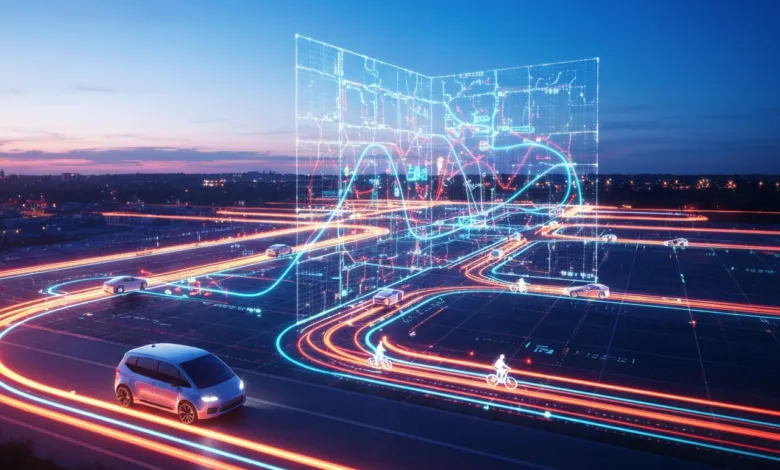
The core innovation lies in a specialized neural network model designed to interpret the scattering and reflection patterns of communication signals. As vehicles exchange data, their radios constantly receive signals that have interacted with objects in the environment. The model is trained to decode these interactions, effectively turning communication hardware into a powerful distributed sensing array. This method facilitates a cooperative perception model where multiple vehicles contribute data, creating a more comprehensive and accurate collective environmental map than any single vehicle could achieve alone.
Key to the system’s performance is its ability to handle highly dynamic scenes. Urban traffic environments feature rapidly moving vehicles, pedestrians, and cyclists. The deep learning algorithm is specifically optimized to track these moving objects and update the reconstructed map in near real-time, providing a continuously refreshed spatial context. This dynamic understanding is paramount for predicting trajectories and preventing collisions.
The implications for autonomous vehicle safety and efficiency are significant. By generating a detailed and shared representation of the road, this technology can reduce latency in decision-making processes. It provides a redundant layer of perception that complements traditional sensors, enhancing reliability in adverse weather conditions where cameras or LiDAR may be impaired. Furthermore, the efficient use of existing communication infrastructure for dual purposes paves the way for more scalable and cost-effective solutions.
This research marks a substantial step toward truly integrated vehicular systems. The fusion of sensing and communication into a single, intelligent process addresses fundamental challenges in machine perception for mobility. As these deep learning models continue to evolve, they will be instrumental in realizing the full potential of connected and autonomous vehicles, making transportation networks smarter and safer for everyone.
(Source: Ieee.org)