Study: AI Citations Favor Listicles and Product Pages

▼ Summary
– Listicles, articles, and product pages together account for 52% of all citations in major AI search tools.
– The format an AI cites is most strongly predicted by the user’s query intent, not the industry or the specific AI model.
– For informational queries, articles are the dominant format, while listicles lead for commercial-intent queries.
– Third-party, editorial listicles are cited far more often than brand-promotional ones, suggesting a preference for neutral comparisons.
– While all models favor listicles, Perplexity uniquely cites a significant portion (17%) of its sources from discussion forums like Reddit.
Recent research reveals a clear preference in how AI search tools cite online sources. A study analyzing over 75,000 AI-generated answers and one million citations from major platforms shows that a narrow range of content formats receives the majority of mentions. Specifically, listicles, standard articles, and product pages collectively account for more than half of all citations, shaping the information landscape presented to users.
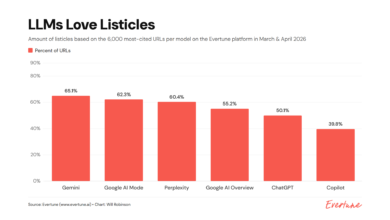
The data shows listicles as the most cited format at 21.9%, followed by articles at 16.7% and product pages at 13.7%. Together, these three structures represent 52% of all AI citations. The type of user query, or search intent, proves to be the strongest predictor of which content gets referenced, a pattern consistent across different industries and AI models.
For informational queries where users seek knowledge, articles are the dominant choice, cited 2.7 times more often than other formats. In contrast, commercial intent queries, where users are comparing or considering a purchase, are led by listicles, which capture 40% of citations, nearly double any other content type. Transactional and navigational queries naturally favor product and category pages, which together account for roughly 40% of citations in those contexts.
This underscores a critical strategy for content creators: success depends on mapping content to user intent. Articles effectively educate, listicles facilitate comparison, and product pages drive conversion. Aligning format with the user’s underlying goal is more effective than simply producing more content and can significantly boost visibility in AI-generated answers.
Not all listicles are created equal, however. The research indicates AI models show a preference for editorial neutrality. In professional services, for example, third-party comparison lists accounted for 80.9% of citations, while self-promotional brand lists made up only 19.1%. This suggests LLMs favor objective, editorial content over overtly promotional material.
While all major AI models showed a strong affinity for listicles, their secondary preferences diverged. ChatGPT leaned heavily into articles and informational sources. Google’s AI Mode displayed the most balanced distribution of content types. Perplexity was distinctive, with a notable 17% of its citations drawn from discussion forums and community platforms like Reddit.
Industry-specific patterns also emerged. Sectors like SaaS and professional services cited listicles above the average rate. Health-related queries strongly favored authoritative articles. Ecommerce spread its citations more evenly across listicles, articles, and category pages, while home repair topics showed the most uniform distribution of all formats.
(Source: Search Engine Land)