25,000 URLs reveal AI search’s listicle obsession
▼ Summary
– LLMs heavily cite listicles, with 63% of nearly 400 million citations pointing to them, and half of the 25,000 most-cited URLs being listicles.
– Listicles are favored because they are tightly focused on a single topic and structured for easy parsing, often comparing products head-to-head.
– Corporate, earned media, and affiliate domains are top sources of listicles, with Forbes.com ranking among the top three sources on every model.
– Google’s Gemini-based models (Gemini, AI Mode, AI Overviews) show the highest overlap in cited URLs, while Copilot shares only 4-6% with any other model.
– Heavily cited pages typically range from 1,000-2,000 words, average 18 words per sentence, link frequently, and use structured headings, though Copilot favors brevity and Gemini favors more verbose content.
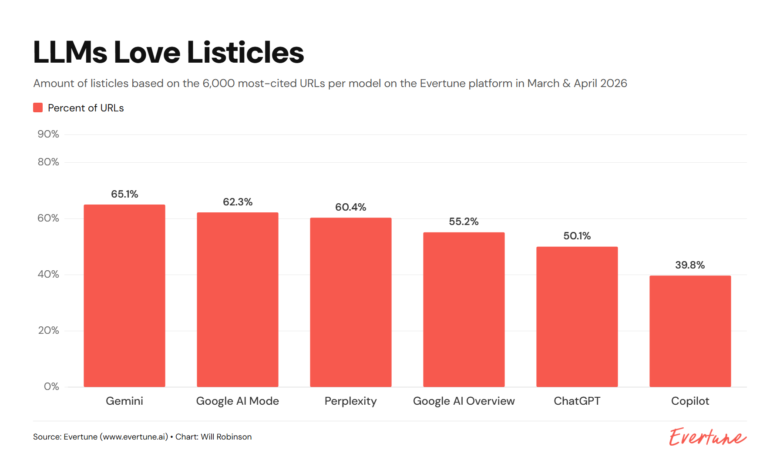
From March through April, Evertune Research analyzed the 6,000 most-cited URLs across six major AI models,ChatGPT, Copilot, Gemini, Google AI Mode, Google AI Overview, and Perplexity,and the findings reveal a clear pattern: listicles dominate AI search citations. Among the roughly 25,000 unique URLs reviewed, half were listicles, and across nearly 400 million total citations, 63% pointed to this format.
Large language models (LLMs) excel at synthesizing vast information into personalized responses, relying on both training data and internet searches. The fastest way to influence what an AI says about your brand is to shape the content it retrieves. At Evertune Research, we track hundreds of brands across 250 categories using our AI marketing platform, giving us unique visibility into which content models cite most when users ask for recommendations.
Listicles are uniquely suited to LLM consumption. They focus tightly on a single topic,like “best laptops for gamers”,making them highly relevant to user prompts. Their structured format is easy for models to parse and reproduce. For brand-related queries, listicles do much of the comparison work, evaluating products head-to-head on features, price, and materials. ChatGPT now prominently features this format in its shopping widget.
Across models, listicles accounted for 40% to 65% of the most-cited URLs, with Copilot at the low end and Gemini at the high end. The vast majority were ranked lists, such as “Top 5 CRM Tools,” making up 71% to 86% of listicles depending on the model. Unranked lists, like “7 Ways to Save on Groceries,” were a distant second. Institutional rankings, such as U. S. News & World Report’s Best Colleges, accounted for just 1.4% to 4.7%.
Corporate, earned media, and affiliate domains were the top sources of these listicles. For example, Forbes.com,an earned media domain with affiliate segments like Forbes Advisor and Forbes Vetted,ranked among the top three sources on every model.
However, a word of caution before building a GEO strategy around listicles. Google has signaled its intent to crack down on promotional listicles. Additionally, ranking your own brand No. 1 alongside competitors could violate Federal Trade Commission rules against misrepresenting independent reviews.
We also examined URL overlap across models. Among the six models, the three Gemini-powered ones,Gemini, AI Mode, and AI Overviews,showed the highest overlap. More than half of Google AI Mode’s most-cited URLs also appeared in AI Overviews. Perplexity shared more than 20% of its URLs with both, while ChatGPT shared more than 15%. Copilot, by contrast, shared just 4% to 6% with any other model, highlighting its unique citation preferences.
The URLs that models cite most deviate for reasons including training data, crawl permissions, and traditional SEO. Pages that rank well in human search results also tend to perform well in bot-driven searches, especially for Gemini-based models.
In terms of page structure, heavily cited URLs typically ranged from 1,000 to 2,000 words, averaged 18 words per sentence, linked frequently, and used structured headings (H2s and H3s) throughout. Copilot favored more concise content, citing pages with an average of 964 words and 24 paragraphs. Gemini skewed more verbose, citing pages with 1,977 words and 53 paragraphs.
While there is no cookie-cutter formula for AI visibility, our analysis of more than 25,000 URLs suggests clear GEO takeaways. All LLMs cite large volumes of highly structured, hyper-specific content,which listicles exemplify. Avoid spammy, self-promotional listicles that Google penalizes, but otherwise aim to create and appear in relevant lists. Traditional SEO supports GEO, especially for Gemini-based models. Pay attention to the page structures most cited by your target model: Copilot favors brevity, while Gemini responds better to expansive content. In general, keep pages under 2,000 words, use frequent links, apply strong structure, and include images and lists when relevant.
(Source: Search Engine Land)