DJI Neo 2 Drone: Obstacle Avoidance & Gesture Controls
▼ Summary
– The DJI Neo 2 is an upgraded selfie drone with new features like gesture controls and obstacle avoidance using LIDAR and infrared sensors.
– It is slightly larger and heavier than the original Neo but includes a larger battery for up to 19 minutes of flight time and improved wind stability.
– The drone can follow at speeds up to 27mph, avoid obstacles in forward and sideways flight, and capture 4K video at 60fps with a dual-axis gimbal.
– It is exclusively launched in China starting at around $211, with bundle options including extra batteries, a multi-charger, and accessories.
– The Neo 2 offers enhanced autonomous filming capabilities and is positioned as a compelling, cheaper alternative to competitors like HoverAir’s X1.
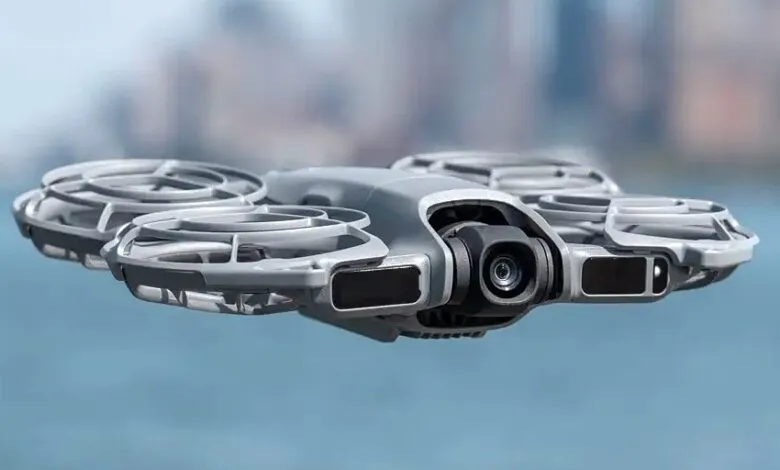
The DJI Neo 2 drone introduces significant upgrades over its predecessor, making it a more capable and user-friendly option for capturing autonomous aerial footage. Building on the original model released last year, this new version incorporates advanced obstacle avoidance technology and intuitive gesture controls, addressing key limitations of the earlier design. While the drone is slightly larger and heavier at 151 grams, the added weight supports a more robust feature set and a larger battery for extended operation.
A major improvement is the inclusion of an obstacle avoidance system that utilizes forward-facing LIDAR and downward-looking infrared sensors. This allows the Neo 2 to detect and navigate around obstacles while following the user in forward and sideways flight modes. Although the integrated propeller guards remain for added protection, the new sensing capabilities mean pilots can fly with greater confidence in varied environments. While not as sophisticated as the systems on DJI’s professional drones, this represents a substantial leap for a compact model.
Performance enhancements are also notable. The maximum following speed has been boosted to 12 meters per second, or nearly 27 miles per hour, a significant increase over the original Neo. Additionally, the drone demonstrates improved stability in windy conditions, with the ability to maintain a steady hover in winds approaching 24 miles per hour, addressing previous issues with drift and control in breezy weather.
Gesture control is a standout new feature, enabling users to adjust the drone’s position and distance through hand movements while it hovers nearby. A small onboard screen now clearly indicates the active mode, replacing the less intuitive LED light patterns and illustrations used on the first-generation Neo. The drone retains its ability to take off and land from the palm of your hand, but these new gestures provide a more interactive and precise way to frame shots without a remote.
Battery life sees a welcome upgrade with a 1,606mAh rechargeable battery providing up to 19 minutes of flight time. Internal storage has more than doubled to 49GB, offering ample space for high-resolution video. The camera system, while retaining the same half-inch sensor, now benefits from a dual-axis gimbal for smoother footage, a wider field of view, and the ability to record in 4K at 60 frames per second, or up to 100fps during manual piloting.
Positioned as a compelling and more affordable alternative to competitors like the HoverAir X1, the DJI Neo 2 is initially launching exclusively in the Chinese market. The starting price is 1,499 Chinese Yuan (approximately $211). DJI is also offering several bundles, including a package with extra batteries and a multi-charger for 1,899 Yuan ($282), and a premium bundle featuring the motion control joystick and Goggles N3 for 3,699 Yuan ($521).
(Source: The Verge)