Samsung’s Tri-Fold Phone Makes Surprise Debut at APEC Summit
▼ Summary
– Samsung unveiled its first consumer triple-display foldable phone prototype at the APEC CEO Summit in South Korea, with a planned launch in November or December.
– The tri-fold phone folds in two places to be compact like a smartphone with a 6.5-inch screen and unfolds to a 10-inch tablet-sized screen, differing from dual-screen foldables.
– Samsung aims to advance innovative technologies and deliver meaningful user experiences, planning to release this next-generation device within the year.
– The device features a unique “G-shaped” inward folding design, contrasting with Huawei’s Z-shaped Mate XT, and is expected to be pricier than the $2,000 Galaxy Z Fold 7.
– Samsung’s entry into the tri-fold market responds to competition from Huawei and maintains its position in foldable phone innovation ahead of Apple’s potential entry.
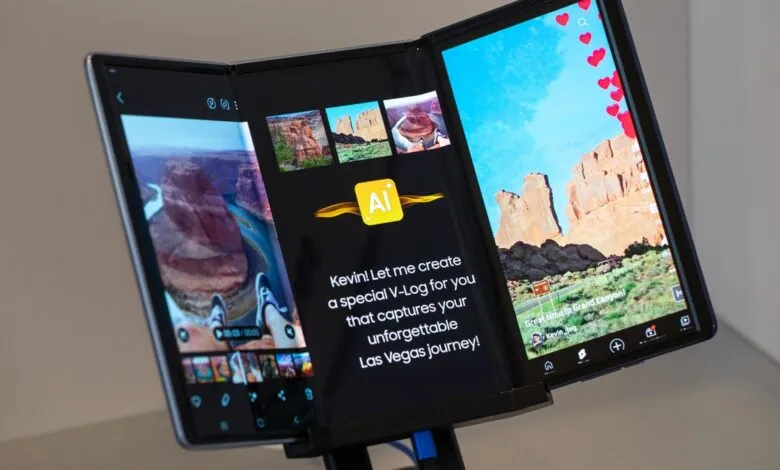
Samsung has unexpectedly revealed its first consumer-ready triple-display foldable phone during a technology exhibition at the APEC CEO Summit in South Korea. According to reports from Korean media, this innovative device is scheduled to launch in either November or December, marking a significant evolution in foldable smartphone design. The tri-fold phone represents a major step beyond current dual-screen models, folding at two separate points to transform from a standard 6.5-inch smartphone into a spacious 10-inch tablet when fully opened.
While the device currently exists as an unnamed prototype, its design philosophy differs substantially from existing Galaxy Z Fold and Z Flip models. Where those devices feature a single folding hinge, this new creation incorporates two hinges, enabling it to achieve a remarkably compact form factor when closed. The expanded screen size notably surpasses the approximately 8-inch displays found on conventional dual-screen foldables, potentially offering users a more substantial tablet-like experience.
In an official statement, Samsung emphasized its commitment to pioneering new form factors within the mobile AI era, stating these developments aim to deliver meaningful user experiences. The company confirmed this showcase reflects ongoing research and development efforts, with plans to bring this next-generation device to consumers before the year concludes.
Samsung’s foldable journey began in 2019 with the original Galaxy Fold, followed by the Galaxy Z Flip in 2020, establishing the company as an early leader in this emerging category. The competitive landscape has intensified recently, particularly with Huawei gaining significant momentum through its own tri-fold Huawei Mate XT and its subsequent iteration. Samsung’s entry into the tri-fold market represents a strategic move to maintain its competitive position against these advancing rivals.
Notably, the mechanical implementation differs between these competing tri-fold designs. Huawei’s approach features hinges that fold in opposite directions, creating a distinctive Z-shaped profile when partially folded. In contrast, Samsung’s prototype reportedly folds inward in what has been described as a “G-shaped” configuration. This design choice presents an interesting contrast to Samsung’s established Z-series branding for its foldable lineup.
Although specific technical details remain undisclosed, industry observers anticipate the tri-fold device will command a premium price, potentially exceeding the Galaxy Z Fold 7’s $2,000 starting point. Photographs of the prototype unit displayed behind protective glass reveal both inner and outer front-facing cameras, though the absence of a live folding demonstration leaves questions regarding durability and practical functionality unanswered ahead of its anticipated launch.
This revelation doesn’t arrive completely unexpectedly, as Samsung has consistently showcased various flexible display concepts, including triple-screen configurations, at previous CES events. Recent months have seen increasing rumors and executive acknowledgments hinting at an imminent tri-fold announcement. The technology community now watches closely to see whether Samsung can successfully introduce another dominant form factor in the foldable segment, particularly as anticipation builds around potential future foldable devices from competitors like Apple.
The company has not provided additional commentary beyond its initial statement regarding the prototype demonstration.
(Source: CNET)