Inside Nintendo’s Design Secrets: The Metroid Prime Art Book
▼ Summary
– The 210-page hardcover book “Metroid Prime 1–3: A Visual Retrospective” launches on October 28th, offering a behind-the-scenes look at the series before Metroid Prime 4: Beyond’s release.
– It features detailed concept art of environments, enemies, bosses, and Samus Aran, including unused assets, and covers each game from the GameCube to the Wii and the Switch remaster.
– The book includes margin notes from producer Kensuke Tanabe, revealing design insights, such as Nintendo’s influence on game qualities and Retro Studios’ creative contributions like the morph ball half-pipes.
– Tanabe discusses Retro’s burnout after Metroid Prime 2, leading to their work on Donkey Kong Country Returns, and the sequel’s sales issues that influenced development decisions for Metroid Prime 3.
– This retrospective provides rare official commentary on Nintendo’s secretive development process, making it a valuable resource for fans interested in the art and history of the Metroid Prime series.
For any fan of the Metroid Prime trilogy, the newly announced art book offers an unprecedented glimpse into the creative process behind these landmark games. Metroid Prime 1–3: A Visual Retrospective is a 210-page hardcover volume set for release on October 28th, arriving just weeks before the long-anticipated launch of Metroid Prime 4: Beyond. Priced at fifty dollars, this collection is an ideal present for dedicated followers of the series who have spent years analyzing video essays and craving a deeper understanding of its development. Nintendo has made a generous 35-page sample available for free, providing a high-resolution preview of the content.
The book’s pages are filled with extensive concept art showcasing environments, common adversaries, major bosses, and the iconic heroine Samus Aran. It is remarkable to view this collection, which includes numerous assets that were ultimately cut from the final games. The visual journey progresses chronologically from the original GameCube title through the Wii entries, concluding with a short exploration of the Metroid Prime Remastered edition for Nintendo Switch, a project that reportedly required approximately four years to complete. Notably, the upcoming Metroid Prime 4: Beyond receives no coverage here, suggesting its own complex development history could easily fill a separate volume.
Scattered throughout the book are numerous animation studies and perspective mock-ups that illustrate early visual ideas.
One of the most compelling features is the marginal commentary provided by series producer Kensuke Tanabe, a seasoned Nintendo designer whose career includes foundational titles like Super Mario Bros. 2 and The Legend of Zelda: A Link to the Past. These producer insights are possible due to Nintendo’s and Retro Studios’ meticulous record-keeping, allowing candid design disputes and challenges from over two decades ago to be recalled with striking clarity. It is particularly engaging when Tanabe recalls instances where he and Nintendo exercised their authority to guarantee Metroid Prime embodied specific qualities. He writes, “…the game we’re making now is a Nintendo game, and this is Retro’s first time working on one. I’ve been working on Nintendo games my entire career, so I believe I have the most experience in making Nintendo games. So please trust me first.”
Tanabe also frequently praises the ingenuity of the Retro team. He highlights one instance where developers successfully persuaded a skeptical Nintendo that morph ball half-pipes were a fantastic addition. “Initially, Nintendo was skeptical,” Tanabe notes. “However, Retro responded ‘Please try it out first before deciding,’ and submitted a prototype. I vividly remember that when we finally tested it, it turned out to be incredibly satisfying and engaging.” By the final pages, it becomes evident that Retro Studios imprinted its unique creative vision profoundly on each installment.
The producer notes, appearing every five to ten pages, significantly enhance the book’s value and justify its price.
These annotations also shed light on rarely discussed elements of the series and Nintendo’s overall development philosophy. Tanabe openly discusses the team’s exhaustion after shipping Metroid Prime 2: Echoes, noting that the staff expressed a desire to work on a Donkey Kong project to lift spirits “after having to work on two consecutive games within the same IP under tight schedules and without much of a break.” This aspiration was later realized with 2010’s Donkey Kong Country Returns, following the completion of Metroid Prime 3: Corruption.
The producer also addresses the disappointing sales performance of Metroid Prime 2, which motivated Retro to pitch a sequel designed for broader appeal. Nintendo, however, rejected these proposals because they relied too heavily on established mechanics, an ex-employee’s interview mentions an open-world concept, and instead chose to leverage the Wii’s motion controls while deepening the narrative around the menace of Dark Samus.
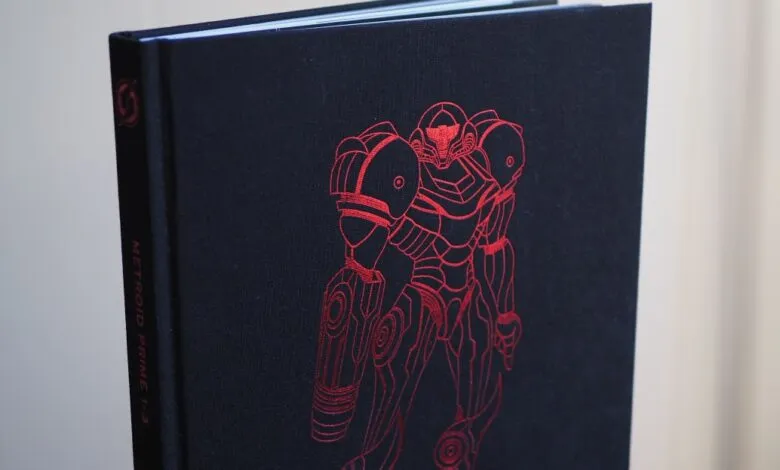
This retrospective makes for a visually stunning addition to any bookshelf, distinguished by a red embossed silhouette of Samus Aran on the cover. Yet the genuine riches are found within its stitched binding, where breathtaking artwork is paired with official commentary that demystifies Nintendo’s famously secretive development practices. The format pioneered by publisher Piggyback could easily be adapted for other Nintendo franchises, especially given the company’s history of retaining key creative talent for decades. For the moment, however, enthusiasts can simply appreciate that this particular volume exists, offering a treasured archive of one of gaming’s most beloved series.
(Source: The Verge)