The Future of EVs: Are Solid-State Batteries Here?
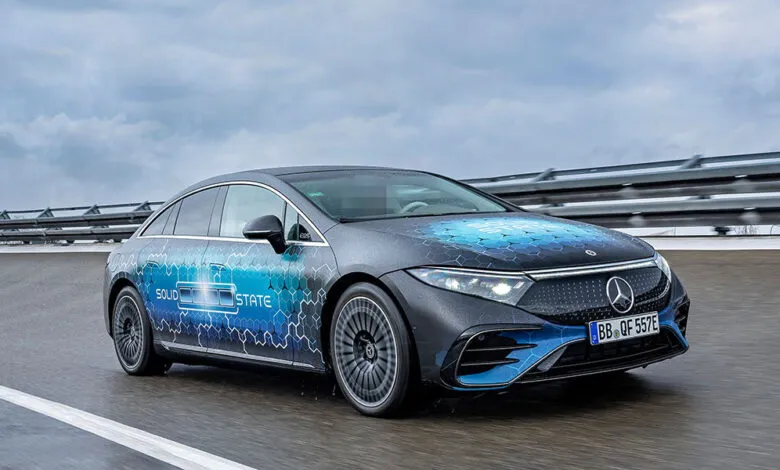
▼ Summary
– Solid-state batteries are being developed to create lighter, safer electric vehicles with higher energy capacity than current lithium-ion batteries.
– These batteries promise significantly faster charging times, comparable to refueling a gasoline car, and could eliminate range anxiety with extended driving ranges.
– Commercial availability of solid-state EVs is not expected until around 2027-2030, with large-scale commercialization projected by 2030 according to industry roadmaps.
– The main challenge has shifted from proving feasibility to solving large-scale manufacturing and cost reduction for solid-state batteries.
– Recent rapid advancements in battery technology were previously considered nearly unimaginable, according to battery researchers.
The future of electric vehicles appears increasingly tied to the development of solid-state batteries, a technology that could redefine performance and safety standards across the automotive industry. Laboratory announcements about breakthroughs in this field arrive with growing frequency, each promising a new generation of power sources capable of making electric cars so advanced that traditional gasoline vehicles may become obsolete.
These innovative solid-state cells are engineered to be both lighter and more space-efficient than the lithium-ion batteries currently powering most EVs. A key advantage lies in their enhanced safety profile, as they eliminate the flammable components responsible for the rare but dangerous fires associated with lithium-ion units. Furthermore, they are projected to store significantly more energy, potentially extending driving ranges to 400, 500, or even 600 miles on a single charge and making range anxiety a concern of the past.
Charging times could see a dramatic reduction as well. Instead of waiting half an hour or more for a “fast” charge, solid-state technology might enable EV refueling in just minutes, a speed comparable to filling a conventional car with gasoline.
While these benefits sound almost too good to be true, consumers should not expect to purchase a solid-state-powered electric vehicle in the immediate future. Looking further ahead, however, the prospects become much more realistic. According to University of Washington materials scientist Jun Liu, who leads the Innovation Center for Battery500 Consortium, industry roadmaps indicate that automakers aim to demonstrate prototype solid-state batteries in vehicles around 2027, with large-scale commercialization targeted for 2030.
The primary hurdle is no longer proving that solid-state batteries are technically feasible, this has already been accomplished in numerous laboratories worldwide. The real challenge now involves scaling up manufacturing processes while keeping costs at a commercially viable level.
Progress in this area has accelerated remarkably, thanks in part to advances in superionic materials. Eric McCalla, a battery materials researcher at McGill University and coauthor of a paper in the 2025 Annual Review of Materials Research, notes that the rapid pace of development toward viable EV power sources was nearly unimaginable not long ago.
(Source: Ars Technica)