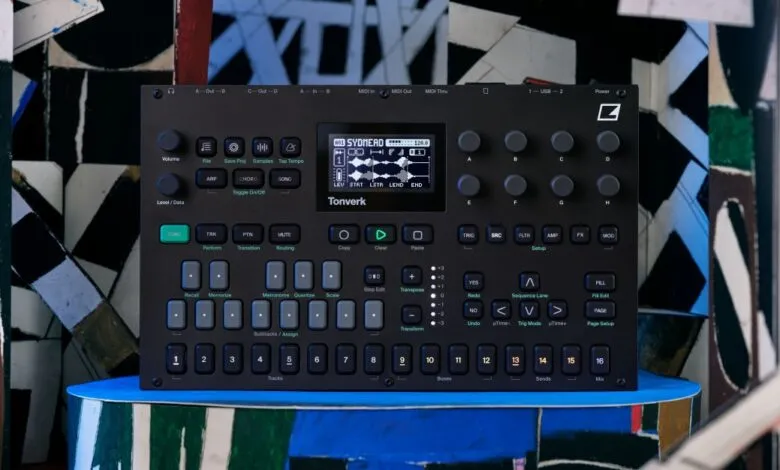
Elektron Tonverk: Polyphonic Sample Mangler & Groovebox
▼ Summary
– Elektron’s Tonverk is a powerful and unique sampler that appeals to experimental musicians, featuring advanced multisampling and extensive audio processing capabilities.
– It includes three sampling machines: Single Player for basic chromatic playback, Multi Player for realistic instrument recreation, and Subtracks for grouping eight samples per track with shared effects.
– The device can automatically create multisampled instruments by recording external gear via MIDI, but lacks sample editing features in the current firmware.
– Tonverk has notable omissions like a sample chopping mode and some workflow limitations, but offers 17 built-in effects, extensive routing, modulation options, and Elektron’s advanced sequencer.
– Priced at $1,599, Tonverk is the first device in a new upmarket hardware platform from Elektron and is currently sold out directly but available for pre-order from retailers.
Elektron’s Tonverk stands as a powerful polyphonic sampler and groovebox, designed for musicians who crave deep sound design and experimental workflows. This instrument builds on Elektron’s reputation for creating distinctive and sometimes unconventional hardware, offering a feature set that goes far beyond typical sampling capabilities. While it excels at crafting rich, textured electronic music, its design clearly appeals to those with an adventurous approach to production.
Central to the Tonverk is an eight-track polyphonic sampler featuring three distinct “machines”: Single Player, Multi Player, and Subtracks. The Single Player operates as a straightforward one-shot machine, playing a single sample chromatically across the keyboard. Multi Player takes things further by blending multiple samples of the same instrument to produce more realistic and dynamic sounds. A standout feature is the unit’s ability to automatically generate multisampled instruments by sending MIDI notes to external gear and recording the results. However, the current firmware does not allow sample editing, which could be frustrating if recordings suffer from latency or premature cutoffs.
Subtracks introduce another layer of complexity, elevating Elektron’s characteristically intricate workflow. This mode lets users load kits of eight samples into a single track, making it possible to group all drum sounds together without needing separate tracks. The trade-off is that effects are applied globally to the entire Subtrack, adding reverb to one sample means every sample in that group receives the same treatment.
Some notable omissions may give certain users pause. There is no sample chopping mode, a feature available on other Elektron devices like the Digitakt, which might disappoint hip-hop producers who enjoy slicing and rearranging samples. That said, the company’s promotional material hints that more machines may be added in future updates.
The Tonverk is packed with an impressive array of sound-shaping tools, including 17 built-in effects, three effects sends, and support for external effects routing. Modulation options are plentiful, with numerous LFOs and envelopes available for detailed sound design. It also includes Elektron’s renowned sequencer, offering 256 steps, per-track pattern lengths, parameter locks, and Trig conditions for introducing variation and randomness into patterns.
Beyond its extensive features, the Tonverk represents the beginning of a new hardware platform for Elektron. The company has indicated that this is only the first device in what will become a broader ecosystem, though no specific details about future products have been revealed. With a price tag of $1,599, the Tonverk is positioned as a premium instrument, and it appears to be sold out directly from Elektron, though pre-orders remain available through retailers like Perfect Circuit and B&H.
(Source: The Verge)