Orchid: A Retro, Approachable Synth for Hipsters
▼ Summary
– The Telepathic Instruments Orchid is a modern digital chord organ inspired by vintage models like the Magnus, allowing users to play full chords with one button for easy songwriting.
– Designed with Kevin Parker of Tame Impala, the Orchid costs $649 and features a digital engine that can theoretically play any chord, unlike limited physical-reed vintage organs.
– The Orchid offers performance modes like strum, harp, arpeggiator, and “slop” for human-like timing imperfections, plus 70 presets and a separate bass section with 12 sounds.
– A built-in drum machine plays preprogrammed beats inspired by 1970s rhythm machines, and an audio looper allows recording chords, basslines, and melodies separately for flexibility.
– The Orchid is limited by a small one-note keyboard that cannot play custom chords, no direct sound design without the $99 Pistil software, and a $649 price that competes with more capable synths.
In 2017, I snagged a vintage Magnus chord organ from a Craigslist ad for just $10. It remains one of the most rewarding music purchases I’ve ever made. Those old electric chord organs let you press a single button to play a full chord, making them ideal for budding singer-songwriters or casual home jam sessions. By the 1980s, however, they largely vanished as digital keyboards from brands like Casio took over.
Now, the Telepathic Instruments Orchid aims to revive that charming, parlor-instrument magic. Like its vintage predecessors, the Orchid lets you play lush chord progressions without needing deep music theory knowledge or complex fingerwork. This isn’t an instrument built for virtuosity. Instead, it’s a tool for songwriters to quickly sketch out ideas, and it modernizes the chord organ concept with clever contemporary features.
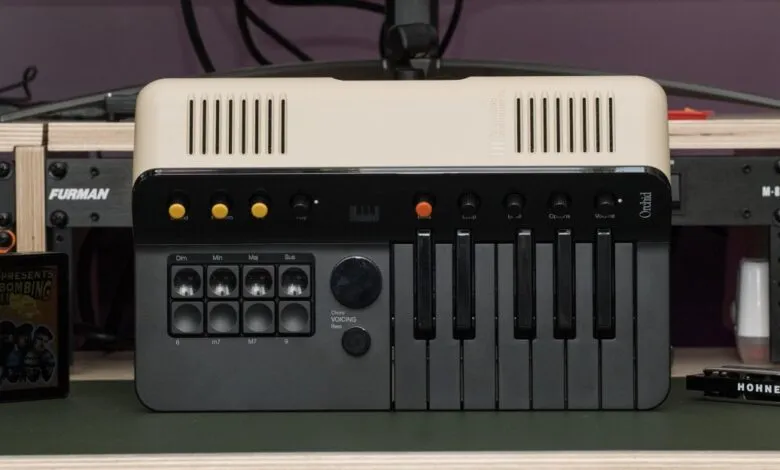
Developed in collaboration with Tame Impala’s Kevin Parker, the Orchid’s design nods to the brown-and-tan organs of the 1960s from makers like Magnus and Bontempi. Its speaker grill even echoes the fan vents on those classic instruments. It’s a clear spiritual successor , just significantly pricier at $649.
While a Magnus organ is limited by the physical reeds it can house, the Orchid is fully digital, capable of playing any chord, in any voicing, from any scale. This also means it can produce sounds far beyond the droney, accordion-like tones of its ancestors.
For songwriters, this freedom lets you concentrate on lyrics and vocal melodies. If, like me, you find it tough to sing and play simultaneously, the Orchid lifts a huge mental burden. The variety of sounds also ensures you’re not stuck with funeral dirges or sea shanties, which is often the case with old-school chord organs.
Even with a basic grasp of music theory , and mine is generously described as passing , you’ll find the Orchid user-friendly. It features a one-octave keyboard and chord-type buttons to the left: major, minor, diminished, major 7th, and more. Press C and major, and you get a C major chord. Press F# and 9, and you hear an F#9. Simple.
The Orchid can also hold your hand as much as you want. You can lock it to a specific key, like E minor or Bb major, so almost everything you play sounds decent and in tune. If your chord theory knowledge is limited, this feature expands your sonic possibilities with minimal frustration. I often used the chord engine to find a progression I liked, then built a track around it during studio jams.
Beyond blasting out block chords, the Orchid offers strum, harp, and arpeggiator modes, plus 13 preprogrammed patterns. My favorite is “slop,” which introduces tiny random timing imperfections to mimic a human playing. The more you crank it up, the more unevenly the notes strike.
While vintage chord organs have a uniquely droney, buzzy accordion sound that still inspired artists like El-P decades later, the Orchid delivers a much wider sonic range. It houses three synth engines: a virtual analog (VA) synth, an FM synth for 80s-style e-pianos and bells, and a reed piano that nails Wurlitzer tones and softer Rhodes electric piano sounds. I often fired up distorted, heavily reverbed pads on the VA engine and used the Orchid as a fidget toy, noodling on simple chord progressions while focusing. You can also connect it to a computer or another synth via MIDI for broader sound options.
The Orchid comes with 70 presets (excluding bass patches), covering most needs. That’s good, because there are few ways to tweak sounds directly on the device. You can adjust the filter cutoff or effect intensity like reverb and phaser, but that’s it. For custom patch design, you’ll need the $99 Pistil virtual synth ($50 bundled with the Orchid), which sends sounds to the device. I found Pistil a bit buggy, with the UI often freezing after patch transfers.
A dedicated bass section, separate from the main synth, can be toggled on or off. With only 12 sounds, it covers essentials: low electric piano octaves, Moog-style synth bass, tuned 808s, and aggressive EDM drones. You can layer these with the main keys for subtle depth or play them solo.
The accompaniment options can complicate things. If you don’t lock to a key and set the bass to follow chords, the low-end thump stays locked to your progression while you add melodic flourishes on top. However, the Orchid’s polyphony handling , you can’t play multiple keys at once , can be frustrating. Patches with long decay times cut off abruptly if you try a solo note. You’re better off using the built-in audio looper to record chord progressions, basslines, and melodies separately for more flexibility.
I love the built-in drum machine. It’s extremely limited , no custom beats or sound tweaks , yet I find it basically perfect, though user-uploaded beats via Pistil would be nice. It’s inspired by 1970s rhythm machines like the Korg Mini Pops, which played preprogrammed beats for home organs. The lo-fi, almost twee sound is among my favorites in drum machines.
The Orchid is fun, sounds good, and is simple to use. But it’s also quite limited. You can’t design sounds without paying extra for Pistil. The keyboard is small, and you can only play one key at a time; all chord voicings come from the chord buttons. If you know how to play a Dm13 on piano, you can’t do it here. This is a key difference from vintage chord organs, which often had full keyboards. My Magnus organ, for example, only has dedicated buttons for Bb, F, C, A, D, and G major chords, but I can play any chord on its two-octave keyboard.
There are far more capable synths in the $649 price range. But the Orchid isn’t competing with the Korg Minilogue or Arturia MiniFreak. If you want to tinker and design patches from scratch, look elsewhere. The Orchid is more a songwriting tool than a synth. For singer-songwriters seeking an escape from acoustic guitars or upright pianos, it offers an approachable, if pricey, electronic alternative.
(Source: The Verge)